

Blue Velvet shrimps are an excellent addition to any hobbyist’s tank. They have gained popularity due to their mesmerizing color and the ease of their care and maintenance. They also have the added bonus of ridding your tank of undesired algae.
Yet, there are a few things you still need to know about them and their needs so that you can enjoy their company for the longest time possible.
In this guide, I’ll walk you through how to care for blue velvet shrimp and provide proper tank conditions.
Blue Velvet Shrimp Key Care Stats
- Tank size: 5–10 gallons ( about 40 liters)
- Temperature: 72° to 82° F (22 – 28°C)
- pH: 6.4 to 8.0 (ideally from 6.8 to 7.5)
- KH: 0-8 (ideally from 2 to 4)
- GH: 4-14 (ideally from 6 to 8)
- TDS: 100-400 (ideally from 150 to 200)
- Nitrate: less than 20 ppm
- Living zone: Bottom-dwellers
- Temperament: Peaceful
- Diet: Algae eater/omnivore
Species Overview, Appearance, & Origin
Blue Velvet shrimps are truly marvelous creatures to behold. They’re a type of freshwater dwarf shrimps, meaning they can only grow to about 1.5-2 inches in the utmost best of circumstances and surroundings.
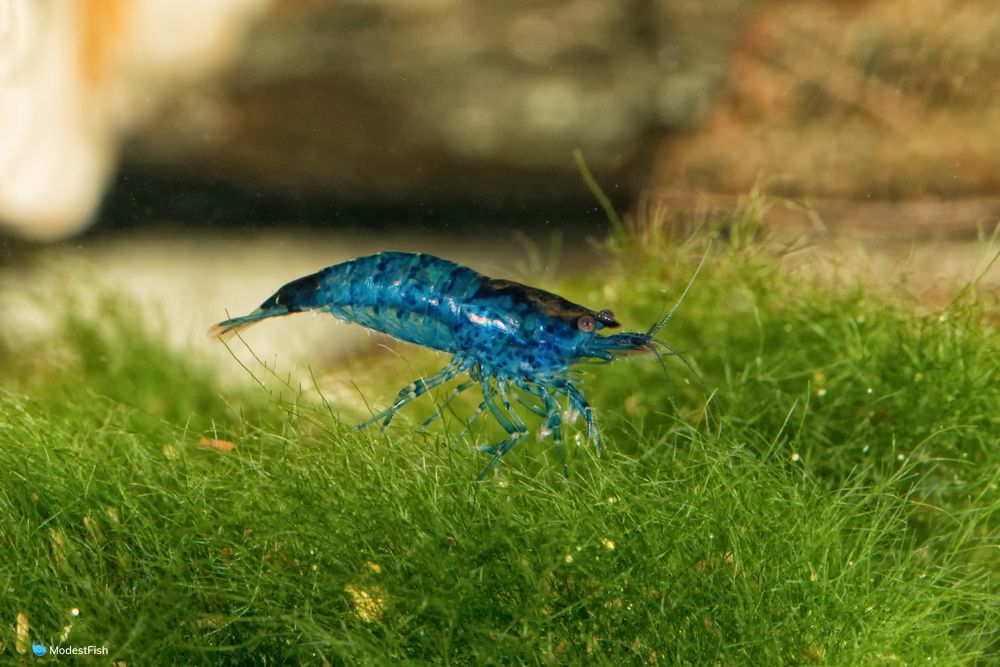
They have a lovely bright cerulean-colored body that can vary in intensity from light to deep hues. The difference in color intensities is mostly dependent on genetics, diet, as well as the light and substrate the shrimps are exposed to.
Their true origin is still debated to this day, with no clear answer in sight. Some claim that they were the result of crossbreeding between the Blue Carbon Rili and Blue Dream shrimps that originated from the Wild Schoko species.
Others claim that it’s an impure type of Blue Dream shrimp originating from the Carbon Rili species, thus having red striations mixed with the blue in a few of them.
A whole other group claims Blue Velvet shrimps come from the Red Rili variety, leading to red lines in some of the offspring.
Even though how they came about has yet to be determined, it’s been clearly expressed that any breeding between the Blue Velvet shrimp and the Dream Blue shrimp is ill-advised as it will lead to offspring that have unpredictable and washed out colors.
Most varieties sold to hobbyists and tank owners nowadays are farmed and tank-bred, but some are wild and originate in areas of south-east Asia such as Taiwan.
In their natural habitat, they live in freshwater environments like streams and ponds with rocky floors amidst numerous plants and wood for their hiding and feeding requirements.
Scientific Classification
- Scientific Name: Neocaridina davidi (formerly Neocaridina heteropoda)
- Common Names: Blue Velvet shrimp, Blue Jelly shrimp, Blue shrimp
- Genus: Neocaridina
- Family: Atyidae
Life Span
Blue Velvet shrimps can live for about 1-2 years. The time variation is dependent on their genetics and quality of life. This, in turn, is determined by the quality of breeding and the care provided during their life in the tank.
Size
In general, female blue shrimps are larger and more vibrant than their male counterparts. A female is commonly about 1-1.5 inches (2.5 – 3 cm) lengthwise and can reach a maximum size of 2 inches.
Males tend to be smaller and less colorful, where they grow up to approximately 0.75-1.25 inches.
The shrimp’s minuscule size necessitates the use of sponge filters to prevent the shrimp, especially the babies, from being drawn into the filtration system. Hang-on-back or canister filters must be fitted with sponge pre-filters to defend against the same danger.
Blue Velvet Shrimp Care & Tank Set-Up
Tank Size
Blue Velvet shrimps don’t require a large aquarium to live well. That’s because they hardly take any space and can acclimate to any habitat within reason.
They can flourish in any tank size, usually starting from 5 gallons. They can even survive in nano or pico-sized tanks (as small as 3.3 gallons), with meticulous tank maintenance, efficient filtration, and suitable decorations.
A 10-gallon aquarium is a better option as the water parameters will be more stable and easier to regulate with no abrupt changes that can be detrimental to your shrimp’s health and longevity.
As we always say, stable water parameters hold the key for the survival of any aquatic creature, and the smaller the tank, the harder they are to keep steady. So if you have the means, go bigger for the sake of your shrimp.
You can place about six or more shrimps together at a time, and they will socialize and breed together in a matter of weeks. A lesser number can cause the shrimps to become shy and fearful of interaction with their peers.
The Nitrogen Cycle
Here’s a quick rundown if you’re unfamiliar with the concept of the nitrogen cycle. It’s basically the process of how beneficial bacteria continuously degrade the ammonia produced by fish and other aquatic organisms into the less toxic nitrite, which is in turn transformed to nitrate. Nitrate is then taken up by plants or eliminated from the water in other ways.
Ammonia, nitrites, and even nitrates are the only weak points of the very hardy Blue Velvet shrimp. They simply can’t tolerate them and will suffer greatly and even perish if exposed to a nitrate concentration higher than 20 ppm.
Therefore, before adding the shrimp to your tank, make sure proper bacterial colonies have been established in your filters and that the water has already been cycled.
If you wish to understand more about the nitrogen cycle and how to cycle your tank, click here.
Water Parameters
- Temperature: 72° to 82° F (22 – 28°C)
- pH: 6.4 to 8.0 (ideally from 6.8 to 7.5)
- KH: 0-8 (ideally from 2 to 4)
- GH: 4-14 (ideally from 6 to 8)
Luckily, Blue Velvet shrimp is very adaptable and can acclimate itself well to its surrounding environment.
Regarding water temperature, it can tolerate temperatures as low as 64°F and as high as 82°F. The higher the temperature, the faster their metabolic rates and the quicker they’ll grow and breed.
Nevertheless, there’s a catch. The higher metabolism will result in an overall shorter life span. Therefore, it’s best to keep it in the 72 to 76°F (22 – 24°C) temperature range, where the shrimp can breed adequately and also live longer.
When it comes to the pH, it generally prefers a neutral environment, ideally from 6.8 to 7.5. It’ll also survive in slightly more acidic (6.4) or more alkaline (8) waters.
As for the KH, GH, and TDS, they can exist in moderate to hard waters. It can hold out in fairly hard water with a KH, GH, and TDS of 8, 20, and 400, respectively. On the other hand, soft water lacks the calcium needed to develop its new skeletons when molting.
Consequently, it’s best to keep them in a KH of 2 to 4, a GH of 6 to 8, and a TDS of 150 to 200. Just make sure your water doesn’t contain too many copper minerals, as they’re lethal to Blue Velvet shrimp in large quantities.
Plants & Decor
Live plants and other decorations, such as rocks, caves, and bogwood, are a critical addition to your shrimp tank. That’s because they provide numerous functions that support the shrimps’ lives.
First and foremost, they increase the surface area on which algae and biofilm bacteria grow. These constitute the core diet and nutrition of shrimps.
They also provide nooks, crannies, and hiding places, making the shrimps feel safe and sheltered, even with no predators in the tank.
Live aquarium plants, in particular, play a vital role in the nitrogen cycle by taking up and eliminating nitrates, which are fatal to shrimps even in small amounts.
Diet & Feeding Blue Velvet Shrimp
As previously mentioned, Blue Velvet shrimps are scavengers/bottom feeders and can survive just fine on fish waste, decaying plants, algae, bacteria, and other aquatic microorganisms.
You can also feed them regular fish food as long as you pay attention to two things.
One, don’t use any food containing copper or copper sulfate as they’re toxic to shrimps. Two, don’t overfeed the shrimps as it’s a common cause of death. Shrimp should be typically fed 2-3 times a week when they’re the only tank inhabitants and only once a week if there are other fish in the tank. Don’t forget to remove the uneaten food particles after 2-3 hours.
Keep your eye on the algae to figure out whether your shrimps are over or underfed. Unchecked algae is a sign that you’re giving too much food, while disappearing algae means you should increase your feeding sessions.
Pro tip: Shrimps can eat blanched carrots, spinach, and zucchinis if you run out of fish food.
In-Tank Behavior & Temperament
Blue Velvet shrimps are overall very amicable and like to mind their own business.
They’re very sociable and interactive with other fellow shrimps, making their breeding easy and quick. They tend to shy away from their fish companions, but they don’t become aggressive or violent when coming in proximity.
They’re also very active and productive, where you’re most likely to find them all over the tank searching for food or trying to hide, which can be very funny as their blue color doesn’t really give them a chance and makes them stand out even more.
All in all, they’re pretty amusing to watch and very easy to raise and breed.
Tank Mates (And Who to Avoid)
To understand what makes a good vs. bad tank mate for shrimps, you need to put the following in mind. A good tank mate is a peaceful creature that doesn’t see shrimp or its babies as a food source. That usually entails small fish, almost all snails, and shrimps outside the Neocaridina species to preserve their blue color.
Unfortunately, it’s very rare for fish to leave them be. That’s because shrimps are at the bottom of the food chain, and the majority of fish species will eat them, especially if they’re aggressive and larger in size.
However, a few species are peaceful enough to coexist with shrimps during their life in the tank, and there are certain methods of making fish more compatible and companionable to shrimps.
Make sure you’ve provided your shrimps with plenty of hiding places from fish and that the tank is large enough to contain both of them without constant clashing.
Also, introduce young fish to the shrimps and try not to do it in reverse, as fish then instantly see the new addition as food.
That being said, here’s a list of some good and bad tank mates that can save you a lot of trouble when choosing a companion for your Blue Velvet shrimps.
Good Tank Mates
- Otocinclus
- Guppies
- Cory Catfish
- Small Tetras
- Ram Cichlids
- Hillstream Loaches
- Caridina cf. Babaulti shrimp
- Amano shrimp
- Bamboo shrimp
- Vampire shrimp
- Ghost shrimp
- Red Nose shrimp
- Malawa shrimp
- Ramshorn snails
- Rabbit snails
- Mystery snails
- White Wizard snails
- Malaysian Trumpet snails
Bad Tank Mates
Breeding
Breeding is quite swift and straightforward for Blue Velvet shrimp as long as it’s provided with numerous hiding places and stable water conditions.
Female shrimps carry many eggs under their tails from which baby shrimps spring out of, ready to feed and look after themselves. Make sure that plenty of algae and biofilm are available during this process to fulfill both the adult’s and the offspring’s nutritional requirements.
Also, take note to remove any possible predators from the tank, even small peaceful fish, as they can eat the tiny offspring before they mature. The only fish you can keep during their breeding season is the Otocinclus catfish, which will, in fact, spit out any babies swallowed by accident.
The little shrimps will mature in approximately three months, ready to breed on their own and bring life to countless new shrimps.
Final Thoughts On Blue Velvet Shrimp
Blue Velvet shrimps are a great choice to have in your aquarium, especially if you’re a beginner. They’re beautiful to look at, easy to raise, and require minimal care.
Once you supply them with suitable tank mates and water parameters as well as a plethora of shelters, they’ll thrive and flourish on their own.
We hope this guide has helped you enough to decide on becoming a proud Blue Velvet shrimp owner, and best of luck with your tank.

Very interesting and insightful!
thank you so much