

I love having snails in my aquarium. They’re easy to care for and do an excellent job helping to keep my aquariums clean.
But, there are also some freshwater snails you absolutely don’t want to put in your tank. A colony of pest snails is not fun.
This guide will introduce you to the best types of aquarium snails, who’ll help keep your aquarium balanced, and the nuisance snails you need to avoid.
Table of Contents
Best Types Of Aquarium Snails
Let’s start with the best types of freshwater snails you can put in your aquarium.
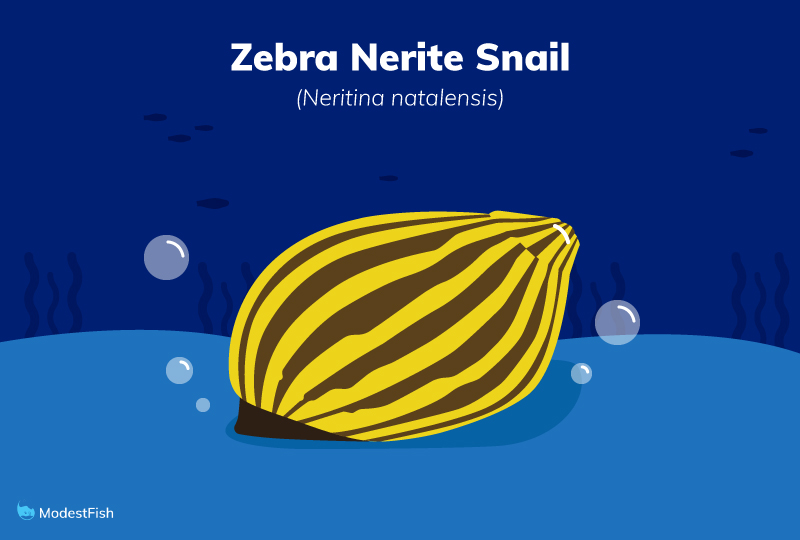
1. Zebra Nerite Snails (Neritina natalensis)
- Care level: easy
- Behavior: peaceful
- Diet: algae, decaying plant material, uneaten fish food, supplement with blanched veggies
- Minimum tank size: 10 gallons
- Temperature: 72°-78°F (22°-26°C)
- Ammonia/Nitrite: 0
- Nitrate: <30 ppm
- pH: 7.5-8.5
- GH: 5-8 dGH
- KH: 5-15 dKH
There are several different species of nerite snails available in the aquarium trade.
I really do think they are the best snails for a freshwater tank. They are excellent algae eaters and never bother live plants. They just delicately scrape algae off plant leaves.
Best of all, they do not reproduce in freshwater. If you have a male and female, they will lay fertile eggs, but the eggs won’t hatch unless they’re in brackish water.
Be aware, if you have a household water softener, the eggs might be able to hatch because of the sodium content of your water.
Most nerites have round shells that are slightly pointed on one end and they only reach about 1.5 inches (4 centimeters) long.
Zebra nerites are pretty darn cool looking. They have dark brown and gold stripes. The stripes can be thick or thin, straight or wavy.
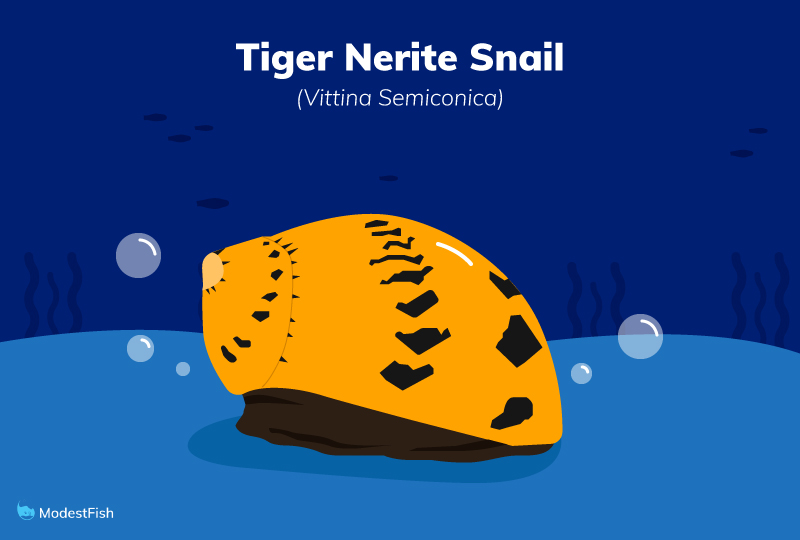
2. Tiger Nerite Snails (Vittina Semiconica)
- Care level: easy
- Behavior: peaceful
- Diet: algae, decaying plant material, uneaten fish food, supplement with blanched veggies
- Minimum tank size: 10 gallons
- Temperature: 72°-78°F (22°-26°C)
- Ammonia/Nitrite: 0
- Nitrate: <30 ppm
- pH: 7.5-8.5
- GH: 5-8 dGH
- KH: 5-15 dKH
Tiger nerites have the same shell shape as zebras. But, their base color is a really pretty sunset orange. Often, they have a lighter golden color that spirals around the shell.
They also have bands of dark brown spots or chevrons that look a bit like tire tracks.
I’ve had several of these over the years. They’re a really active snail who can get themselves into places you wouldn’t believe, like the filter intake.
They’re escape artists, like all nerites, so I really would recommend a tight fitting lid.
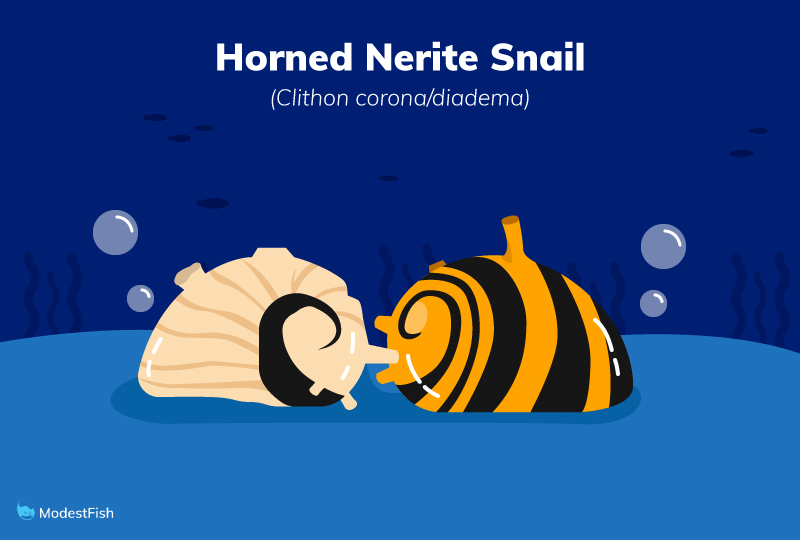
3. Horned Nerite Snails (Clithon corona/diadema)
- Care level: easy
- Behavior: peaceful
- Diet: algae, decaying plant material, uneaten fish food, supplement with blanched veggies
- Minimum tank size: 10 gallons
- Temperature: 72°-78°F (22°-26°C)
- Ammonia/Nitrite: 0
- Nitrate: <30 ppm
- pH: 7.5-8.5
- GH: 5-8 dGH
- KH: 5-15 dKH
Horned nerites are a little different. Instead of the typical shell shape, horned nerites have projections that come off their shells.
They’ve always looked like antennas to me, but if folks want to call them horns, that’s OK with me.
The “horns” are made out of the same material as the rest of the shell.
There are several color variations of horned nerites. My favorite ones have this really cool looking yellow and black spiral pattern.
Care and feeding of horned nerites is just like the other varieties and their eggs will only hatch in brackish water.
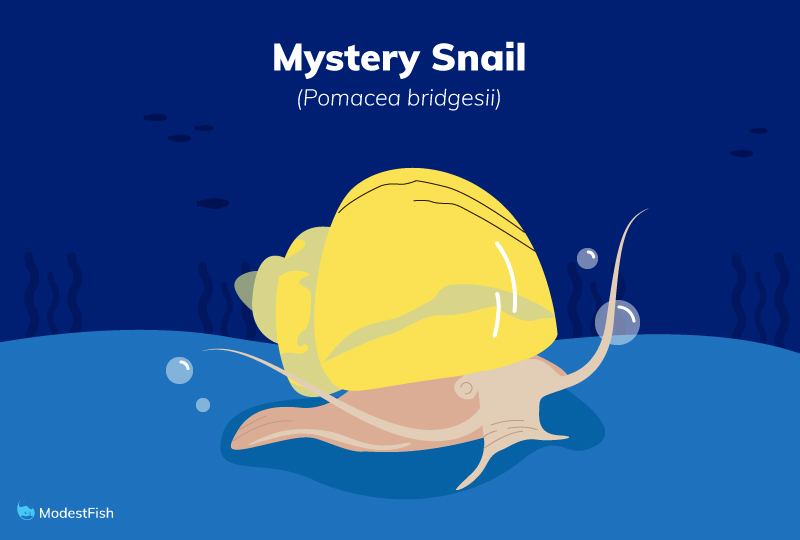
4. Mystery Snails (Pomacea bridgesii)
- Care level: easy
- Behavior: peaceful
- Diet: some algae, decaying plant material, uneaten fish food, supplement with blanched veggies
- Minimum tank size: 5 gallons
- Temperature: 68°-82°F (20°-28°C)
- Ammonia/Nitrite: 0
- Nitrate: <30 ppm
- pH: 7.5-8.5
- GH: 5-8 dGH
- KH: 5-15 dKH
Mystery snails have a rounded shell that can be white, golden, red, blue, green, brown, black or purple.
They are a kind of apple snail, but it’s easy to control their numbers.
If you end up with a male and female mystery snail, they will breed and lay eggs. But, females lay big clusters of bright pink eggs above the waterline.
So it’s fairly easy to just remove the eggs and dispose of them.
If you want to avoid eggs altogether, only keep a single snail.
I really like mystery snails. I think they look really cute cruising around the tank and I’ve never known them to bother any of my live plants.
But, mystery snails are not the best algae eaters. They eat some, but they’re better for things like cleaning up the uneaten food your fish leave behind.
5. Japanese Trapdoor Snails (Cipangopaludina japonica)
- Care level: easy
- Behavior: peaceful
- Diet: algae, decaying plant material, uneaten fish food, supplement with blanched veggies
- Minimum tank size: 15 gallons
- Temperature: 64°-84°F (18°-29°C)
- Ammonia/Nitrite: 0
- Nitrate: <30 ppm
- pH: 7.0-8.0
- GH: 5-8 dGH
- KH: 5-15 dKH
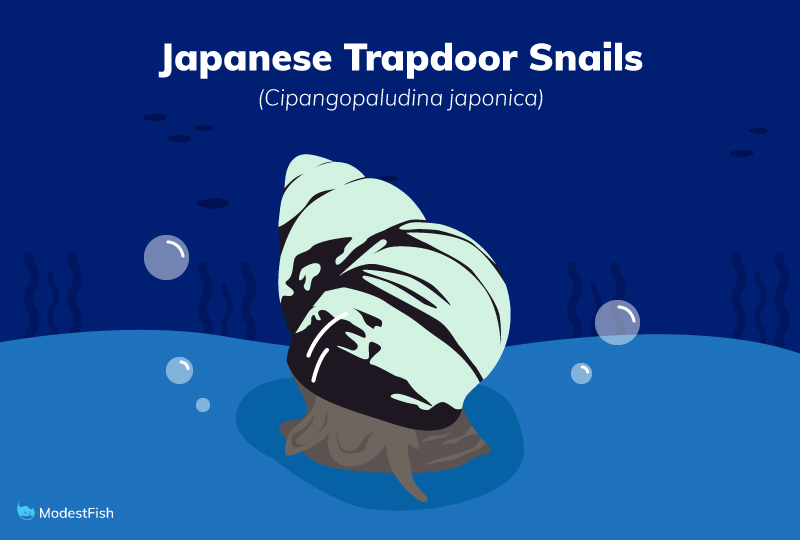
Japanese trapdoor snails (JTS) have a twisted conical shell that gets distinctly larger with each whorl. They come in a variety of colors, like golden, green, white or dark brown.
They’re mostly kept in ponds but are becoming more popular for aquarium use.
JTS will happily eat algae and other detritus in the tank and will leave live plants alone as long as they are well fed.
They will breed in an aquarium if you have a male and female. The only way to make sure you don’t end up with more is to have only one in your tank. But, they’re a large snail(2”/5cm), with a voracious appetite, so a single snail can make a huge dent in your tank’s algae.
6. Rabbit Snails (Tylomelania sp.)
- Care level: easy
- Behavior: peaceful
- Diet: algae, decaying plant material, uneaten fish food, fish waste, supplement with blanched veggies
- Minimum tank size: 10 gallons
- Temperature: 74°-84°F (23°-29°C)
- Ammonia/Nitrite: 0
- Nitrate: <30 ppm
- pH: 7.5-8.5
- GH: 5-8 dGH
- KH: 5-15 dKH
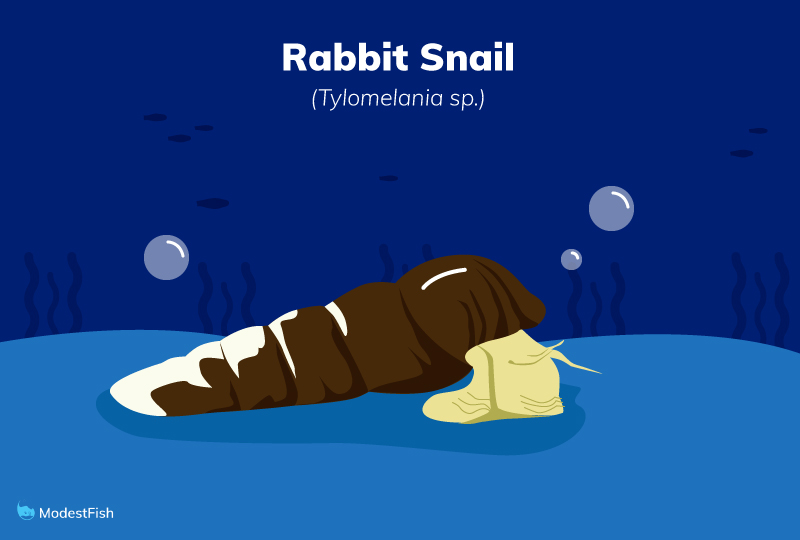
There are many different species of rabbit snail so they come in a variety of colors and sizes. They all have a twisted conical shell that can be anywhere from 1-4 inches (2.5-10 centimeters).
These guys love to dig around in the substrate. This is great for planted tanks since it aerates the soil.
They feed on soft algae, uneaten fish food and fish waste around the aquarium. They usually leave live plants alone.
But they do seem to have a thing for Java fern. Apparently they find it rather tasty and will devour it like candy.
Keep in mind, rabbit snails will breed in the aquarium if you have a male and a female. They breed relatively slowly, only laying an egg every 4-6 weeks, but that still means baby snails in the tank.
The only way to guarantee you don’t end up with babies is to keep only one rabbit snail in your tank.
7. Black Devil Snails (Faunus ater)
- Care level: easy
- Behavior: peaceful
- Diet: algae, decaying plant material, uneaten fish food, may munch on delicate plants, supplement with blanched veggies
- Minimum tank size: 10 gallons
- Temperature: 72°-78°F (22°-26°C)
- Ammonia/Nitrite: 0
- Nitrate: <30 ppm
- pH: 7.0-8.0
- GH: 5-8 dGH
- KH: 5-15 dKH
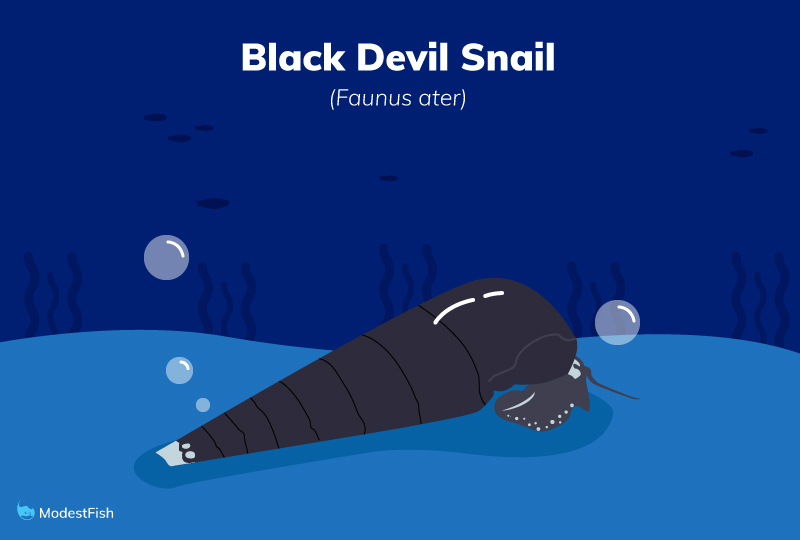
Black devil snails have a pointed conical shell that’s either very dark brown or glossy black. They get pretty big, about 2-3 inches (5-7.6 centimeters) long.
These are brackish water snails and so their eggs will not hatch in freshwater.
I think they’re really interesting looking aquatic snails. The shells of the black variety always look like obsidian to me.
One thing about them, though, some aquarists have had issues with them eating live plants. It doesn’t always happen if they’ve got plenty of algae to munch on, but it is something to be aware of.
Types Of Pest Snails In Aquariums
Let’s now go through common species of unwanted snails found in freshwater aquariums.
1. Bladder Snails (Physella acuta)
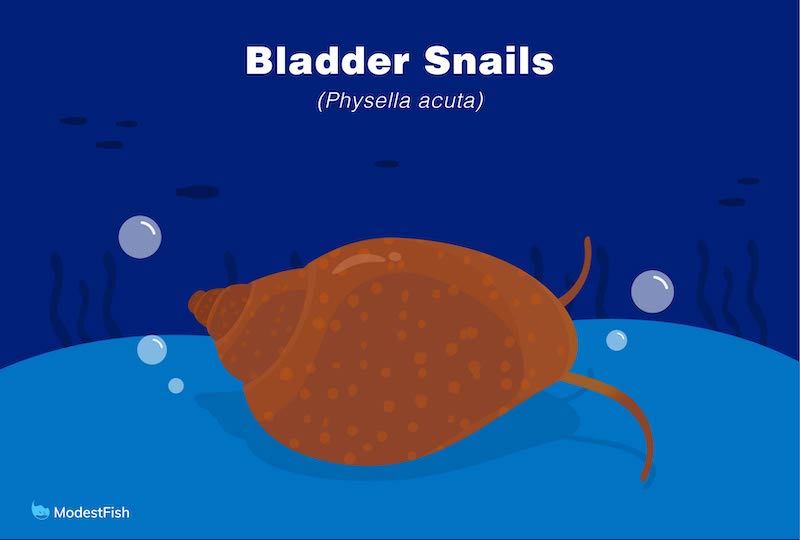
Bladder snails don’t get very big, only about a ½ inch (1.25 centimeters) long. They’re a muddy brown color with speckles.
Their shells are mostly round. One end is just slightly pointed so they mostly appear just a bit asymmetrical.
They can reproduce both sexually and asexually. They’re hermaphroditic so they can actually fertilize themselves to create viable eggs.
All it takes is one to get in the tank and they will breed like crazy, putting off tons of waste that breaks down into ammonia and nitrates.
All that extra waste can be produced so quickly that it overwhelms your biofilter and really fouls your water.
A lot of the time, aquarists see just one pop up, and think, “Ah, no big deal, it’s just one little snail.”
And then a week later they see another and another and another. Soon, they’re everywhere.
Their population only grows to match the food supply, but if you have a heavily stocked tank, they can feed off the fish waste. And they’ll gladly reproduce until you have dozens in the tank.
They also make their way into your filters where they’ll gladly eat up filter gunk and have about a million babies.
Luckily, bladder snails won’t destroy your live plants. They just want to munch on algae, fish poop and other detritus. But they’re still pretty darn annoying.
What’s bad about them?
- Breed like crazy
- Hard to get rid of
- Get into your filters
2. Malaysian Trumpet Snails (Melanoides tuberculata)
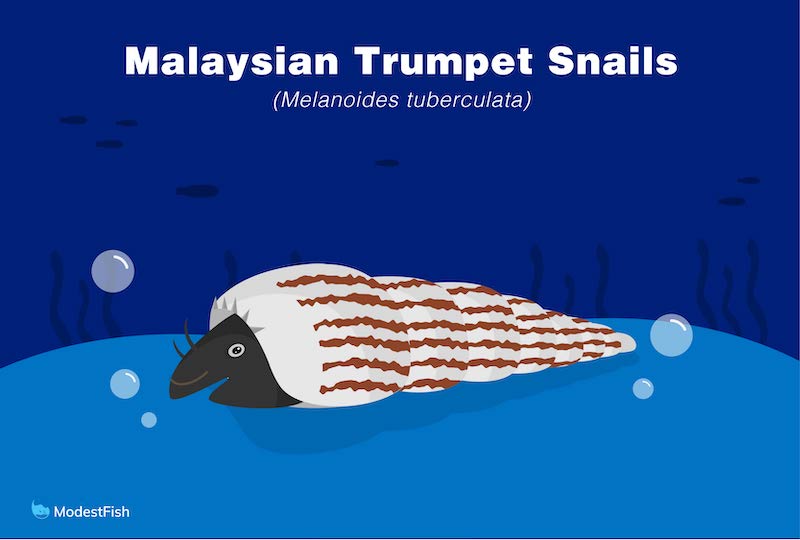
Malaysian trumpet snails have a long, thin conical shell. It always reminds me of a unicorn horn.
These little guys are hermaphroditic and will breed like mad.
They are also practically indestructible. Once these get in your tank, it’s darn near impossible to get rid of them.
Malaysian trumpets can go months with little to no food and they can even survive things like bleach being added to a tank.
Yep.
On top of that, predators like pea puffers and assassin snails don’t really like to eat them.
Basically, they are the snails of Satan and could survive a nuclear holocaust.
What’s bad about them?
- Just about impossible to kill
- Reproduce very quickly
- Can reproduce sexually or assexually
3. Apple Snails (Ampullariidae)
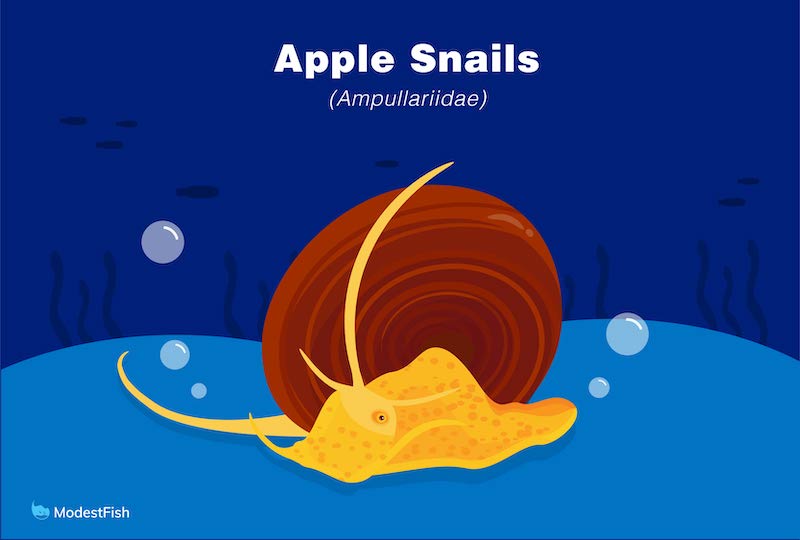
There are several different species of apple snails, all from the family Ampullariidae. They come in a variety of colors, like brown, white, yellow, blue, purple, etc.
Their shells are mostly round with a pointed whorl. Turned on their sides, they look like an old fashioned spinning top.
Some species have escaped into the wild around the US and are considered to be a serious pest that negatively affects both wildlife and agriculture.
Even rabbits are impressed by how quickly apple snails can reproduce. They lay 200-600 eggs at a time. So all it takes is one clutch of eggs and your tank will be completely overrun with snails.
And females can store sperm for prolonged periods of time. So they can be on their own and still lay fertile eggs even if there are no boys around.
What’s bad about them?
- Reproduce in the hundreds
- Invasive species
- Females can reproduce without a male for months
4. Ramshorn Snails (Planorbidae)
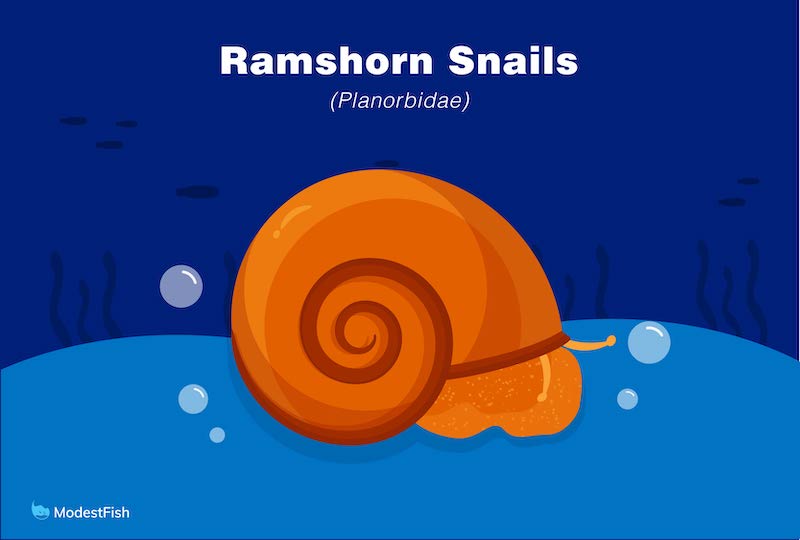
I’ve included ramshorn snails as a “bad” snail, however, it’s considered a minor pest.
There are two main colorations: black and red. You can also get other rare varieties of ramshorns including, pale pink and blue. They grow to around one inch and have a lifespan of one year.
Ramshorn snails can do an excellent job of eating algae, uneaten fish food, and general waste. Some aquarists have great success keeping ramshorns in shrimp or fry tanks.
However, they can reproduce rapidly and quickly become a nuisance and overrun a tank. They can be ferocious eaters, known for eating delicate plants and stem plants like ancharis.
When managed well, ramshorns can be an excellent aquarium snail. When left to a novice, a ramshorn will be a pest.
What is bad about them?
- Reproduce very fast
- Eat plants
- Hard to get rid of
5. Pond Snails
There are several different species of pond snails that can hitch a ride into your aquarium, all from the family Lymnaeidae. They’re usually a drab brown color with a very pointy spiral shell that flares out drastically as it twists around to where the snail’s foot emerges.
Another clue that you’ve got pond snails: they grow and mature very quickly. So if it seems like the snails cruising around your tank get bigger every 5 minutes, they’re probably some kind of pond snail.
Some species can get pretty large. They can have shells up to 2 inches (5 centimeters) long. Their big size means they put off a lot of waste that can really affect your water quality, and quickly.
All that fast growth and large size means these guys have a huge appetite. When they’ve eaten all the algae in the tank, they’ll start tearing through your plants and devouring them.
What’s bad about them?
- Put off tons of waste
- Reproduce very quickly
- Can reproduce sexually or assexually
- Will devour live plants
Good vs Bad Aquarium Snails
There isn’t really such a thing as “good” and “bad” snails. Generally speaking, all types of aquatic snails can be beneficial to your aquarium when managed properly.
However, some types of snails can be extremely tough to manage. They’ll reproduce rapidly and quickly overrun your aquarium. We call these “pest” or “nuisance” snails.
Pest snails can be tough to get rid of, and can quickly become a burden on your tank’s environment by taking up a lot of resources.
Good snails for your aquarium will be peaceful scavengers, and do a great job eating algae and left over food. Aquarium snails have some stunning patterns and colors, are easy to care for, and are suitable for freshwater tanks of all sizes.
Which Aquarium Snail Will You Pick?
Many people in the aquarium hobby have a love/hate relationship with snails, and I’m one of them.
I’ve really enjoyed having the snails that I put into the tank on purpose. They’re not hard to take care of and they do a good job of helping to clean up your tank.
Plus, it’s neat to watch them climb around in the tank, especially species like mystery or nerite snails that seem to glide along without any effort.
But, suddenly dealing with a plague of pest snails is no fun at all. I just recently went to war with bladder snails. It was the classic scenario: I picked up some new plants, about a week later I saw one tiny snail, and a week after that, there were billions of them.
OK, maybe that’s a bit of an exaggeration, but it felt like there were billions.
It was really frustrating, and about as fun as a root canal, but I finally got them under control.
So don’t beat yourself up if you’ve suddenly got a snail problem. I’m pretty sure it happens to every aquarist at some point.
There are things you can do to reduce or eliminate pest snails in your aquarium. Honestly, limiting the food supply will help you control the majority of infestations.

Thank you for this!
Incredibly informative, and a engaging, relatable, attention capturing writing style.
I will be sharing this in all of my fish groups when people ask about snails!
Interesting facts.
Question – Are a couple Gold Inca Snails a good choice for a 10 gallon tank?
Hi Josh, yes a 10 gallon would be fine for a couple of Gold Inca Snails
An excellent and very informative account. Many thanks.
The easiest way I’ve found to eliminate the bladder snails is to drop a romaine lettuce leaf in the tank, watch the masses descend onto it to eat, then remove it and dispose of it in a ziplock bag.
This article definitely helped me to decide which one to get. Thank you so much! I really love how easy is to understand every different topic on this website.
I’ve found that XO loaches are effective at controlling pest snails that show up with aquarium plants. But alas they can’t seem eat trumpet snails. For those I siphon them out after they come out at night.