

The Aquarium Nitrogen Cycle is the single most important concept that you’ll need to understand if you want to have a successful aquarium. Without this important biological process, keeping fish in aquariums would be impossible.
Understanding this pivotal function of aquarium life, and implementing the steps to get it established and keep it maintained in your tank, often means the difference between success or failure with keeping fish alive.
There are lots of things in the aquarium hobby that you can customize, or find your own way of doing, but the Aquarium Nitrogen Cycle isn’t really one of them.
Have no fear, today I’m going to go over everything you need to know about this important concept and how you can apply that knowledge to your home aquarium.
Table of Contents
Understanding The Basic of an Aquarium Cycle
The Aquarium Nitrogen Cycle is a little mini version of the Nitrogen Cycle that is an integral part of life on our entire planet.
In a nutshell, the Aquarium Nitrogen Cycle is a biological process whereby beneficial bacteria that live in filters and the substrate transform toxic byproducts from wastes into nontoxic compounds.
There are two main sources of harmful wastes in a fish tank:
- Fish respiration – as fish take in oxygen with their gills, they also expel waste ammonia from them directly into the water column.
- Decomposition of fish waste – fish also excrete wastes in the form of urine and feces. These are broken down by putrefying bacteria that put off ammonia as a byproduct of their digestion.
All of this ammonia going into the water is bad news in an aquarium. Ammonia is highly toxic to fish. It only takes one drop in 13 gallons (49 liters) of water to stress fish, even kill many delicate species. Two drops in 13 gallons, or 2 ppm (parts per million), will kill most species of fish.
Left alone, animals in the tank keep producing wastes, and ammonia keeps accumulating until it becomes toxic. This is something people refer to as “new tank syndrome.”
As ammonia builds up in the water, it gets harder and harder for fish to clear the ammonia from their gills. The more this happens, the more the ammonia starts to burn the delicate gill tissue, until the gills get so inflamed that they can’t absorb oxygen, and the fish dies.
This is why the beneficial bacteria (aka nitrifying bacteria) that carry out the Aquarium Nitrogen Cycle are so important.
It works like this:
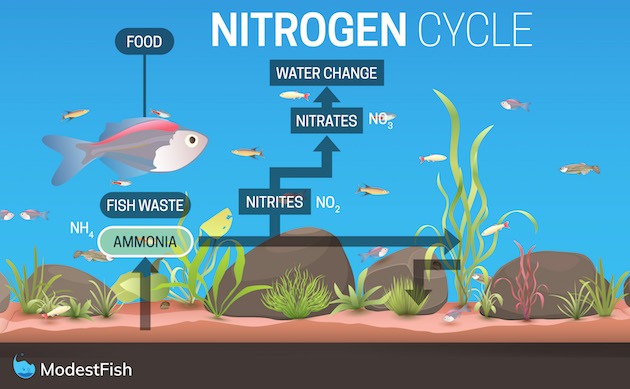
- Rotting fish waste and fish respiration leach ammonia (NH3) into the water.
- Ammonia oxidizing bacteria eat the ammonia and turn it into nitrite (NO2 -1), which is still quite toxic to fish and invertebrates.
- Nitrite oxidizing bacteria eat the nitrite and turn it into nitrate (NO3-), which is nontoxic in low concentrations.
Nitrate is safe at low levels, so it can be allowed to build up in the water column in between water changes.
Important Things to Know About Beneficial Bacteria
The bacteria that carry out the Aquarium Nitrogen Cycle do not live in large numbers in the water column. They spend their lives attached to surfaces.
In order to have enough beneficial bacteria in your filters to keep up with ammonia, it’s important to have special filter media, called biomedia, to provide sufficient surface area for a large population of bacteria to live on.
Nitrifying bacteria are almost everywhere on Earth. They’re in soil, natural waterways, even in the air we breathe.
But here’s a big problem: when you’re setting up your first fish tank, these beneficial bacteria don’t just instantly show up in large enough numbers to take care of fish wastes. It takes time to get them to grow in sufficient numbers to transform fish waste safely.
This process of getting the beneficial bacteria to colonize your aquarium is known as “cycling” your tank, and there are several different ways to do this.
This is a process that requires some serious patience as it can take 2-6 weeks to get an aquarium safely cycled!!
So, now that we’ve covered what the Aquarium Nitrogen Cycle is, let’s go over how to get your own aquarium cycled.
The average aquarium needs weekly or biweekly 50% water changes to keep nitrate at nontoxic levels.
Phases of an Aquarium Cycle
There are several phases that the water chemistry will go through as beneficial bacteria begin to get established
- Increased ammonia levels – while there are no beneficial bacteria in the tank to eat ammonia, levels will remain elevated. Usually, bacteria start to colonize when levels get somewhere around 2 ppm and stay there.
- Nitrites appear – as ammonia oxidizing bacteria begin to build in the biomedia, they start to put off nitrite. Usually nitrite gets up to around 1 ppm. This step is usually quite quick, lasting only a few days at most.
- Nitrates appear – once nitrite oxidizing bacteria begin to emerge, nitrites will start to disappear and nitrates will start to show up.
- Cycling complete – the tank is completely cycled when ammonia and nitrite disappear completely and nitrate continues to climb.
When a tank is newly cycled, it is important to only add fish a few at a time. Adding too many fish too quickly can overrun the beneficial bacteria with more ammonia or nitrite than they can handle. Given enough biomedia, the bacterial colony will grow to meet the demands of the wastes produced, but this will take time.
Introducing an Ammonia Source
OK, not gonna lie, the best way to cycle a tank is something that can be hotly, hotly debated online. But, no matter what method you choose to go with, there are some underlying principles that are the same no matter what.
In order to get a cycle going, you’ve got to add a source of ammonia to the tank. The beneficial bacteria can’t begin to colonize the tank if they don’t have anything to eat.
This is usually the part of the process that draws the most controversy. Here are the most common ways to introduce an ammonia source to a tank, and my opinions about them, based on my lengthy experience with them:
Introducing Hardy Fish
Known as a “fish in” cycle, I really don’t recommend this except for more advanced aquarists, since you are risking the welfare of live fish. Also, I think that it requires WAY more work than doing a fishless cycle.
But basically, you put in one or two fish that can likely handle elevated ammonia levels, like molly fish or a Betta, and let their waste start to build up.
Pros:
- Lets you have fish immediately
Cons:
- Risky for the fish
- Requires more testing
- Requires very frequent water changes
Frozen Shrimp Method
This method entails throwing an uncooked frozen shrimp into the tank and allowing it to rot for several days. Some people even recommend letting it rot for several weeks in a mesh bag.
There are many denizens of the internet that tout this as the best method to cycle a tank because, by the time the shrimp has rotted for a few days, both ammonia and nitrite oxidizing bacteria will have colonized the tank.
This method does work, but again, I don’t really recommend it. It’s not just beneficial bacteria that will move in to break down the shrimp.
Saprolegnia, also known as water mold, will also move in and grow on the shrimp in large numbers. Saprolegnia can also attack fish, causing cotton mouth or cotton wool disease. These infections can be extremely difficult, often impossible, to treat. Saprolegnia is in all aquatic environments, at least in the periphery, but allowing something as large as a whole shrimp to rot in the tank will greatly increase the amount in the tank.
New fish, already stressed by moving into a novel environment, could be much more susceptible to infection. It just seems like a completely unnecessary risk.
In my experience, this method can also make the tank smell pretty gross because of the rotten shrimp.
Also, since you remove the shrimp after several days, you’re removing the source of ammonia to keep the fledgling beneficial bacteria colony fed. This doesn’t make sense to me.
Pros:
- Simple and requires little effort
- Doesn’t risk live fish during the cycle process
Cons:
- Increases saprolegnia populations in the tank
- Can make the tank smelly
Fish Food Method
This is the cycling method that I recommend the most for beginners. It’s quite simple.
All you need to do is add a small pinch of fish flakes per 10 gallons each day. It’s very, very important that you grind the flakes down as much as possible. Leaving the flakes whole can encourage the growth of saprolegnia.
Grinding the flakes into powder lets them diffuse all over the tank and doesn’t leave big pockets of material for large saprolegnia colonies to grow on.
Pros:
- Easy method
- Doesn’t risk live fish during the cycle process
- Doesn’t require water changes
Cons:
- Can increase saprolegnia if done incorrectly
Pure Ammonia Method
For this technique, you add pure liquid ammonia (make sure it’s the unscented, non-sudsing kind!!) as a food source for beneficial bacteria.
I’ve used this method myself, and seen many aquarium buddies use it over the years, but I don’t recommend it.
Your tank doesn’t need just the beneficial bacteria that process ammonia and nitrite. It also needs the putrefying bacteria that break down food and fish poop. This method doesn’t provide them with a food source. That’s an important piece of the puzzle you’re leaving out.
With this method, you’re trying to start an organic system with solely inorganic compounds. It’s possible, but not the best, in my opinion. In my experience, this method takes the longest to establish a stable cycle in the tank.
Pros:
- Doesn’t risk live fish during the cycle process
- No chance of increased saprolegnia
- Doesn’t require water changes
Cons:
- Doesn’t seed putrefying bacteria
- Can take a very long time to get the cycle going
How To Cycle Your Aquarium (3 Methods)
There is no way to give an exact timeline for when the phases of cycling an aquarium will happen for your tank. There are many, many unpredictable variables involved.
The first and probably most important step for cycling a tank is to get a test kit. You will need to be able to test for ammonia, nitrite and nitrate repeatedly throughout this process.
You can’t know what’s going on with your water without testing it. I prefer liquid tests, but I can also understand the convenience of test strips when you have to test every day during this whole process.
My first choice for test kits is the API Freshwater Master Kit. I’ve used one of these for years.

Unfortunately, a lot of aquarium test strips do not include ammonia tests because they are essentially swimming pool test strips that have been relabeled for aquarium use.
But, Tetra Easy Strips also come with a bottle of ammonia strips.
These aren’t quite as accurate as liquid tests, but they’ll give you enough of a ballpark estimate during your cycling process.

Cycling Using A Seasoned Filter Media (Fastest Method)
Hands down, the best and easiest way to cycle an aquarium is placing biomedia from an established tank into your filter. So, if you have a friend or family member with a tank that’s been up and running for quite some time, you can move some biomedia from their tank to yours.
This will instantly bring in beneficial bacteria that your tank needs.
I have two preferred methods of doing this:
- Sponge filter – if at all possible, I like to set up a sponge filter with an air pump in an established tank and leave it to run for several weeks. Beneficial bacteria will colonize the sponge. You can then remove the whole sponge filter and set it up in the new tank.
- Spare biomedia – you can put a mesh bag of biomedia, like ceramic noodles or bio balls, into the filter of an established tank for several weeks, the longer the better. Then remove it from the existing tank, keep it wet in tank water and transfer it to the filter on the new tank.
Please, remember, there are very few beneficial bacteria in the water column, so just getting water from an established tank is not a great way to jumpstart your cycle. You need something the bacteria was able to grow on, like sponge or ceramic biomedia.
Just remember, though, there is a potential downside to this method: cross contamination.
Other things besides beneficial bacteria can ride in with the filter media:
- Algae spores
- Snail eggs
- Harmful bacteria (rare but possible)
- Viruses (rare but possible)
- Parasites (rare but possible)
Look, I’ll be completely honest, I’ve done a fish food cycle and a pure ammonia cycle basically just for experimental reasons because I’m a major fish geek.
But at home, for my purely personal use, if I’m going to start a new tank, I swap out a seasoned sponge filter into the new tank and call it done.
But, I also know full well that if there’s snails (which I don’t mind, I think they’re useful) or some pesky form of algae in that tank, those sorts of things are going to ride into the new tank.
How to Perform a Fish-In Cycle
Alright, I am not a big fan of doing this. I don’t like to do things that I know are going to add unneeded stress to fish, especially anything that is going to expose them to ammonia.
But, if you’ve already added fish to an uncycled tank, here’s the best way to keep them alive while the tank cycles.
I highly recommend that you pick up some Seachem Prime. I use Prime as a dechlorinator usually, but it also can detoxify ammonia, nitrite and nitrate.
Prime binds free ammonia (NH3), which is toxic, into ammonium (NH4+), which is nontoxic, for about 48 hours.
After those 48 hours, the ammonium will switch back to ammonia and become toxic again, so you’ll need to dose regularly while the cycle goes on.
Aquarium test strips do not distinguish between free ammonia, the toxic form, and ammonium, the nontoxic form. Ammonia tests will still show the same amounts because they test for total ammonia, both forms together. So, if you test before and after dosing Prime, it will show the same level of ammonia in the tank.
Test your aquarium daily, as ammonia starts to creep up towards 1 ppm, you will need to dose the tank with Prime so that fish do not start to get too stressed.
I highly recommend that you perform water changes every other day during this process. This will make the process take longer, but it is for the sake of the fish that you should do this.
When you dose with Prime, you bind the ammonia that is in the water column at the time. But fish respiration and poop are continually putting out more ammonia.
Make sure to feed very sparingly during this time. Overfeeding will just add more ammonia into the system.
Continue daily testing, periodic water changes and dosing Prime until ammonia and nitrite are at zero and nitrate begins to climb.
Once you’ve had several days of no ammonia or nitrite, you can go to weekly water changes and testing a few times a week.
You can add more fish a few at a time after this point. I really recommend adding a few fish and then giving the tank a few weeks for the biofilter to catch up.
Just keep testing, doing water changes, and dose with Prime if ammonia starts to creep up after adding more fish.
How to Perform a Fishless Cycle
Fishless cycles are much easier and less stressful, in my opinion. Yes, you have to wait longer to have fish in the tank, but there’s less worry about fish being killed by ammonia.
I think the best and easiest kind of fishless cycle is the fish food method. It does take some patience, but not a lot of effort.
When I did it, I used a small pinch per 10 gallons or so. No need to be super precise, but err on the side of less.
It’s important to grind the flake food as finely as you can. Big clumps can grow large saprolegnia colonies.
Add the powdered fish food each day and test daily for ammonia.
Once you start getting ammonia, add just a single pinch of powdered food per day until ammonia gets to 1-2 ppm. If ammonia starts to get above 2 ppm, stop adding fish food for several days.
Test daily for ammonia and nitrite. Usually, within a few weeks, you’ll start to see ammonia drop and see nitrite rise.
Keep adding a single, small pinch of food every three days or so until you see ammonia and nitrite drop and nitrate start to rise.
Once you’ve had several days of no ammonia and nitrite, it’s safe to add a few fish. Start adding only enough food your fish can eat in about a minute or so.
It’s easy to overwhelm the beneficial bacteria in your tank if you add too many fish at once. As long as you have enough biomedia capacity, over time, the colony of bacteria will grow to meet the demand of fish waste being produced by the fish.
But, if you add too many fish too quickly, the ammonia from their poop and gills will be more than the bacteria can process all at once.
I know it’s hard to resist filling the tank with fish after you’ve been patient during the cycling process. I feel your pain!
But, adding fish slowly is so much safer for the fish, and it keeps you from having to go back to daily testing and frequent water changes.
What is the Role of Biomedia in the Aquarium Nitrogen Cycle?
Biomedia is filter media that’s primary purpose is to provide surface area for beneficial bacteria to grow on.
Good biomedia is porous, with lots of little nooks and crannies for beneficial bacteria to stick to.
Some of the best biomedia’s are:
- Unglazed ceramic
- Man-made sponge
- Sintered glass
- Plastic bio balls
The porous nature of all these materials greatly increases the surface area inside the filter, creating more room for beneficial bacteria to colonize.
Nitrifying bacteria are aerobic bacteria, meaning they need oxygen to live. So, it’s important that they have a constant flow of oxygenated water moving over them.
Porous biomedia lets water flow through it, delivering the oxygen and food bacteria need.
It’s important to protect the beneficial bacteria growing on biomedia. Don’t clean it other than to rinse off excess gunk with dechlorinated water. This only needs to be done once a month at most. Make sure to keep your biomedia wet while you do maintenance on your tank.
Can You Speed Up Cycling an Aquarium?
Bottled Cycling Products
OK, talk about a controversial subject. I’ve seen this debated endlessly online.
Here’s the main thing to remember: the ammonia oxidizing and nitrite oxidizing bacteria that you need for your aquarium CANNOT survive in a bottle. They are fully aerobic bacteria that would die if they were placed into a sealed bottle.
However, there are other kinds of bacteria that take part in the nitrogen cycle besides just the ammonia/nitrite oxidizing ones that can survive in a bottle.
These helpful bacteria help break down wastes and uneaten food, helping to make the environment more favorable for the aerobic nitrifying bacteria to colonize the filter, speeding up the cycle somewhat.
I will say that not all of these products are created equal, and some can be rendered completely ineffective if they are not properly handled in shipping and storage. I would recommend caution while doing any sort of cycle on your tank. Nothing is just a miracle in a bottle that will instantly cycle your aquarium.
Seachem Stability can be very effective, although you will still need an ammonia source for bacteria to feed on.

Conclusions
The Aquarium Nitrogen Cycle is the single most important aspect of fishkeeping. Understanding how it works, its requirements and its limits is paramount to success with keeping aquariums.
I can’t emphasize enough that getting a tank cycled from scratch can take a great deal of patience. I know how hard it is to have to wait around and fuss with a fishless tank.
But, I think some waiting is much better than the heartache and guilt of losing your beautiful fish to ammonia poisoning.
Again, the simplest way to get a tank cycled is to add seasoned filter media. If you don’t have this available, I recommend going with the fish food method for a fishless cycle.
I don’t recommend fish in cycles. It’s very stressful and risky for the fish and it requires daily, diligent testing and fussing, as well as frequent water changes. It’s not my idea of a fun time.
I hope you find this article helpful.
I wish you and your fish the very best!
Solving Common Nitrogen Cycle Problems
It’s always good to be prepared in case you run into any problems. Here are some common problems you may experience and how you can combat them.
Ammonia Poisoning
This is a serious threat to your fish if you’re cycling your aquarium with fish. The symptoms to look out for are:
– Lethargy and lack of movement
– Loss of appetite
– Staying at the bottom of the tank
– Inflamed gills, eyes, or anus
– Red streaks in the fins
– Gasping for air at the surface
It’s important you deal with this quickly, or these symptoms can lead to death. To lower the ammonia levels, perform water changes more frequently – changing a greater portion of the water each time.
Aquarium Won’t Start Cycling
Ammonia tends to start rising around day 3. If by day 5 you can’t measure any, and you’ve removed the possibility that you have a faulty test kit. Your tank may not be cycling.
The most common reasons for this happen, is that there’s no source of ammonia or somethings eating it too fast for the bacteria to get to it.
Try adding some more ammonia. If you have a lot of plants in the tank, try removing some of these and see if there’s a change.
Test again after a few days, if there’s still no ammonia or nitrites, try adding more ammonia.
Ammonia is Not Dropping (Fishless Cycling)
Three main reasons this can happen: pH is too low, you’re using chlorinated water, or you’ve been cleaning too much.
If the pH is under 7, ammonia will be mostly present as ammonium which the nitrifying bacteria can’t feed off. Use a pH kit to increase the level.
Using chlorinated water will disinfect your tank – killing all the beneficial bacteria. So make sure you’re adding a de-chlorinator to the water before putting it in your tank.
The bacteria you need lives in the gravel, filters, and decorations in your tank. If you clean them too much, you’ll remove the bacteria before is has a chance to establish.
My Nitrate Levels Aren’t Rising Enough
The reasons for this are similar to ammonia levels not dropping. If your Nitrate levels won’t budge from 0, it’s likely you’re killing them off before they get a chance to establish themselves.
Again, make sure you’re not using chlorinated water or cleaning your tank to vigorously.
Algae Bloom During Cycle
Unfortunately, cycling your new aquarium can be an ideal environment for algae to grow.
If you suffer from an algae bloom, try turning off your aquarium lights. If you’re using plants, you can’t just turn off your lights. So make sure your plants don’t get more than 6 hours of light a day.
Avoid over-fertilising your tank and using a CO2 injector can also help.

Omg i love you! Finally!!! A frigin sigh of relief for finding you!!! I have read AND UNDERSTOOD every si gle laymans english word you wrote here!!(bow to u..bow )… Im so tired of talking w fish people who look at me lime im stupid. Like GIMME A BREAK!! YOU WERE ONCE NEW TOO. Gosh whatever happened to humilty and grattitude for BEING INQUISITIVE and LOVING THIS HOBBY TOO? Thank you! As a creature liver myself of land ,air and water I am blessed to have the curiosity of knowing…researching and finding the people who ..like you…speak to me…who take the time to break it down enough to ACTUALLY CARE TO COMMUNICATE THOROUGHLY AND MINDFULLY. I am NOT a scientist or chemist in the least. Im more operatiinal from the right brain of artistic thoughts. So ive been doi g my best at understanding the Nitrogen Cycle and well…Repetition is the mother of skill! That combined wth so many other contributi g factors im starting to get the hang of this! Now time will tell if im able to reflect and example what ive learned here!?. I just bought a 65 gal for my buddies that were growing too big for the 16 gallon. And i successfully transferred them tonight via the weeks help with cycling tank from the established 16 gal via filter media in external pump AND tank media …water..decor..plants…..there were just a couple thgs i did too fast compared to what you suggested here however there were more thgs i did correctly so THATS a plus! Now ive got to watch my numbers and do water changes until new tank is fully cycled! Im so tired but had to just say THANK YOU SO MUVH and i hope to stay in touch! Dianna!
Dianna, I love your attitude! The goal of this site is to make it easy for anyone to start the hobby and provide proper care for their aquatic buddies, so I’m so happy you’ve found it useful. I wish you all the best, and please feel free to share your experiences with us. This hobby has so many variables (it’s part of the fun and frustration) it’s great to hear what works and doesn’t work for others. If you find anything we’ve suggested doesn’t work for you or you find better methods, please share, I might be able to update this post over time with more useful content. Happy fishkeeping.
It’s really a nice and helpful piece of info. I’m glad
that you simply shared this useful info with us.
Please stay us informed like this. Thanks for sharing.
Hello! It’s Ericka again! Based on what you told me last time, I do plan on doing the fishless cycle! I do have some questions and I’ve been taking notes as well so I make sure I do this right. When the level of nitrite starts to drop do you keep adding ammonia to the tank??? I like to make sure on things and you never specifically said to keep adding ammonia, so I’m just wondering. Also what type of water would I need to do this fishless cycle? Could I use tap water if I use the betta purification liquid thing (I’m not sure what it’s called, it’s suppose to clean the water of chlorine or something?)
Hi Ericka, to answer your question, I don’t believe adding anymore ammonia to the tank is necessary once the nitrates are present. The nitrifying bacteria should do it’s job from that point on… Sometimes adding TOO much ammonia can kill the good bacteria off during the cycling process and that’s the last thing you will want considering how long it takes to cycle a fish tank… Also, if you have a test kit, it can sometimes be a good idea to test your tap water! Obviously there will be no nitrites or nitrates in your water (there may be some ammonia depending on where you live and the quality of your water) but it can be beneficial to test the pH of your tap water to see where the natural levels are at and if you’ll need to adjust them at all… For tropical tanks, you’ll want your pH to sit at about 7-7.5. Any lower, then as Christopher mentioned, it can be a bit more of a pain because the nitrifying bacteria struggles to feed off of the ammonium, therefore there will be ammonia present in your tank for a lot longer than is necessary when trying to cycle it… Also, I ALWAYS recommend to add tap water conditioner to your water whenever you’re putting even the slightest bit of tap water in your tank. It’s safer for your fish because it will dechlorinate it, plus you know your fishies are swimming around happily and their gills aren’t burning…
-Emmi (I know I’m a couple years late, your tank is definitely cycled by now, but I’m just hoping this helps someone else)
this is great, exactly what i was looking for. Please can you tell me when is best to add live plants, before or after the tank is cycled?
Thank you for your comment, Emma. Live plants can actually help the Nitrogen cycle so you have the freedom to add them before or after.
thanks so much for the advice. By the way, can i say a big thank you for your really well constructed information. I have read so much all over the web, but yours is the most easily digested. I am really excited to get my tank cycled and then populated, nothing fancy, just beautiful fish. I am keeping your page in favourites for quick reference! take care and thank you again!
Thank you so much for your comment, Emma! Really happy you enjoyed the guide and I wish you all the best. Happy fish keeping!
Great article! The only question I have, I’m doing a fishless cycle on a new planted aquarium, my ammonia is 0 and my nitrite is 0, PH 6.5-7, but my nitrates are over 200ppm. Should I continue to do 10%-25% water changes every other day before I add any fish? Or should I just wait a few weeks and hope the plants help reduce the nitrate?
Hello Daymon, thank you for your comment :). Yes, plants will naturally reduce the nitrates, but you could also try a nitrate remover as well.
You are a rare writing talent. A complicated topic for non-insiders explained in a very magnetic article! Thank you veeeeery much.
Thank you very much for your comment and support! I really appreciate it. Happy fish keeping!
Your blog is the most easily understood one I have read. I have been trying to understand why my local pet shops would tell me its okay to add fish after one week but it’s still better to wait. Now after reading your blog I understand. In my last set up I added guppies and after one week then lost one to dropsy then I added two more. Two weeks later, I lost the lot – all to dropsy. I do believe that one of the first fish was ill because the other fish was stalking him on day one but I also understand now that some if it was my impatience. I have just drained the tank to start again. I have a 38 litre (10 gallon) tropical tank. Decided to get driftwood and an Anubias Nana for it to hopefully reduce maintenance. It annoys me that pet shops have told me not to worry about testing for nitrates too. Going to keep and print this blog for maintenance. Thank you ❤️
Thank you so much for your support, Debbie. I’m very happy you have a better understanding after reading the blog :D. I wish you all the best and happy fish keeping!
Your blog is the most easily understood one I have read. I have been trying to understand why my local pet shops would tell me its okay to add fish after one week but it’s still better to wait. Now after reading your blog I understand. In my last set up I added guppies and after one week then lost one to dropsy then I added two more. Two weeks later, I lost the lot – all to dropsy. I do believe that one of the first fish was ill because the other fish was stalking him on day one but I also understand now that some if it was my impatience. I have just drained the tank to start again. I have a 38 litre (10 gallon) tropical tank. Decided to get driftwood and an Anubias Nana for it to hopefully reduce maintenance. It annoys me that pet shops have told me not to worry about testing for nitrates too. Going to keep and print this blog for future reference. Thank you
I had planned to set up an South American themed tank and did my best to add driftwood etc. to keep the PH as low as possible it sits around 6.6 to 6.8. I have just started the cycling process and now I read the ammonia devouring bacteria are non functional at a PH. below 7? This begs one big question: How does anyone have a true South American Amazonian environment when it is not possible to cycle the tank? Please explain! Thank you
Thank you for your comment, Olaf. Most South American tanks will do fine with a stable pH range of 6.5 to 8.0. Now, when I say stable, I mean you keep it from changing too much. Also, when I say 7, it’s not a rule that’s 100%, more of a guide, target, or a potential fix to an issue. Some studies suggest it can occur with a pH as little as 4.0, however, when it comes to creating the Nitrogen cycle in the most efficient way, 7 is an ideal number to aim for. Hope this helps and let me know if you have any further questions.
This was the best guide I’ve read on the subject – and I’ve read a lot the past few weeks! Recently set up my tank and will begin properly cycling it from tomorrow following your advice. I want to ensure everything is done meticulously to ensure the fish will have comfortable and healthy lives from the very beginning. Thanks for writing this.
Thank you for your kind comment, Mark 😀 Wish you all the best with your tank
Man, if u were my teatcher at school perhabs i would be a chimest long time ago…:)
Thank you very much
I have completed a fishless cycle previously but must say this is an easy and excellent explanation of how to do it, so easy to understand and follow.
Well done !!!
Many thanks for clearly explaining this. I’ve read a ton of pages on the topic and this is, BY FAR, the most understandable. Well done!
Great article. Thank you.
Best thing I’ve read on how to cycle your aquarium! Honestly so lost before this, I gauged the general gist of how to do it before and seriously just winged it with my first tank just hoping my fish wouldn’t die but now I’ve got it down packed and I feel a whole lot more comfortable with cycling my fish tanks. I wish the people in fish stores informed people of how to properly start a tank so that the fish have the best and healthiest life. All the times I’ve asked people in the store about cycling a tank they basically just said set up the tank, sprinkle some food in and wait a few weeks and then add fish.
Newly fish hobby to be ,just bought 55 gallon fish tank.My first ever tank very clueless thank godness for google save me a lot of money of buying books for research.Thank you vry much for thouroughly explanation.
thank you for all the info now i know i am on the right path
I finally understand thanks so much.
I have to agree with everyone else- this has been an incredibly helpful guide and the first one I’ve read that I actually feel confident about following! The employees at the pet shop I went to were helpful, but I think also really distracted and busy with other things, so while I could get one question answered, I would have five more there was no time to ask- as well as an armload of products I didn’t understand shoved into my hands. I am disappointed though, as they also told me the cycling process was only a week, and that it would be okay for me to take my betta home in a temporary tank until the cycling process was done on the larger one I bought. Now I am concerned for him in the smaller tank, as it doesn’t have anything- heater/filter/etc. I used water conditioner in it, and he’s happy still at the moment (I only got him yesterday) but I’m anxious I’ll do something detrimental to him while waiting to move him to his new tank. Sigh- I suppose I will just test his water as I test the aquarium’s water and if anything seems off I will buy products to adjust it.
As the comments on your post already reads I second everything they have said! Well written for a frustrated newb like me. Unfortunately I went into the tropical fish set up thinking we (my partner knew what we were doing). Oh boy how we were sadly mistaken. I got the tank cycled with the fish but got a bit lost along the way listening to advice from others. We have now lost a few fish and are trying to bring back the levels into a new nitrogen cycle. I am in the process of a week into it and think I am seeing an improvement with testing every or every other day to monitor it and complete the tasks needed to reduce the levels of ammonia, chlorine and nitrite or I could mean nitrates. I get a bit confused with the two but I know when I look at the testing kit. I am trying to leave off fiddling with it too much (as I did before) and letting it do its magic. I am crossing my fingers this time otherwise it will become a very expensive hobby.
I will ask for your very good advice it seems if I fail miserably this time.
Wish me luck
Nata
I’m just wondering if we put all the decoration and then we start the nitrogen cycle or we need to leave the tank empty to start the cycle so then we can put decorations on the tank.
This is a great article thanks for all the new information and for spending for time doing this piece of writing that people can never find.
I’m just wondering if we put all the decoration and then we start the nitrogen cycle or we need to leave the tank empty to start the cycle so then we can put decorations on the tank.
This is a great article thanks for all the new information and for spending for time doing this piece of writing that people can never find. Thanks again
You could do it either way with your aquarium decorations.
Great article! I’ve been cycling our tank for over four weeks now, have used de chlorinator in the water and also a bacteria improver (Seacem Prime and Stability) as recommended by by the pet shop, we added some fish after a week but ran into problems. We contacted the shop and took the fish back. We started again with a 50% water change and started to cycle the tank again with a little fish food for a couple of days and Tetra Filter active bacteria daily after a week the Ammonia was at 4.0 ppm, no Nitrate or Nitrite, PH 7.2, temp 26.5C. Now after a 25% water change and a further two weeks the Ammonia is 2.0ppm. Nitrite 0, Nitrate 0 and has not changed for a week, should I be adding a little food regularly or not as nothing seems to be happening! Am I being impatient or just thick? A novice fish keeper just wanting to enjoy a hobby in my retirement!
Thanks
Paul
Hi Paul, don’t do water changes if it’s a fishless cycle. You’ll reset the process. Water changes are only needed if you have fish in the tank
Hello!!
This was very helpful especially when most of our newbie experiences are unique.
I began my fishless cycle Saturday 7/17 with live plants, substrate, water conditioner and frtiz 7. There was an ammonia and nitrite spike and i did a water change with conditioner. Rinsed out the valve sponge and trimmed some plants. I do not have air stone yet.
Today 7/19 in the late morning ammonia was 0 nitrite 0 and nitrate 0.
This evening Ammonia was 0 and nitrate 0 but nitrite was 0- .25
Should i do a small water change or wait to see in the morning if its increased or stayed the same?
I am using API test on my 6 gallon tank.
Thank you!
Hello, for a fishless cycle, don’t do any water changes. Water changes are only needed if you’re doing your cycle with fish. You’re doing the right things just keep going.
Letting ammonia build up encourages the ammonia eating kind to grow. Then, letting nitrite build encourages the nitrite eating kind to grow
Thank you!
Thank you so much for the advise!
Thankfully the ammonia since the spike has been 0. The nitrite spike decreased and this morning is 0. Yesterday my nitrates were increasing to 5. Today 7/21 the nitrates are 5.
So…i will wait this afternoon and tomorrow readings to start shopping for endlers. Just a few.
Youve been great!
Hi! I had a previously cycled tank that I ignorantly crashed by changing the filter without seeding the new one. I have other already established media in the filter so I thought I would be okay. Unfortunately my ammonia has been high ever since. It was steady at .25 for a week or two but has now climbed to 2.0 despite having 0 nitrite and 10-20 nitrate. I am not sure what is the best course of action to get my ammonia to come down to safe levels. In the meantime I am using Prime to bind it so it won’t harm my ACF.
Hi Whitney, It can be so tough when you have to recycle a crashed tank. Don’t feel bad about it, it happens to everyone if they’re in this hobby long enough. You’re doing the right thing when it comes to the Prime. This effectively detoxifies the ammonia by turning it into ammonium but still leaves it in a state that beneficial bacteria can eat. I would recommend doing water changes every few days to bring the level down to a more manageable level. Other than the water changes and the Prime, the only thing you can really do is stay vigilant wait it out.
Great article, BUT….. the cycle is most definitely not complete when ammonia and nitrite are zero, that is why we have to do regular water changes, to remove NITRATE. In a full cycle nitrate can be processed by anaerobic bacteria thereby reducing the need for such frequent and/or large water changes. Most aquariums never reach this magical point though due to lack of anaerobic bacteria which requires very large amounts of the correct media to grow within. They take around 4 to 6 months to fully populate the media, THEN you will have a full cycle with the nitrate being converted to nitrogen and released harmlessly into the atmosphere. It’s not easy to achieve but it’s worth understanding and aiming for because any amount of nitrate-eating anaerobic bacteria is better than none!
Thank you for your comment, Steve. You are right, and that is why our last paragraph is about how the nitrogen cycle never really ends. Appreciate your comment and willingness to share more details with fellow readers.
Hello!
I am new to the hobby and just got my first tank last week. I had a question about the fish less cycling process. I got a 10 gallon tank and am planning to put 1 betta, a small school of peaceful schooling fish, 1 snail or some sort of small pleco. I have planted a wide variety of live plants and am using the Fluval Stratum substrate. For the last week I’ve been adding fish food every other day and trying to get the tank to cycle. I put in some beneficial bacteria (API quick start) to try and jump start the process. When I first started testing the water, my ph was 7, ammonia was 1 ppm, nitrite was .25 ppm, nitrate was 5 ppm. I was expecting a spike in ammonia but ever since that initial reading everything other than the nitrate has gone down. Now the ph is 6.8, ammonia is 0, nitrite is 0, and nitrate is still 5 ppm. I didn’t have any used filter media, I started practically from nothing so I don’t really know what to make of these numbers. There is no way the tank has already completed a cycle since it’s only been a week. How will I know when my tank is safe to put fish in when it’s already showing me the numbers that are ideal for fish? Would love some advice from an experienced aquarist! Thanks!
Hi Bella, there is no official time frame with the nitrogen cycle. It’s ready when it’s ready. If all your parameters are safe for your fish, you can add them. If you’re worried, you could also just give it another week, test again and ensure you’re getting consistent readings.
Thank you for explaining that is well. I have owned many tanks and never quite understood the nitrogen cycle. Thanks so much!
Wow! I, too, am new at this fish keeping and, although I have read many articles about the nitrogen cycle, I’ve never come across anyone except YOU who explained it so succinctly and at a level us “newbies” can easily grasp. Now it seems so simple! The Step by Step information was priceless. Understanding the cycle is one thing, but how to do it is equally important. Thank you so very much, Christoper! Now I can proceed more confidently setting up my new tank or tanks!
I just lost one of my glo danios, I feel like such a failure. It stated with his eyes, which made me think it was popeye but then I checked my ammonia levels, OMG, I am surprised I have any fish left! I did a water change, added conditioner, and AmmoLock. It is a fine line I walk/swim with a nano tank. Thanks for your article, it helped me feel like I was not as much as a failure as I could have been.
A little background info: I have a betta in a 4 gallon biorb, It is doing well. And I have a 9 gallon Fluval Flex which I feel is a bit more of a challenge. I recently put a Seachem Purigen pack in the Fluval, it helped with the nitrates but now its the ammonia I am dealing with, I just cannot get a good balance.