

The Marineland Penguin power filter is famed for its patented BIO-wheel and powerful GPH. It looks great, so I decided to purchase it and run it through some real world tests in my own tanks to see how good it really is.
To bring you the best review of the Marineland Penguin power filter, I also tested it against 4 other hang-on-back power filters to see how it compares to similar models.
Note: I tested the Marineland Penguin Pro 375 Power Filter. However this filter comes in the following sizes:
- Marineland Penguin Pro 375 Power Filter
- Marineland Penguin 350 Power Filter
- Marineland Penguin 300 Power Filter
- Marineland Penguin 200 Power Filter
- Marineland Penguin 150 Power Filter
All filters have the same features, the only difference is the GPH rating for different tank sizes.
Here are your results after my testing:
Review Quick Overview
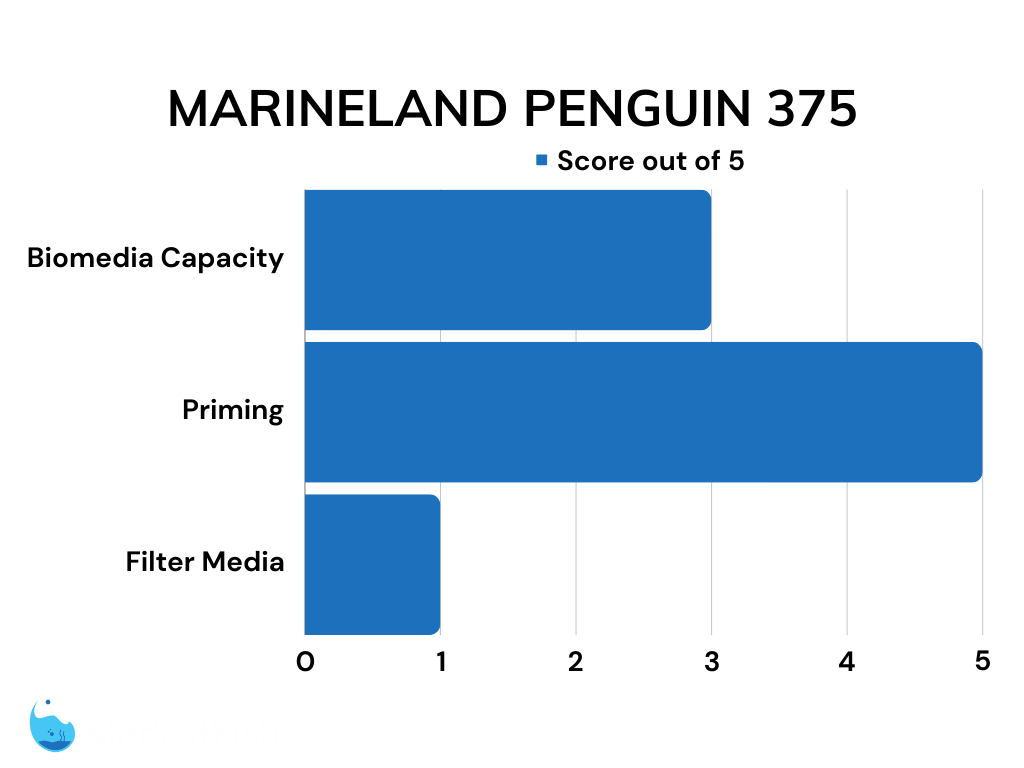
I compared the Marineland Penguin with four other popular models of hang-on-the-back filter.
The conclusion was that this filter isn’t bad, but it also wouldn’t be my first choice.
I think that the Seachem Tidal 75, Fluval C4 and AquaClear 70 filters out match the Marineland Penguin when it comes to features.
I do like how easy it is to get the Marineland filter started. It has an internal motor so there’s no need to prime it or make a fuss over it to get it up and running.
This filter also had the highest GPH compared to all the rest.
But, it’s lacking in other departments.
This filter is designed to use filter cartridges, something I really don’t find appealing.
For myself, if I was going to use this filter, I would want to ditch the cartridges and buy additional media.
The BIO-Wheels do provide biomedia, but I think that you would need to add more media to ensure your filter has enough room for beneficial bacteria to grow.


How it’s Tested The Marineland Penguin Power Filter
We bought five of the most popular hang-on-the-back filters in the aquarium hobby so we could put them through their paces in a head-to-head challenge.
We tested and ranked the filters in two categories: GPH (gallons per hour) and features.
GPH Testing
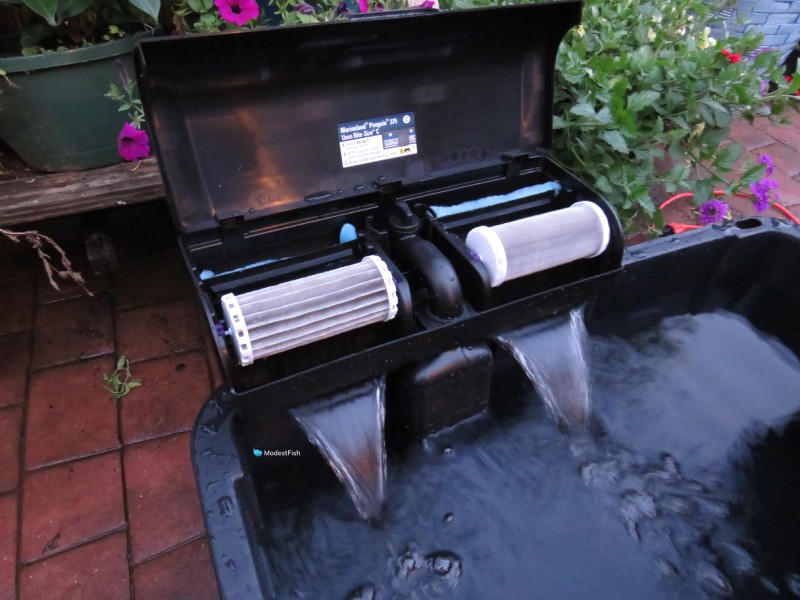
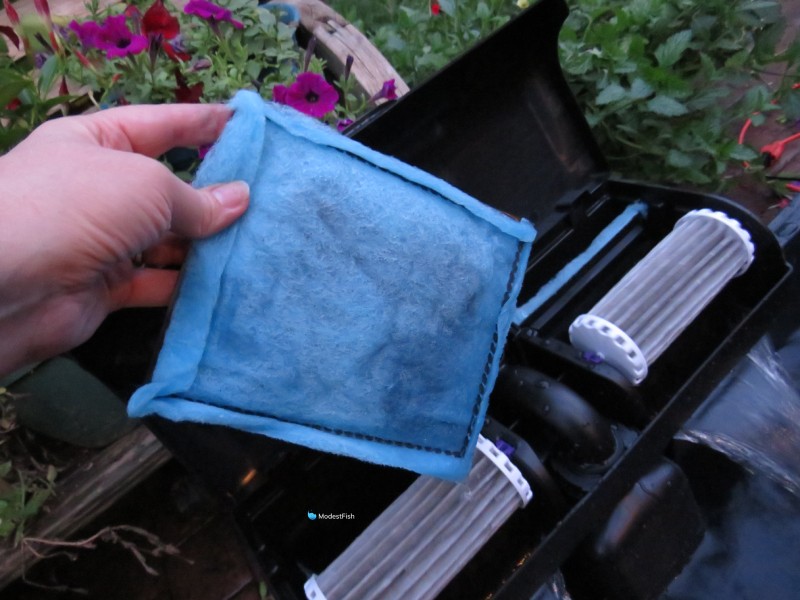
In order to test the GPH of each filter, we first filled a 30 gallon (113 liter) storage tote with water.
One at a time, we hung each filter on the tote and got it up and running. Then, we put a 4 gallon (15 liter) container underneath the outflow to catch the water cascading out of the filter.
We timed how long it took for the filters to fill up the 4 gallon container. We tested each filter four times, twice with no media and twice with all the provided media installed.
Then, it was time to bust out the calculators to do some math. Yay…
All of the times were converted to seconds, because that made the math a lot easier. For each category (empty vs. with media) we took the two times and averaged them together.
Then, each average time was divided by 4 to find the gallons per second.
Lastly, the number of gallons per second was divided into 3,600, the number of seconds in an hour, to calculate the gallons per hour.
Here’s an example if the times were 01:30 and 01:50:
That would be 90 and 110 seconds, respectively.
(90+110) ÷ 2 = 100 average time in seconds
100 ÷ 4 = 25 gallons per second
3600 ÷ 25 = 144 gallons per hour
Here’s a comparison of all five of the filters that we tested:
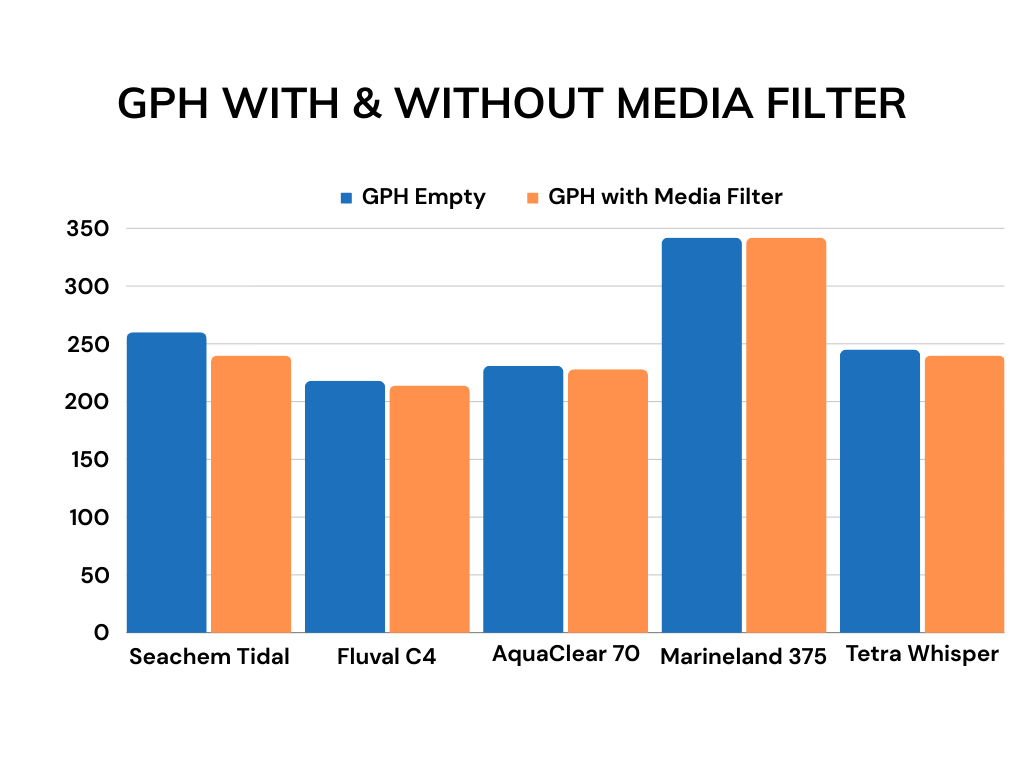
As you can see, the Marineland blew the doors off of the other filters that we tested. With almost 100 more GPH than its nearest competitor, this filter has a monster pump that can really move some water.
But, just keep in mind, GPH is important, but it’s not everything.
What Features I Tested
So, our second category focused on looking at the features of each filter and comparing them.
We were looking specifically for the following things:
- Biomedia capacity – does the filter have ample room for biomedia?
- Priming – how difficult is it to get the filter started? Do you have to fill the reservoir with water to get it started?
- Filter media – what is the quality of the filter media that is provided? Do you have everything you need to get started? Or will you need to buy extra media?
A Note on Filter Cartridges and Why I Hate Them
As I go through this article, I’m going to voice some fairly strong opinions about filter cartridges. I just wanted to make sure I explained why I judge this form of filter media so harshly.
In my opinion, filter cartridges are a really expensive rip off that can do more harm than good. A filter cartridge is just a piece of filter pad on a plastic frame that has some activated carbon inside.
Filter companies have sold many a hobbyist on the idea that they need activated carbon in their filters in order to maintain a healthy tank. This is totally bogus!
There is no need to run carbon in your filters unless you’re trying to remove something like medications or tannins from the water.
Carbon does not filter out wastes like ammonia or nitrite. These compounds are only removed from the water by the beneficial bacteria that grows on filter media.
But, changing out filter cartridges every month reduces the amount of beneficial bacteria in your filter. All of the beneficial bacteria that have grown on the outside of the cartridge get thrown away each month when the cartridge is discarded.
So, you’re essentially throwing away what you actually need, the beneficial bacteria, so you can swap out what you don’t actually need, the activated carbon.
Plus, filter cartridges are expensive. This hobby is expensive enough without adding on having to buy filter cartridges every month.
I recommend ditching the cartridges entirely in favor of reusable media like sponge and ceramic rings for biomedia.
To find out more about the different kinds of filter media, and what they do, you can read our article on the best filter media
Marineland Penguin Power Filter Review
Let’s go through what you get it in the box and review the quality.
Sizes Available
- Marineland Penguin Pro 375 Power Filter
- Marineland Penguin 350 Power Filter
- Marineland Penguin 300 Power Filter
- Marineland Penguin 200 Power Filter
- Marineland Penguin 150 Power Filter
What’s in the Box?
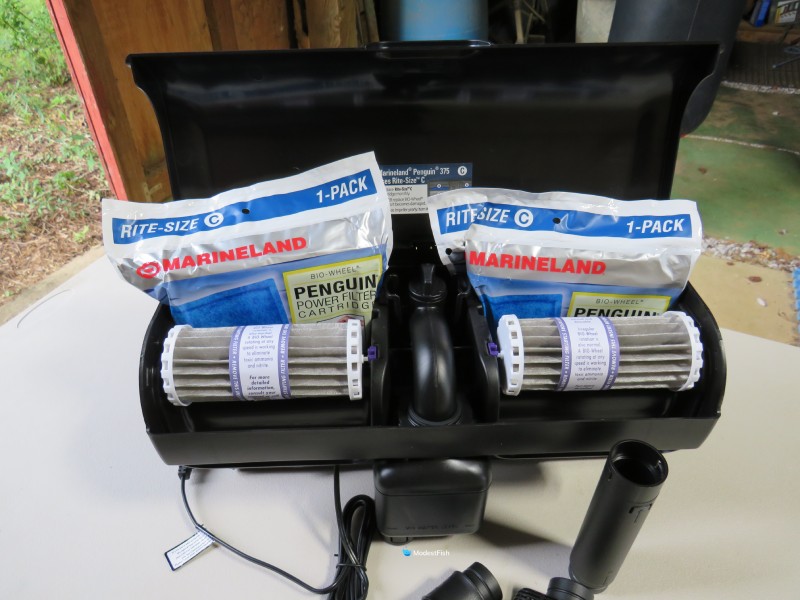
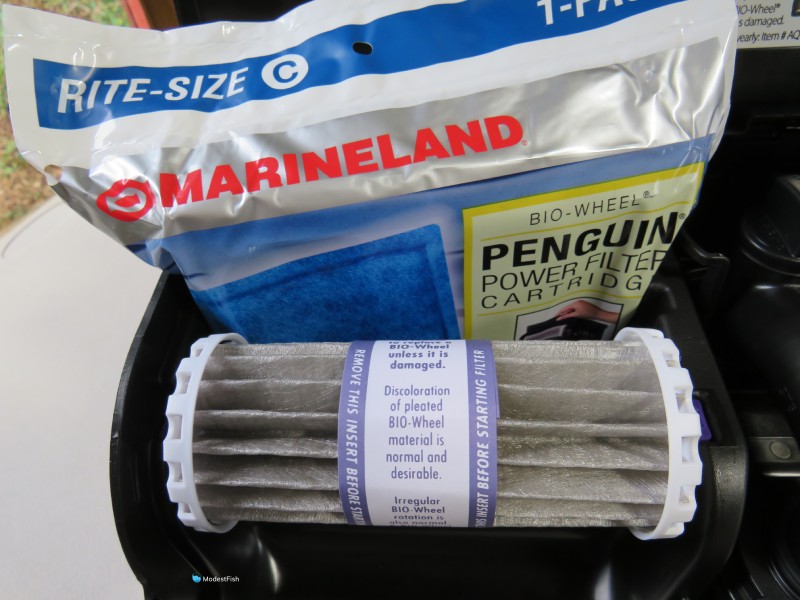
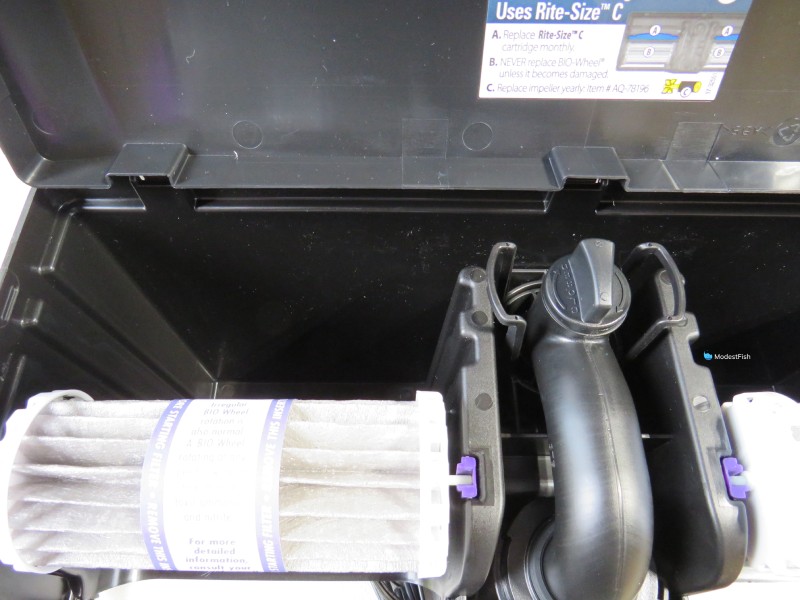
There’s not a whole lot to unboxing this filter. You get:
- Filter
- Additional lift tube pieces and strainer
- Two filter cartridges
- BIO-Wheels
Biomedia Capacity
The BIO-Wheels included with this filter are Marineland’s patented spinning biomedia. They’re cylinders made out of this accordion-like mesh that you place in the stream of the outflow.
The force of the water flowing out of the filter makes the BIO-Wheels spin. Beneficial bacteria grows on the mesh and processes fish wastes like ammonia and nitrite from the water column.
I’ve owned lots of Penguin filters over the years; I know from experience that BIO-Wheels do act as biomedia that can keep the cycle going in a tank, as long as stocking levels are moderate.
There is room in the reservoir to add your own biomedia, but it’s very limited if you use the filter cartridges.
For my personal tanks, I ditch the cartridges completely and add my own media. This lets me have higher stocking levels than with just the BIO-Wheels by themselves.
Priming
Priming this filter is super easy. It has an internal motor, meaning the motor sits inside the aquarium instead of being in the reservoir on the back of the tank.
As soon as you plug it in, it starts to pump water with no priming at all. It’s pretty cool.
Filter Media
I will grant you that the BIO-Wheels are a good biomedia.
But…
My biggest gripe about this filter is that it’s designed to use filter cartridges. Every time you change out the filter cartridges, you’ll be throwing away valuable beneficial bacteria that has grown on them.
I really, really wish this filter came with more high quality filter media, like some reusable sponges and additional biomedia beyond just the BIO-Wheels.
In my opinion, I wouldn’t run this filter with just the media that’s included. I would swap out the cartridges for reusable sponge or matala and use the rest of the space for biomedia, like ceramic rings or bio balls.
Overall Pros and Cons
Pros:
- Excellent GPH
- Easy priming
- Does have room for customizing media
- Sturdy construction
Cons:
- Uses filter cartridges
- Needs more dedicated biomedia space
How Does it Compare To Similar Filters?
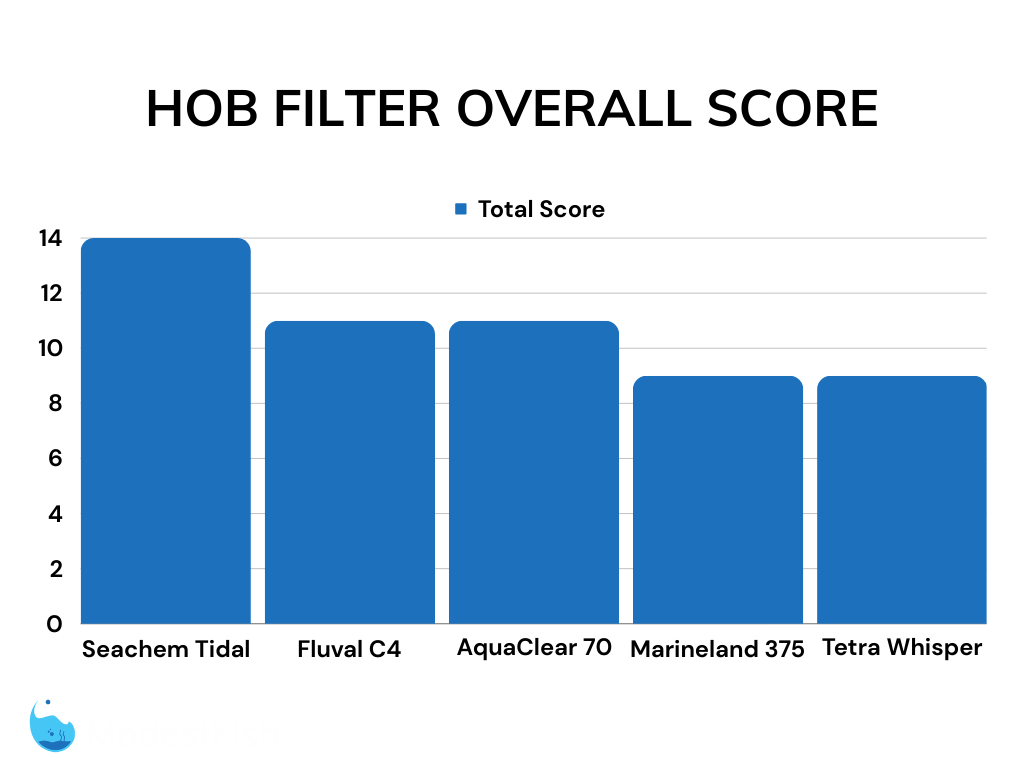
There are some things about this filter that I really like and some things I really don’t.
There’s no doubt that it’s the clear winner when it comes to GPH. The pump on this filter is outstanding and can really crank out some water.
But, when it comes to features, the Penguin lags behind in some areas.
Compared to the other filters on the list, the Marineland Penguin is a bit of a hulking beast. It’s big and bulky, but it’s also sturdy and well built. Just don’t expect it to blend into the background.
When you handle it though, you can tell it’s much tougher than the Tetra Whisper EX. The plastic doesn’t just bend and bow when you’re installing or maintaining this filter, it seems much stronger and higher quality.
Also, even though both the Marineland and the Tetra are designed to use filter cartridges, there is much more room in the reservoir of the Marineland to add your own filter media than there is in the Tetra. Way more.
This filter does not have the same level of quality when it comes to filter media as some of its competitors. The Seachem Tidal 75, Fluval C4 and Aquaclear 70 have much better media.
It is nice that you don’t have to prime this filter, but the Seachem has this feature as well.
Overall, the Marineland isn’t terrible by any measure, but I still have to give the Seachem, Fluval and Aquaclear higher marks.
Final Thoughts
I really don’t want to disparage this filter at all. It’s a solid workhorse with a beast of a motor.
But, if I was going to be adding it to one of my tanks, I would want to buy a bunch of extra filter media so I could retrofit it.
I do like the easy priming. That’s always a nice feature when you can get it. The internal motor also makes this a very quiet running filter.
So, I don’t hate it, but there are definitely other filters (seachem tidal & fluval C4), I would choose before this one.
I hope you find this article helpful.
I wish you and your fish the very best!

Thanks for the article. I recently set up a new tank after getting new flooring in the house and replaced my trusty old Eheim cannister with a Penguin, as I had a tube blow on the Eheim (my worst fear). I decided to go with the Penguin as a safer alternative. I would like to incorporate items like Chemi-Pure and Purigen in the Penguin. Any suggestions for using my own media in the Penguin? How/what did you use in replacing the cartridges?
Thanks so much for your question. Kate, here. As a general rule, I don’t use any kind of chemical filtration media in my filters.
So, no carbon or Purigen or anything like that.
Instead, I dedicate that space to reusable mechanical filter media and some sort of biomedia. I like to use matten filter media and cut it to size to fit where the filter cartridges would normally go. I also add mesh bags of ceramic noodles for biomedia.
Every month, I rinse out the matten filter media in dechlorinated water to clear out built up wastes.
I have healthy, successful tanks that have literally never had any sort of carbon or chemical filter media. For years they’ve been running, with no issues, and zero chemical filtration.
Very, very rarely, I’ll have a fish get sick and need to add medications. I will add carbon to the filter when I need to remove the medications after treatment. That’s the only time I use it at all.
I’ve had an extremely high rate of success using no chemical media for well over a decade. I know some folks swear by activated carbon, but I personally never use it.
Thanks for reading and I wish you well!