

A darting school of silver dollar fish is really something, so it’s no wonder they’ve been such a popular choice in the aquarium community for decades.
And the best part is, they’re a hardy species of fish that’s beginner friendly.
But they do have some specific requirements you’ll need to know about. And in this guide, I’ll take you through everything you need to know so you can set up your own successful silver dollar fish tank.
Care Overview for Silver Dollar Fish
- Care level: easy
- Tank size: 100 gallons (378 liters)
- Lifespan: 10 years +
- Size: 6-10 inches (15-25 centimeters) depending on species
- Diet: Herbivore
- Family: Characidae, subfamily – Serrasalmidae
- Temperament: peaceful schooling fish
- Temperature: 75°-82°F (24°-28°C)
- Ammonia/Nitrite: 0
- Nitrate: <30 ppm
- pH: 6.0-7.0
- GH: at least 6 dGH (100 ppm)
- KH: at least 3 dKH (53 ppm)
Silver Dollar Fish Appearance & Natural Habitat
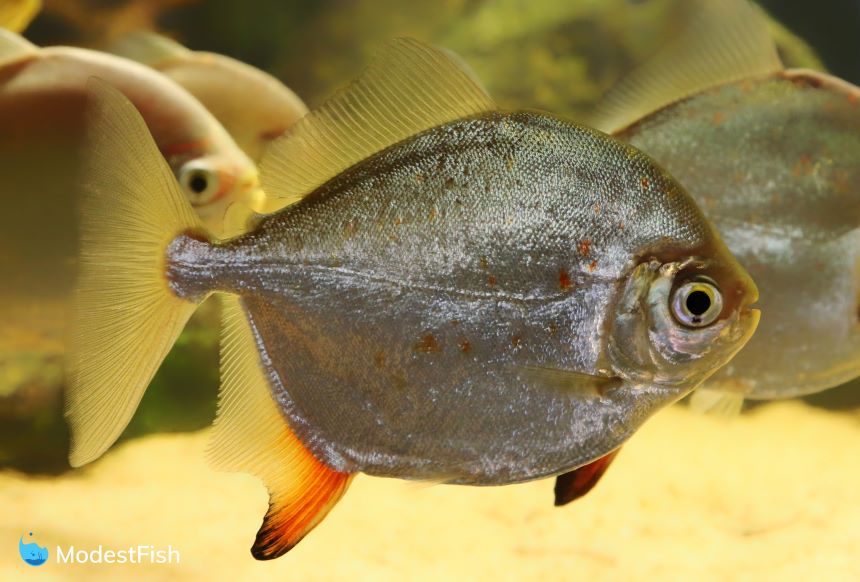
There are several different species of fish that are sold under the common name of “silver dollar,” (metynnis argenteus) but they all have a similar appearance.
They are extremely laterally compressed, meaning from side to side, their bodies are very flat. So if they’re swimming straight at you, they look very thin.
When viewed from the side, their bodies have a roundish shape.
Most species are an unbelievably bright shiny silver, so they resemble a coin, hence the name.
Family
Silver dollar fish have some pretty famous relatives: piranhas.
But don’t worry, silver dollars are extremely peaceful. They are herbivores that prefer the salad bar to a steak.
So they will not be tempted to take a chunk out of you and they won’t bother most other fish (see the “Tank Mates” section below).
In the Wild
Silver dollars are native to South America and can be found in rivers in the Amazon River Basin in Brazil as well as waterways in Guyana and Peru.
They live in large schools along the edges of rivers, darting among the weeds and reeds found there.
Their native waterways are mostly blackwater environments with extremely soft and acidic conditions. Also, since tannins in these dark waters blocks a lot of sunlight, they are most comfortable in dim lighting.
How to Set up a Silver Dollar Fish Tank
Now I’ll take you through what you need to create your own silver dollar fish aquarium.
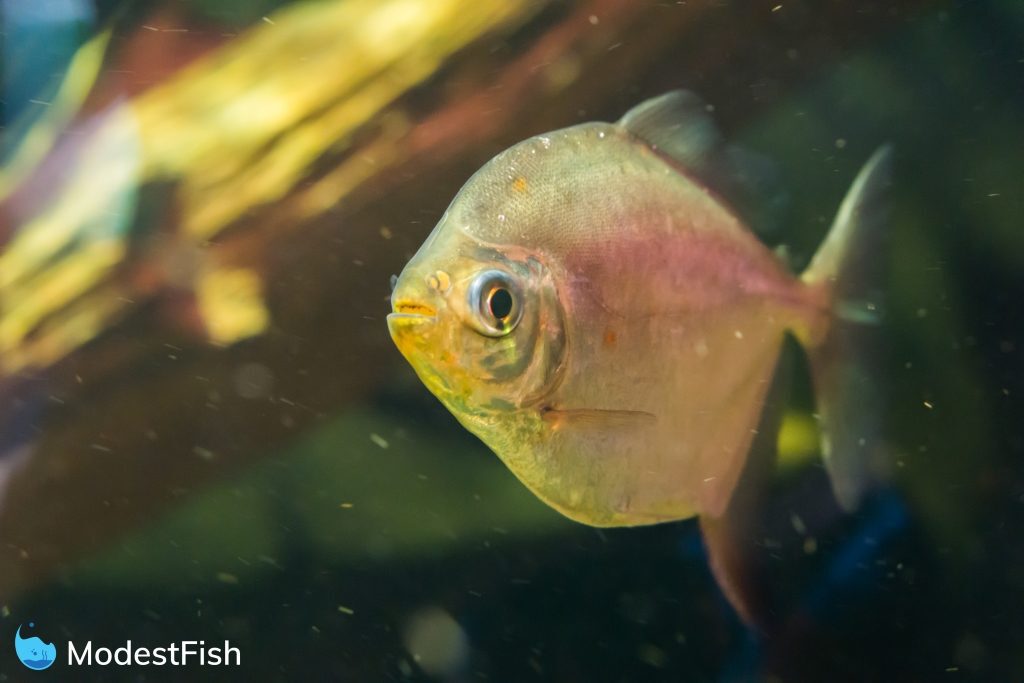
Best Aquarium Size for Silver Dollar
Like most fish in the aquarium trade, the silver dollar fish you see at the live fish store are small juveniles, nowhere near their full adult size.
This species gets pretty big, and they should be kept in schools of five or more, so they require a fairly large tank.
I would recommend a 100 gallon (378 liter) tank as an absolute minimum.
The typical 100 gallon tank is 6 feet (1.83 meters) long, which is important for a fish this active. Silver dollars can really zip through the water. They need the long footprint of a 100 gallon tank so they have the room to maneuver.
For bigger varieties, like red hooks, you need at least a 125 gallon (473 liter) tank. Do your best to research the species you’re going to buy so you know just how big they’ll be when they’re adults.
Fish like this are a pretty big commitment.
Filter
For a fish this size, I would really recommend adding as much filtration as you can. Silver dollars are large and active fish, which means that they put off a lot of waste.
As fish waste breaks down in your tank, it puts off ammonia (NH3). This is a bad thing since even a small amount of ammonia is toxic to fish and invertebrates.
Lucky for us fishkeepers, there are beneficial bacteria that live in our filters. One kind eats ammonia and turns it into nitrite (NO2 -1), another toxic byproduct. But then another species of bacteria eats the nitrite and puts off something called nitrate (NO3-).
This whole process is known as the aquarium nitrogen cycle.
Nitrate is much less toxic and can be allowed to build up in the aquarium in between water changes.
But, you need a filter with the capacity to process all that waste. The filter needs to be large enough to house a substantial population of beneficial bacteria.
And it needs to be able to pump enough water so dissolved wastes come into contact with the bacteria.
Without a big enough filter, rotting waste will put off deadly ammonia as it breaks down in the tank, eventually killing your fish.
Pro Tip: The beneficial bacteria you need for your tank doesn’t show up instantly. For steps on how to get your tank properly set up and establish a colony of beneficial bacteria so it’s safe for fish, follow these steps.
So how do you know what to look for when you’re buying a filter?
Filters have ratings for the size of tank they can handle, it’s called gallon per hour (GPH). The GPH lets you know how many gallons of water the pump can move in an hour.
Normally you want a filter that has a GPH that is at least 4 times the volume of the tank. So, if you had a 10 gallon tank, you’d want a filter with a GPH of 40.
So, for a 100 gallon tank, you would want a filter with a GPH of at least 400.
You can see our reviews for aquarium canister filters here.
Heater
A heater is an absolute must if you’re going to keep silver dollars since they’re a tropical fish and need a stable water temperature between 75° and 82°F (24°-28°C).
See reviews for safe and reliable aquarium heaters here.
Powerhead
A powerhead is an extra water pump that goes inside your tank and helps add some extra water flow.
OK, this one is a bit of an extra instead of a necessity, but it really can help your fish thrive.
Silver dollars will appreciate having a gentle current in the tank that they can swim against. This helps mimic their natural habitat since they are riverine fish.
Plants and Decorations for Silver Dollar
Silver dollars love plants.
And by that, I mean they love to pull them up by the roots so they can destroy and eat them.
Since these guys are almost completely herbivorous, any live plants in the tank will be seen as a tasty snack.
So, if you have your heart set on a gorgeous aquascape with lush live plants, these are not the fish for you.
However, it is a good idea to provide tall artificial plants. Silver dollars can be nervous fish and tall plants give them a place to take cover.
Other than the artificial plants towards the back, the tank should be dedicated to open swimming areas. Silver dollars are very active swimmers that need lots of space to maneuver in.
Lighting
These fish really prefer a dimmer lighting with some shadowy areas that they can retreat to.
They’re not the kind of fish that swims into a cave to find cover. For this species, areas of deep shadow makes them feel like they have a secure place to hide when needed.
Water Parameters
- Temperature: 75°-82°F (24°-28°C)
- Ammonia/Nitrite: 0
- Nitrate: <30 ppm
- pH: 6.0-7.0
- GH: at least 6 dGH (100 ppm)
- KH: at least 3 dKH (53 ppm)
Silver dollars come from waterways that have extremely soft and acidic waters, with a pH between 3.8 and 5.4.
Captive bred fish can tolerate water conditions with a much higher pH, but they will still do best in acidic water contitions with a pH between 6.0 and 7.0.
Although the mineral content in these waters is low, it’s still important to maintain a proper GH (general water hardness) and KH (carbonate hardness).
KH will help stabilize your pH and keep it from suddenly dropping too low. I recommend that you maintain a pH of at least 3 dKH (53 ppm).
It’s best to maintain a GH (general water hardness) of at least 6 dGH in your tank.
Even soft water loving fish like silver dollars need calcium and magnesium in the water to replace what their bodies use up and to maintain a healthy osmoregulation, the movement of water in and out of their cells.
Feeding Silver Dollars
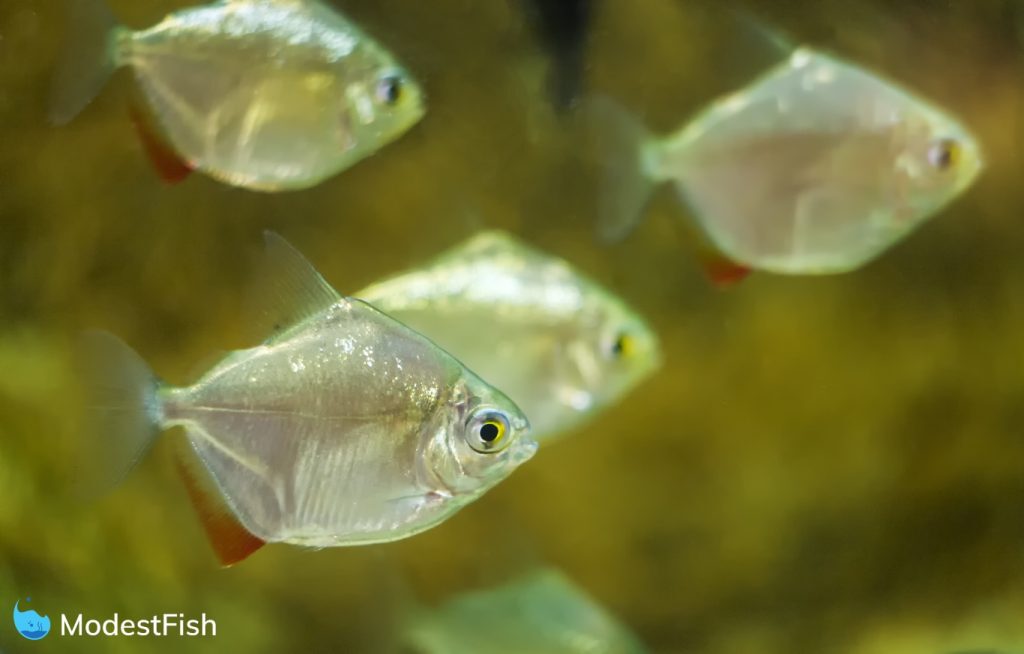
Although silver dollar fish are related to piranhas, and other carnivorous fish, they are classified as herbivores.
They cruise along the edges of their river habitats in big schools and munch on the plants growing there.
Silver dollars will eat tiny fish and invertebrates that they come across, but they don’t actively hunt these critters down.
Since they have evolved to eat a mostly plant-based diet, their need for protein is much less than their carnivorous and omnivorous cousins.
It’s more important to offer them a varied diet with lots of different vegetables and algaes than it is to pack their meals full of protein.
What Foods for a Silver Dollar Fish?
The staple diet for your silver dollar fish should be a pelleted or flake food that is designed for herbivores:
- Omega One Veggie Kelp Flakes
- Spirulian 20
- Fluval Vegetarian Flakes
You can supplement their diet with things like:
- Squash
- Green peas
- Carrot
- Omega One Veggie Rounds
- Cobalt Aquatics Algae Grazers
How Often Should You Feed Dollar Fish?
It’s best to feed silver dollar fish 2-3 times a day.
They are very active fish. In nature, they would be grazing on plants constantly, kind of like a cow that’s always grazing on grass.
So multiple feedings throughout the day better mimics what they would do in nature.
If that seems like too much for you to handle, don’t worry! You can add an automatic feeder to give your silver dollars a snack when you’re not home.
Best Tank Mates for Silver Dollars
One thing is for sure, you shouldn’t own just one silver dollar fish.
These guys are pretty skittish to begin with. They will be super nervous all the time if they don’t have a big enough group.
Plan on keeping at least a group of five. More is always better if you can swing it.
Silver dollars feel more secure in a bigger group. Then they know they have enough sets of eyes to look out for danger.
But No Nano Fish
OK, silver dollar fish are generally super peaceful and don’t bother anybody.
But, they may still eat fish that are really tiny. A fish that they can easily swallow whole may just be too much of a temptation to pass up.
So don’t mix full size silver dollar fish with tank mates that are tiny. Keep away from fish like: chili rasboras, neon tetras, Endler’s guppies, basically, any super small nano fish that is less than an inch long.
Silver dollars may also eat fry. It’s best to count on moving breeding fish out of the main display tank.
Good Community Fish
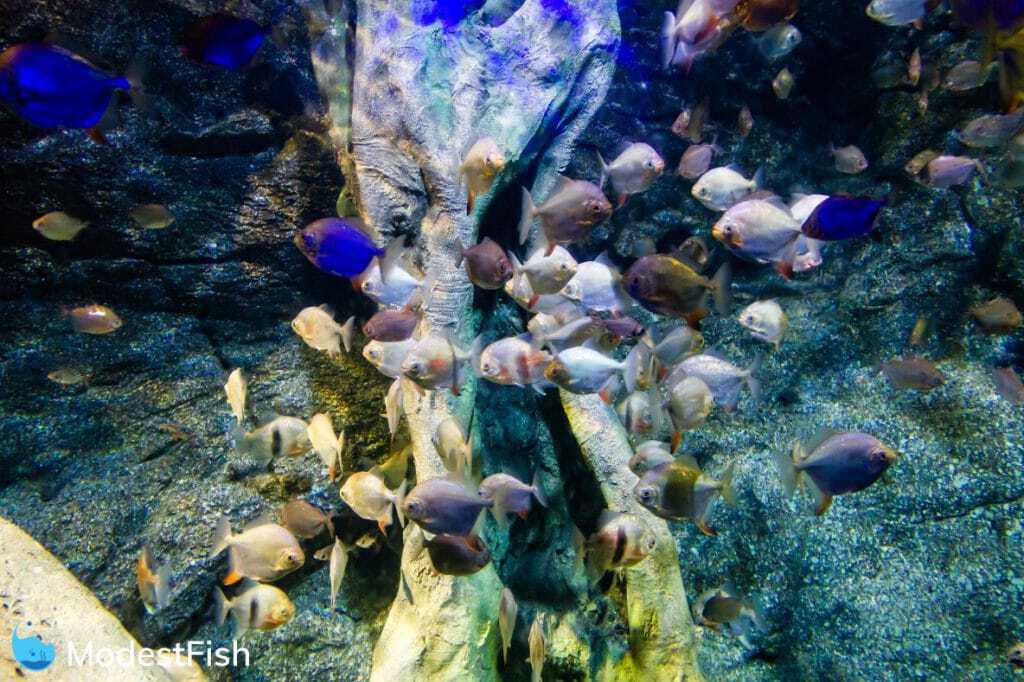
If you want to keep them in a community tank, their tank mates for should be large enough that they don’t look like dinner, but peaceful enough that they don’t beat anyone up.
Blue acara – these bright blue South American cichlids get about 6 inches (15 centimeters) long and are fairly peaceful as long as they’re not spawning.
Green severum – severums are a disk shaped South American cichlid that grow up to 8 inches (20 centimeters). Severums also come in a golden variety and have a lot of personality. They’re one of my all time favorites.
Angelfish – these beauties of the cichlid world are also from South America and would do well in a large tank with silver dollars. Any of the different color variations available will be a good match.
Yoyo Loaches – these quirky little bottom feeders are a great addition to a cleaning crew and usually grow from 3-5 inches (7.5-13 centimeters). They also need to be kept in a school of at least five or more.
Plecos – just about any species of pleco is compatible with silver dollar fish. They come from the same part of the world and need similar conditions. Just be aware that some species, like the common pleco, get really big and can add a lot to your bioload.
Nerite snails – silver dollar fish will eat tiny snails, but nerites are too large for them to snack on. There are several species of these gorgeous invertebrates available in the trade and they’re awesome algae eaters.
One thing to mention, cichlids can make good tank mates for silver dollars, but most species of cichlids become absolute holy terrors when they are spawning. Even small cichlids can harass and bully much larger tank mates to death.
It’s not a good idea to have homicidal cichlid parents in a community tank with them.
The best way to prevent this is to keep only single members of a species in your tank.
Another sound method is to keep the tank at a slightly lower temperature. A lot of South American cichlids won’t be triggered to spawn in cooler water and will be less aggressive overall.
The colder water will literally chill them out.
If only that worked on people, just think what we could accomplish with air conditioners and ice water.
Breeding Silver Dollar Fish
It is possible to breed silver dollar fish in an aquarium. They can lay thousands of eggs at a time, so be prepared!
Sexing Silver Dollar Fish
Female silver dollars have a straight anal fin that usually shows little to no color.
Males have a more rounded anal fin that often has a red leading edge or red and black bars.
Males may also develop black splotches behind their gills when they’re revving up to spawn.
Conditioning Fish
To get silver dollar fish ready for spawning, offer more meaty foods, like frozen bloodworms and brine shrimp.
Male silver dollars will start to get pronounced red and black bars on their anal fins when they’re ready for spawning.
This is a good time to move a male and female to a separate 55 gallon (208 liter) breeding tank.
The breeding tank should have tall artificial plants. In nature, silver dollar fish lay their eggs at the base of tall plants. So the fake plants will help make the fish more comfortable.
The Mating Process
The male will begin to chase the female. He will swim very close to her and wrap his anal fin around hers.
The female releases her eggs and the male fertilizes them. The pair then shakes as they seperate to scatter their eggs.
They will scatter about 20 eggs at a time for hours. Up to 2,000 eggs may be laid at a time.
Raising Fry
Once the eggs are laid, it’s best to remove the parents back to the main tank. The eggs will hatch in 3-4 days.
The fry should be fed finely ground brine shrimp and powdered spirulina.
Are Silver Dollar Fish Right For You?
Fish keeping is an excellent hobby, and there’s nothing like a school of adult silver dollar fish darting around a tank.. It’s easy to see why they’ve been so popular tropical fish in the aquarium trade for decades.
They’re a really hardy species of fish that is beginner friendly, but they’re still not for everyone.
Adult silver dollars require a very large tank, at least 100 gallons (378 liters). If you’re not able to provide them with a tank of that size, it’s best to go with a different species of fish.
This active fish may be related to some of the most fearsome freshwater fish on the planet, but they are actually gentle giants who mostly eat plants.
They are skittish fish that will thrive in a calm environment that has an assortment of shaded areas so they can hide when they feel threatened.
Although they do require you to maintain a large tank, these gorgeous fish really are worth it. Their striking silver color and schooling behavior makes them an impressive centerpiece fish well worth the effort.

Hello,
Happy New Year,
Really enjoyed reading your article. Thanks for sharing. Have loved tropical fish for years. Finally decided to give it a go again. Have 4 silver dollars bought small, they are so grown now. Two tetra’s and one medium sized algae eater. I’m feeding the silver dollars Tetra tropical flakes the algae eater Algae eater Algae Thins. Low and behold I noticed the algae eaters started eating the Algae Thins as well. I thought it was the nearest thing. Only have 36 gallon tank.