

Pothos is a very easy plant to grow in aquariums and is an excellent addition to any aquascape.
And one I love to incorporate into my tanks.
In this guide, I’ll walk you through how to grow and care for pothos in your own tank. Including, how to place, plant, propagatem and maintain this visually stunning plant in your aquarium.
Pothos Plant Quick Care Stats
- Scientific Name: Epipremnum aureum
- Family: Araceae
- Order: Alismatales
- Genus: Epipremnum
- Care Level: easy
- Growth Rate: medium
- Maximum Size: 6.5 feet (2 meters)
- Water Conditions: pH range of 5.0-8.0, temperature 63°-86°F (17°-30°C)
- Lighting: low to medium
- Propagation: cutting
- Tank Placement: emersed
- Common Names: devil’s ivy, silver vine, devil’s vine, taro vine, hunter’s robe, golden pothos
Table of Contents
Pothos (Epipremnum aureum) Overview
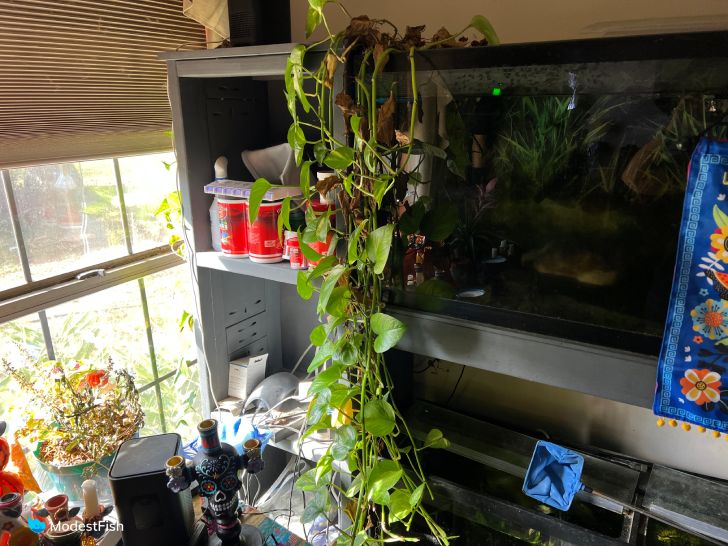
Pothos is an extremely common house plant. You know that vine that people grow out of little cups of water all around their kitchen window?
Yep,that stuff, that’s pothos.
Funnily enough, the common name pothos is extremely inaccurate. Pothos is a genus of plants native to Asia and the Pacific Rim.
The houseplant we all know as pothos was originally classified under that genus, but after further study, scientists reclassified it, instead placing it in Epipremnum.
But, I guess the common name just stuck around anyway.
So, since it’s the most widely used name for this plant, for the sake of clarity, I’ll just call it pothos, too.
This tenacious vine is native to the islands of French Polynesia. In the wild, it clings to trees, using them as support as it grows towards the sun. It can reach heights of 66 feet (20 meters).
It also sends down trailing vines that grow along the ground. These vines put out roots that attach themselves to trees, rocks and even grow down into the soil.
As a houseplant, pothos can be grown rooted in soil or emersed, meaning the base of the plant is submerged in water and the top of the plant grows out of the water.
In an aquarium setting, pothos is really useful because it feeds directly from the water column, removing nitrate and other wastes and lessening the need for water changes. The roots that grow in the tank also provide hiding spots for small fish and ornamental shrimp.
The base of the plant is stuck down into the top of the aquarium, and the vine climbs its way out of the water and then hangs off the side of the tank.
I find the trailing vines coming out of the aquarium to be quite beautiful. I’ve incorporated pothos in several of my tanks with great success.
While pothos is not harmful to aquarium animals, it is toxic to cats and dogs! Please, be careful to keep pothos vines out of the reach of your household pets.
Caring for Pothos In Aquarium
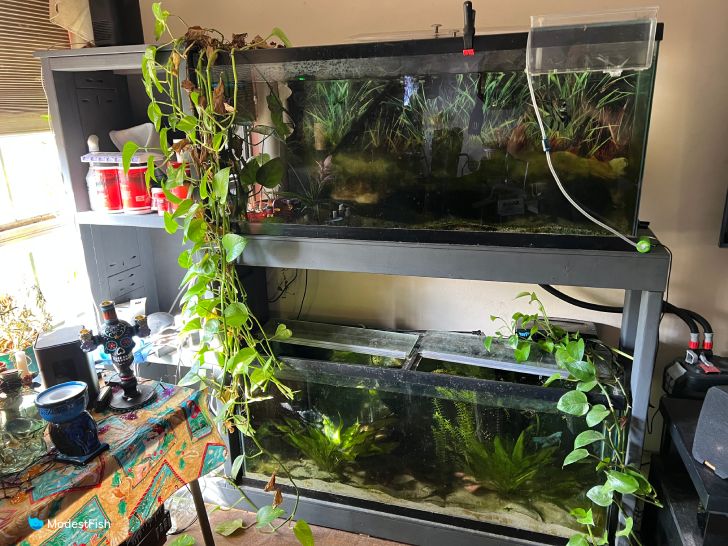
Pothos is extremely easy to care for; it is hardy and undemanding.
Tank Requirements
Pothos plants can get quite large. The end that is in the tank will put out a bushy cluster of roots that takes up room inside the aquarium.
Because of this, I would recommend keeping it in at least a 30 gallon (113 liter).
For smaller tanks, I would recommend using a Peace Lily instead of pothos.
Water Parameters
- Temperature: 63°-86°F (17°-30°C)
- pH: 5.0-8.0
- dGH: 2-15
Lighting Conditions
Pothos plants do best with low to bright indirect light. If they are exposed to direct sunlight for too long, their leaves will burn and die.
This plant can easily be grown just by placing it near a sunny window or in the light of a desk lamp.
The giant pothos plants that grow out of my 55 gallon (208 liter) tanks thrive in the indirect light coming from a southern facing bay window.
Substrate & Fertilizers
Pothos can be rooted in the substrate in the aquarium, but most aquarists don’t do this.
It’s much simpler to submerge one end of a pothos vine 6 inches (15 centimeters) into the water and let it grow without substrate.
Pothos plants don’t require fertilizers, but if you’re already dosing fertilizers for other plants in the tank, they’ll grow even quicker.
Maintenance & Trimming
Occasional trimming is all that this plant requires. You can trim back the vines and roots with simple plant scissors.
I’ve been using the ones from this set for several years, and I really like them.

How to Plant Pothos in your Aquarium
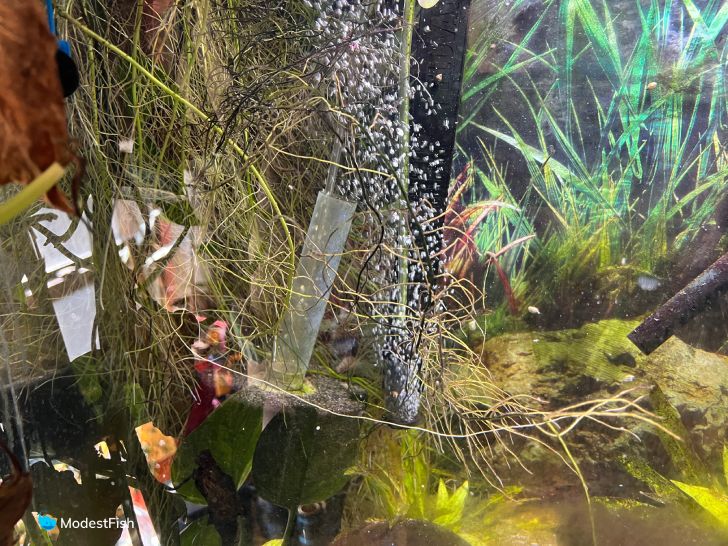
In my experience, the best way to plant pothos in your aquarium is to use a holder, something that attaches to the back or side of the tank that will keep the vines from floating to the surface.
The biggest pothos plant I have is growing out of a heater guard that I attached to the back of the tank with suction cups.
Because they’re the kind of suction cups that are meant for heaters, instead of the little clear ones that crap out after a few months, the plant has been held securely against the back of the tank for a very long time.
I stuck two vines down into the heater guard about 3 years ago, and they’ve been growing like crazy ever since. The vines are over 7 feet long (2.1 meters) and the roots have grown out into a bushy beard through the holes in the heater guard.
Every few months, I trim a few feet of vine off the ends.
If you only want to plant one or two vines, I can vouch that this heater guard will hold them in place long term.

There are also plant holders available that hook over the side of the tank.
I particularly like the one made by MyFatBoss because it has a sliding panel that lets you take the plants back out without disturbing their roots, something that you can’t do with the heater guard.
This holder has room for five vines. The roots will dangle down into the water below.
Just make sure that you get the right version for your tank; one version is meant for rimless tanks and the other is for rimmed tanks.

How to Propagate Pothos
It’s very simple to propagate a pothos plant. All you have to do is cut off several inches of vine. Place the cutting into a container of water. After a week or so, roots will start to emerge from the cutting.
You can keep the rooted cutting in water or plant it in a pot with soil.
If you keep your new pothos plant in water, change the water out twice a week.
How to Use Pothos in Aquarium
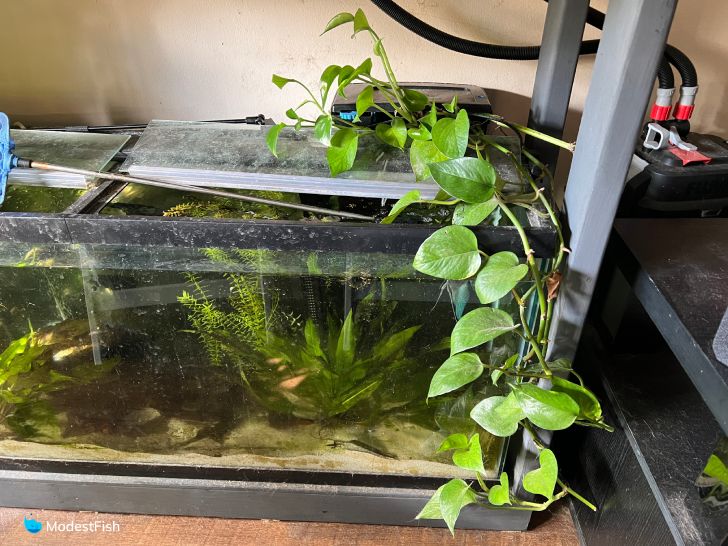
Pothos is best used as an emersed plant at the back or side of the tank. It makes an excellent addition to the biofilter of your aquarium.
Especially once they get large, the vines can remove a lot of ammonia and nitrate from the water column.
Tank Mates for Pothos
You can keep a pothos plant in just about any aquarium.
Small fish, snails and shrimp will explore the roots and feed off algae that grows on them.
Some Goldfish and large cichlids may try to eat the roots. There’s no way to tell for sure unless you try. I had an entire community of large South American cichlids that never touched the pothos roots.
But then, I had a female green severum that would destroy pothos, or any other plant in the tank, with extreme prejudice.
You just can’t tell for sure which fish will tear up your pothos, and which won’t. Luckily, pothos is cheap and plentiful. If your cichlids decide to rip it to shreds, it doesn’t cost very much.
Also, if you keep the pothos in the heater guard, fish might be able to get roots that stick out of the guard, but they won’t be able to get at what’s growing inside the guard.
Is Pothos Right for You?
Growing a pothos plant in your aquarium is very easy. I love the look of the long trailing vines flowing down the side of the tank.
On top of being aesthetically pleasing, the vines feed directly from the water column, eating up waste compounds, like ammonia, nitrite and nitrate.
The roots can also provide hiding places for shrimp, snails and small fish.
I highly recommend this plant. It’s so pretty and adds a nice extra visual element to your tank, in my opinion.
I hope you find this article helpful.
I wish you and your fish the very best!
