

The Bubble Eye Goldfish is one of those creatures that make you wonder how it can even exist. With its distinctive looks and physical attributes, it makes for a truly unique addition to any aquarium.
However, the same qualities that set it apart from others cause it a ton of problems. That’s why it’s imperative you know how to properly take care of this fish before you go ahead and purchase it.
That way, you can provide it with the best possible environment and conditions while it’s spending its days in your tank.
Overview: Origin & Appearance Of The Bubble Eye Goldfish
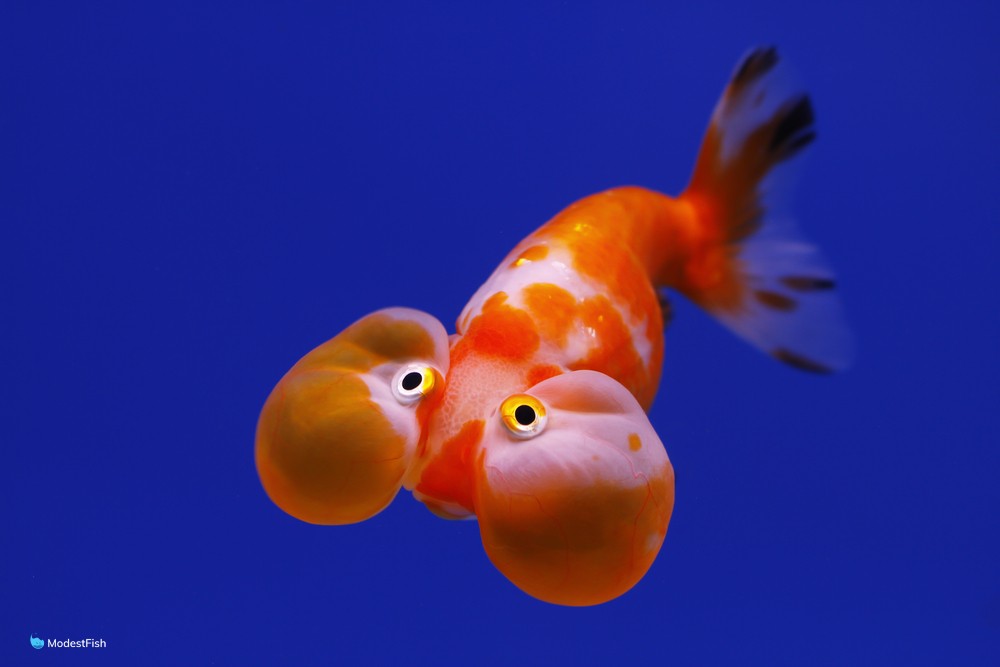
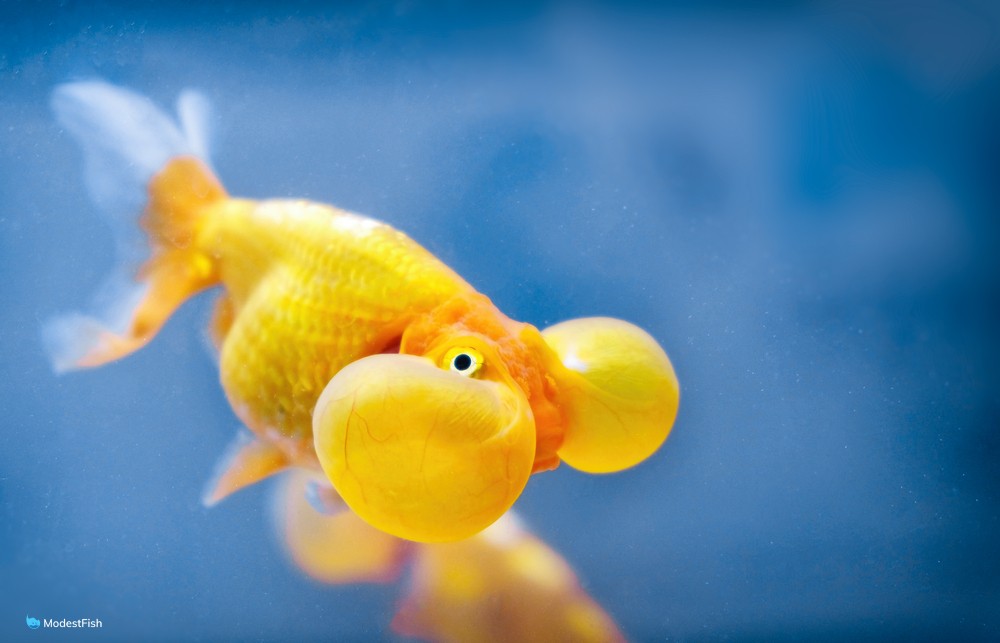
The Bubble Eye Goldfish is one of the more amusing fish to look at with their cartoonish eyes. The presence of two large fluid-filled sacs directly below its eyes makes it seem like a caricature with its eyes popping out its head.
Unfortunately, the bubbles weigh its head down, making it difficult for the fish to move, especially when they get too big.
One more thing that’s special about its appearance is its lack of a dorsal fin. This, coupled with its eye sacs and upturned eyes, makes it unbalanced and unable to swim with agility and finesse. It does have a double tail to compensate for its problems, but it’s not quite enough.
It usually grows up to 4 or 5 inches, developing a more rounded body shape than the common Goldfish. It can come in all sorts of colors and color combinations. Red, orange, gold, white, black, and calico Goldfish are all available in most pet stores for quite a small sum, though the black ones are pretty rare. Matte, metallic, and nacreous varieties are also available nowadays.
These fish don’t breed in the wild. They’ve been explicitly bred in China in the 1900s as part of their fancy Goldfish breeds. It’s believed to be a descendent of the Toadhead/Hamatou fish, which is quite similar to it but without the over-pronounced eye sacs.
More recent varieties of the Bubble Eye include ones with four eye sacs instead of two, though it makes us wonder how it can even swim at this point.
Care Stats Overview
- Tank size: 10 gallons
- Temperature: 65 – 72 °F (18 – 22 °C)
- pH: 6 – 8
- KH: 5 – 19
- Living zone: All tank levels, preferring the bottom
- Temperament: Peaceful
- Diet: Omnivore
Scientific Classifications
- Kingdom: Animalia
- Phylum: Chordata
- Class: Actinopterygii
- Order: Cypriniformes
- Family: Cyprinidae
- Genus: Carassius
- Species: c. auratus auratus
Bubble Eye Goldfish Lifespan
Most Bubble Eye Goldfish live from 10 to 15 years when properly taken care of in aquaria. Some owners even reported this fish can for over 20 years.
The less stress this fish is exposed to, the longer it can live. That means consistently providing it with a good, balanced diet, as well as optimal water conditions.
Sexual Dimorphism: Size & Coloration
You can’t distinguish between the males and females of this species until they have fully grown and become ready to mate.
Then, you’ll find the males to be thinner and smaller than the females, who are on the more rotund side. Moreover, only the males develop small, white tubercles/spikes on their heads and gill coverings when they completely mature.
Why Does a Bubble Eye Goldfish Have the Bubble?
Back in 1908, China created this Goldfish by selectively cross-breeding certain species. This resulted in a genetic mutation that brought about the development of two eye sacs below the fish’s eyes that grow in size as the fish grows in age.
Initially, these eye sacs aren’t present but come into existence three months after the eggs have hatched. Then, a lymph-like fluid fills these eye sacs, which continue getting bigger until they reach their maximum size in 6-9 months.
What Happens if a Bubble Eye Goldfish Pops?
There is good news and bad news. The good news is that the bubbles can heal and regrow if damaged. The bad news is that these bubbles are very susceptible to infection. If that happens, the injury won’t resolve, and the fish can die if the infection persists.
Even if the wounded tissue doesn’t become infected, the new bubble can grow to a size unequal to the original one. This asymmetry ruins the fish’s appearance and may cause more swimming troubles because of the unequal load on either side of its head.
Bubble Eye Goldfish Care & Tank Set-Up
Tank Size & How Many Can Be Kept Together
A Bubble Eye Goldfish can be kept by itself or as part of a group. The only thing that you need to account for is its notable waste production.
That’s why a single Goldfish should be kept in a 10-gallon tank, at the very least. 20 and 30 gallons are even more preferable because you won’t have to change the water as much.
For young Bubble Eye Goldfish, you are required to provide 1 gallon of space for every inch of their body. This ensures that they have enough space for swimming and sufficient oxygen levels. As the fish grow older, this rule is no longer applicable as their oxygen demand increases.
Therefore, a better rule for the adults is 10 gallons of space for every single fish. That way, they can get all the oxygen they need, and their growth isn’t stunted nor their health affected in any way.
Some Goldfish may jump outside the tank, so get one with a tank cover just in case. Even if your fish isn’t a jumper, the cover has the added benefit of decreasing water evaporation, so it’s still a good thing to have around.
The Nitrogen Cycle
As most aquarists know, the nitrogen cycle is an integral part of any tank that controls the ecosystem the fish lives in. The breakdown of wastes and debris into ammonia, which is consecutively broken down into nitrite and nitrate, is an ever ongoing process that should be constantly controlled and monitored.
The fish can become afflicted with many illnesses if this cycle isn’t properly executed from start to finish with the eventual elimination of the produced toxic nitrogenous substances.
Like we previously mentioned, this species generates more waste than the average freshwater fish. It’s also more sensitive to contamination and poor water conditions.
Therefore, it’s vital that you clean the tank and change the water frequently. You should change about 25 percent of the water once a week. This ensures that your ammonia, nitrite, and nitrate levels are under control and aren’t toxic to the fish.
To know how to establish a bacterial colony capable of fully breaking down wastes and the resultant toxins, take a look at this article. You’ll find everything you need to know about the nitrogen cycle and cycling your tank over there.
Water Parameters
- Temperature: Bubble Eye Goldfish are cold-water fish like the other Goldfish species. However, they can’t survive in temperatures below 60 °F. So, make sure to stay in the 65 – 72 °F (18 -22 °C) range.
- pH: They can tolerate a relatively wide pH range, starting from 6 and ending at 8.
- KH: A carbonate hardness of 5 – 19 degrees is the sweet spot for this fish.
- Hardness: Moderately hard waters are best for this fish. Make sure your overall water minerals aren’t too low or high.
Tank Set-Up
With Bubble Eye Goldfish, the less stuff in the tank, the better. This is to reduce any dangerous objects that can accidentally puncture their bubbles.
You can scatter some rocks, driftwood, and plants like Java Fern and Anacharis if you really want to. Just ensure that they’re all blunt and smooth.
However, this goldish can uproot live plants as it’s searching for food. So, get artificial plants instead, preferably made of silk, as they’re much safer than those made of plastic.
As for the substrate, anything will work. Sand is okay, so is medium-sized gravel. The gravel can help create more of a natural-looking environment, but make sure there are no sharp particles that can harm the fish during its search for food at the bottom of the tank.
Considering that they aren’t good swimmers and have terrible eyesight due to their upturned eyes and enormous eye sacs, they need all the help they could get. This translates into having moderate to strong lighting to help them see and navigate the tank better.
The most important thing you need to set up is the water filtration system. Under-gravel filters are usually the favored option with Bubble Eye Goldfish. That’s because all its components stay out of this delicate fish’s way. With regular filters, the fish can easily get sucked into siphons and filter intakes, leading to the rupture of its eye sacs.
If you don’t have an under-gravel filter, then covering your filter’s intake valve with a sponge or foam prefilter can circumvent this problem. Also, keep in mind that these fish are bad swimmers. This means that they tend to flail and struggle with strong currents, so minimal water flow is the way to go.
Diet & Feeding
Bubble Eye Goldfish don’t really require a complex feeding regimen. They can eat anything offered to them and can survive just fine on quality fish food.
Opting for sinking pellets rather than flakes as these fish may accidently ingest air which can consequently lead to health problems.
To add variety and protein to their diet, you can feed them live or frozen food. Daphnia, brine shrimps, bloodworms, and tubifex worms are all great options. Blanched vegetables can also be offered from time to time.
Try to account for their terrible sight by giving them a little longer to find and eat their food. Also, try to feed them several times a day (2-4 times) to ensure they get all the nutrients they need. Oh, and keep an eye on them as they’re eating to make sure no other fish breeds are stealing their food.
Bubble Eye Goldfish Behavior & Compatibility
Bubble Eye Goldfish are some of the most laid-back fish that exist. They’re incredibly peaceful and sociable and would fit in with most aquatic creatures if not for their physical shortcomings.
Since they can’t swim well due to their rounded body shape and missing dorsal fins, they are extremely slow and prone to injury. That’s why you can’t house them with any fish that are fast or aggressive.
They’ll either outcompete them for food, leaving them to starve or injure their delicate eye bubbles. Also, avoid bottom-dwellers as Goldfish spend most of their time at the bottom searching for food.
You can either pair this fish up with its own species or with breeds with similar limitations and activity levels. Lionhead and Celestial Goldfish are one such type as are Telescope Goldfish and Black Moors.
You can also keep them with peaceful shrimps and snails. They’ll leave them alone as long as they’re well-fed.
Breeding Bubble Eye Goldfish
Breeding this species isn’t too difficult as long as you provide them with the right conditions. Since most Goldfish spawn in the spring, gradually bringing up the temperature from 60 to about 68 °F will make these fish think that spring has come and they’ll go into breeding mode.
The male will start following the female around for a few days till he pushes her against a plant/spawning mop.
Then, she’ll release her eggs so that the male can fertilize them. However, Both parents start targeting and eating the eggs once the male finishes. That’s why you have to remove the adults after they’ve completed the process.
In a few days, the eggs hatch, and the baby Goldish emerge looking nothing like their parents. They’ll have a dark color that helps them hide and will develop their true colors after a few months have passed.
The same goes for the eye bubbles, which don’t exist when they’re born but form later on.
Will You Pick The Bubble Eye Goldfish?
All in all, the Bubble Eye Goldfish is truly unique and is very charming in its own way. However, it can be a bit hard to maintain if you’re a beginner.
If you’re certain that you can meet its needs and demand, then go ahead and get one. It’ll definitely be the show-stopping piece of your tank for years to come.
