

In this guide, I’ll help you choose the best pond plants for you. I’ll review the most popular plants people use so you can make an informed buying deicsion.
Quick overview For Pond Plants
All these plants I mention could be considered the best pond plant. They’re all great and what you should do, is mix and match your favorite ones.


Best Pond Plants Reviewed
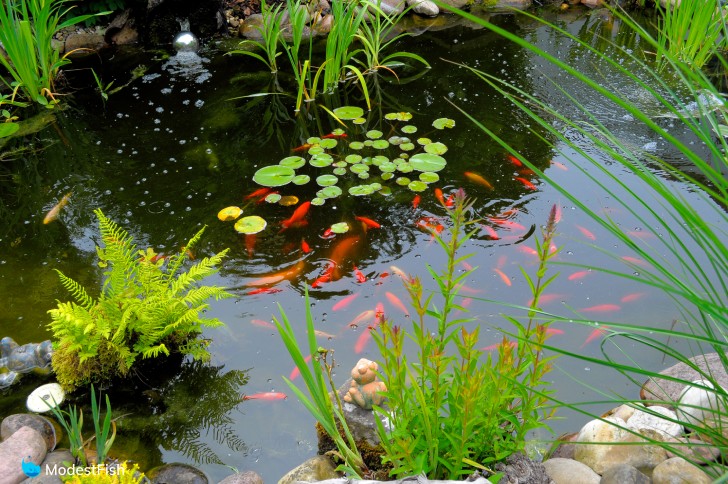
Let’s get started and review good plants for your pond
1. Blue Pickerel (Pontederia cordata)
- Type: bog/marginal
- Perennial or Annual: perennial
- Hardiness zones: 3-10
- Care level: easy
- Small pond friendly: spreads easily so may be better for larger ponds
- Flowering: yes
Blue pickerel has thick stems that shoot straight up from the substrate. Broad, pointed leaves flare out near the top of the stalk and most of them will be topped with an inflorescence of purple flowers. This hardy plant thrives on neglect but may aggressively spread shooting out runners from its rhizome. Keeping it in containers instead of direct planting can keep it from spreading.
2. Creeping Jenny (Lysimachia nummularia)
- Type: bog/marginal
- Perennial or Annual: perennial
- Hardiness zones: 3-9
- Care level: easy
- Small pond friendly: yes
- Flowering: yes
Creeping jenny (aka moneywort) is a low-lying plant with cascading stems covered with penny-sized round leaves. Throughout the warmer months it will put out bright yellow flowers. This plant does best when planted just along the water’s edge so that it always stays wet. It’s really easy to care for and will die back in winter and emerge again in spring within its hardiness zones.
3. Cardinal Flower (Lobelia cardinalis)
- Type: bog/marginal
- Perennial or Annual: perennial
- Hardiness zones: 3-9
- Care level: medium
- Small pond friendly: yes
- Flowering: yes
Cardinal flower grows as a bunch of upright stems covered in finger-length pointed leaves. It puts out absolutely gorgeous inflorescences of blood red flowers.
This is a great plant to add if you want to attract butterflies and hummingbirds. You will need to do a little deadheading and pruning to keep it looking its best, so I give it a care level of medium.
4. Horsetail Reed (Equisetum hyemale)
- Type: marginal
- Perennial or Annual: perennial
- Hardiness zones: 4-9
- Care level: easy
- Small pond friendly: can spread aggressively, plant in pots for a small pond to keep it contained
- Flowering: no
Horsetail reed shoots up straight stalks that grow in sections, much like bamboo. In fact, if you like the look of bamboo, you’ll probably love this plant. This marginal plant likes to grow dense clusters of reeds along the shoreline.
The reeds sprout up from a central rhizome under the water. This plant loves to spread, so it will need to be kept in pots or else it will quickly start taking over. Depending on the available light, it can grow between 2 and 6 feet tall (0.6-1.8 meters).
5. Northern Blue Flag Iris (Iris versicolor)
- Type: bog/marginal
- Perennial or Annual: perennial
- Hardiness zones: 3-9
- Care level: easy
- Small pond friendly: yes
- Flowering: yes
If you’re at all familiar with regular garden irises, this blue flag is very similar in appearance. It shoots up a cluster of sword-shaped leaves from a central rhizome. The leaves can reach up to 2 feet (61 centimeters) and are a beautiful shade of soft blue green.
As attractive as the foliage is, the blooms each spring are simply spectacular. They have large, delicate petals with yellow-orange throats and you’ll look forward to them every year. This plant is super easy to care for, it thrives on benign neglect.
6. Hornwort (Ceratophyllum demersum)
- Type: submerged
- Perennial or Annual: perennial
- Hardiness zones: 5-11
- Care level: medium
- Small pond friendly: yes
- Flowering: no
Hornwort is a fully aquatic plant that is popular for both ponds and aquariums. This plant does not grow typical roots; instead it feeds directly from the water column through its stems and leaves. So, it’s best to weigh it down by tying it to rocks or other heavy objects. It will put out long, thin stems that will grow until they reach the water’s surface, up to 8 feet (2.4 meters) long!
All along the stems grow pointy needle-like leaves that make the plant look like a bottle brush, or a racoon’s tail (hence the common name coontail).
Hornwort does a great job of oxygenating the water and makes an excellent shelter for young fish to hide in. It should be pulled up and trimmed back when cold weather starts to set in, which is the only reason I mark it’s care as “medium.” Otherwise, it is extremely simple to grow.
7. Anacharis (Elodea candensis)
- Type: submerged
- Perennial or Annual: perennial
- Hardiness zones: 6-10
- Care level: medium
- Small pond friendly: yes
- Flowering: no
Anacharis is very similar to hornwort in that it is a submerged plant that you just weigh down instead of planting in the substrate. It will also grow up to the surface of the pond. But it’s leaves are more broad so they don’t have the needle-like appearance that hornwort leaves do.
Anacharis is a fast growing plant that will help beat back algae by sucking up nutrients. It makes an excellent shelter for fish and will help provide oxygen in the water. But, you do need to pull it up and trim it back as winter sets in.
8. Water Lettuce (Pistia stratiotes)
- Type: floating
- Perennial or Annual: annual
- Hardiness zones: 9-11
- Care level: easy
- Small pond friendly: yes
- Flowering: no
Water lettuce is an interesting floating plant with a pretty darn apt name, it does look a lot like floating lettuce plants. It’s extremely easy to grow, simply place it on the water’s surface and let it do its thing. It grows long roots that hang down and take up nutrients directly from the water column.
It provides shade that helps keep algae at bay and the roots are great for small fish. It does not, however, tolerate cold weather whatsoever. It will die back at the first frost and need to be removed from the pond and discarded.
9. Water Hyacinth (Eichornia Crassipes)
- Type: floating
- Perennial or Annual: annual
- Hardiness zones: 9-11
- Care level: easy
- Small pond friendly: yes
- Flowering: yes
Water hyacinth forms floating mats of shiny leaves. Throughout the summer, it produces inflorescences of purple flowers with yellow throats. This is a very fast growing plant that is considered an invasive pest in many Southern states.
It helps fight algae by creating shade and eating up nutrients from the water column before algae can use them. It is a great home for baby fish that can hide among its roots and stems.
Water Lilies
I have to admit some bias here, for me, the whole reason to have a pond is to grow water lilies. They’re widely popular, grown literally around the world, and are renowned for their beauty.
I have broken them off into their own section because there are so many different kinds and I thought it might be helpful if you just have some basic facts.
Then I’ll go over some of my favorites.
Deep Water Plant
Water lilies are true deep water plants. They grow from rhizomes that are planted in the substrate. They shoot up long stems, topped with floating leaves (lily pads), up to the surface of the water.
Hardy vs. Tropical
You will see water lilies listed as either “hardy” or “tropical.”
Hardy water lilies can live through cold winters as long as their rhizomes stay below the layer of ice in the pond. Their flowers and leaves will die back, but they will emerge again once the weather warms back up.
Tropical water lilies cannot survive in cold water. So you have to treat them like an annual plant and expect that they’ll die once cold weather sets on.
When they start to turn brown, you pull the plants out and discard them. Then you can plant new ones next spring.
10. Yellow Sensation Water Lily (Nymphaea sp.)
- Type: deep water
- Perennial or Annual: perennial
- Hardiness zones: 4-11
- Care level: medium
- Small pond friendly: yes
- Flowering: yes
Description: this variety puts out flat, dark green lily pads and stunning yellow flowers. It needs to be cut back to below the waterline before the pond freezes over in the winter. Other than that, this plant really doesn’t require much care.
11. Blue King Water Lily (Nymphaea geena)
- Type: deep water
- Perennial or Annual: annual
- Hardiness zones: 9-11
- Care level: medium
- Small pond friendly: yes
- Flowering: yes
This water lily is one of my favorites. It puts out large lily pads that tend to form a kind of ruffle around their edges. The flowers seem too gorgeous to be real. Just incredible. They’re a bright lavender with a yellow throat and a profusion of stamen that crowd the center.
12. Nymphaea alin
- Type: deep water
- Perennial or Annual: annual
- Hardiness zones: 9-11
- Care level: easy
- Small pond friendly: yes
- Flowering: yes
Nymphaea Alin has dark purple flowers with an orange throat. The center sports a ring of bright orange stamen that make a beautiful contrast to the purple petals. This is a tropical lily, so expect to pull it out of the pond and discard it when the weather turns cold.
Which Is Right For You?
I hope that I’ve given you some food for thought when it comes to the best pond plants.
There is nothing more gorgeous than a well kept pond with lots of different plants. Mixing the different kinds of plants, like marginals, floating and deep water, help make a pond look more natural.
Plus, they help provide a healthier environment for fish and other pond inhabitants.
