

Keeping an aquarium as small as a 5 gallon can be challenging. With a small water volume, it takes just a small error to throw your tank’s environment out of balance.
So, it’s important to pick the right livestock for a 5 gallon aquarium.
This guide will help you understand which fish and other critters are suitable, and the best fish for your 5 gallon tank.
1. Chili Rasboras (Boraras brigittae)
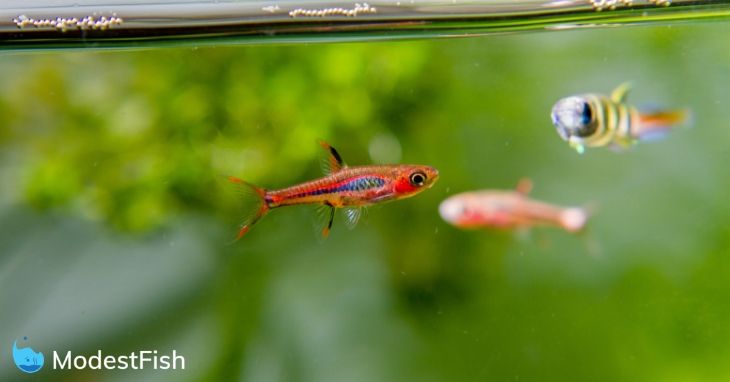
- Size: 0.5-0.75 inches (1.25-2 centimeters)
- Minimum tank size: 5 gallons
- Care level: easy
- Temperament: peaceful
- Schooling/shoaling fish: yes, needs to be in a group of 5 or more. For these fish, it’s the more, the merrier.
- Temperature: 68°-82°F (20°-28°C)
- Diet: carnivorous
These tiny fish would be my number one choice for a 5 gallon (19 liter) tank. They might be small, but their bright red coloration and interesting movements make a big statement.
Chili rasboras are one of the cutest things on Earth, in my opinion. They dart from place to place so quickly, it looks like they teleport. I don’t know how else to describe it, it’s so cool to watch.
These fish are simple to take care of, but they require clean water. Make sure that you are on a good maintenance schedule so that water gets changed out regularly. I usually recommend a 50% water change weekly.
2. Endler’s Livebearer (Poecilia wingei)
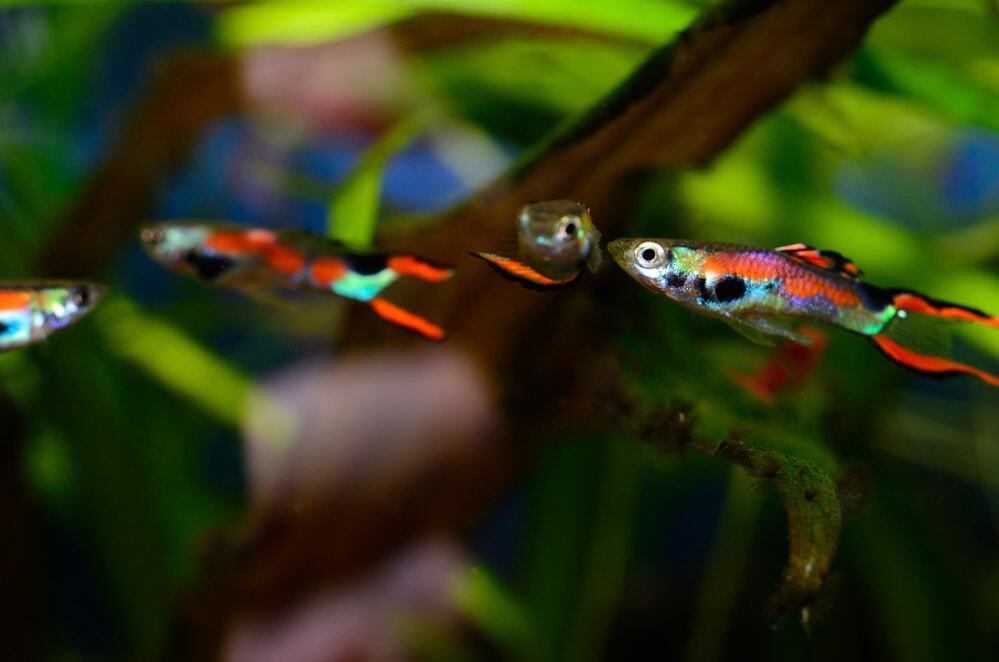
- Size: 1 inch (2.5 centimeters)
- Minimum tank size: 5 gallons
- Care level: easy
- Temperament: peaceful
- Schooling/shoaling fish: yes. I recommend keeping a male only group. Males are the most colorful and you won’t have to worry about your fish producing 8 million babies every month. If you want to keep males and females, you’ll need 3 females per male, and be prepared for a lot of fry!
- Temperature: 65°-82°F (18°-28°C)
- Diet: omnivore
Endlers are beautifully colored little fish that are related to guppies, mollies and platies.
They kind of look like you gave a small child some neon crayons and then asked them to draw you a picture of a fish; they’re so colorful and bright, they almost don’t look real.
I think Endlers are even more beautiful than fancy guppies because their bright colors and intricate patterns cover their entire bodies, not just their tails.
Since they are livebearers, they can produce dozens and dozens of babies every year. So, I suggest only getting male Endlers. It’s the males that are so brightly colored anyway, the females are a drab gray, so it’s no sacrifice to keep just boys.
3. Fancy Guppy (Poecilia reticulata)
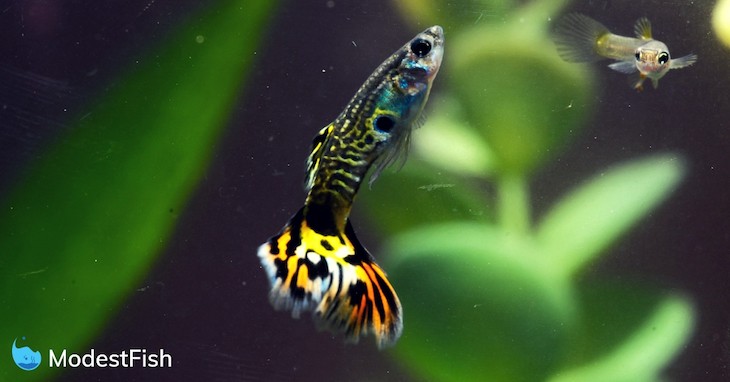
- Size: 1-1.5 inches (2.5-3.5 centimeters)
- Minimum tank size: 1 gallon
- Care level: easy
- Temperament: peaceful
- Schooling/shoaling fish: yes. I recommend keeping a male only group. Males are the most colorful and you won’t have to worry about your fish producing 8 million babies every month.
- Temperature: 72°-84°F (22°-29°C)
- Diet: omnivore
Fancy guppies are one of the most recognizable fish in the aquarium hobby. Males are brightly colored and females are a dull gray color.
Guppies are hardy and easy to take care of, but I recommend that you keep an all male school to avoid being overrun by baby fish. But, since the males are more colorful anyway, keeping only males is actually makes the tank more colorful and easier to take care of.
Yes, they’re a very common fish, but there’s a reason for this! Guppies are active and entertaining fish, as well as beginner friendly.
4. Betta (Betta splendens)
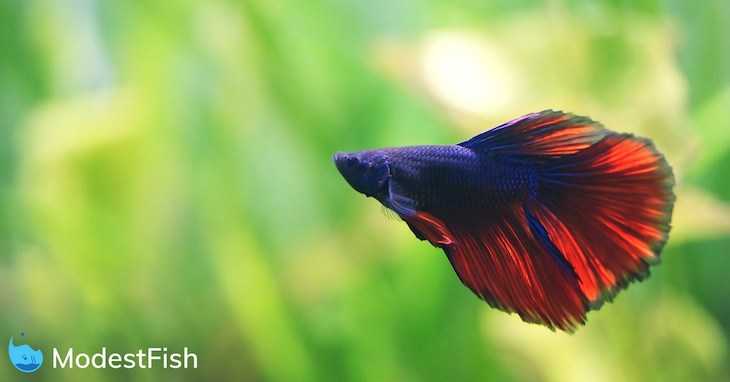
- Size: 2-3 inches (5-7.5 centimeters)
- Minimum tank size: 5 gallons
- Care level: easy
- Temperament: aggressive, especially with other Bettas. May tolerate other tank mates, but it is a huge risk.
- Schooling/shoaling fish: NO! You should only have one per tank.
- Temperature: 75°-82°F (24°-28°C)
- Diet: carnivorous
I love Bettas. I’ve had several over the years and I’m always amazed by their curiosity and their spunky personalities.
And there’s no more gorgeous fish in the aquarium hobby. A happy, healthy Betta in full regalia is a stunning creature.
Unfortunately, this is one of the most mistreated fish in the industry, in my opinion. Don’t be fooled by seeing row after row of Bettas kept in tiny plastic cups.
Sure, they can survive this, just like you could survive being kept in an elevator, surrounded by your own poop for a few months, but that doesn’t mean that they’re happy or healthy in those conditions.
Bettas need at least a 5 gallon tank, and absolutely must have a heater to keep their water warm, as well as some sort of filtration.
These are great fish, they come in so many different colors and fin types, it’s amazing.
5. Killifish
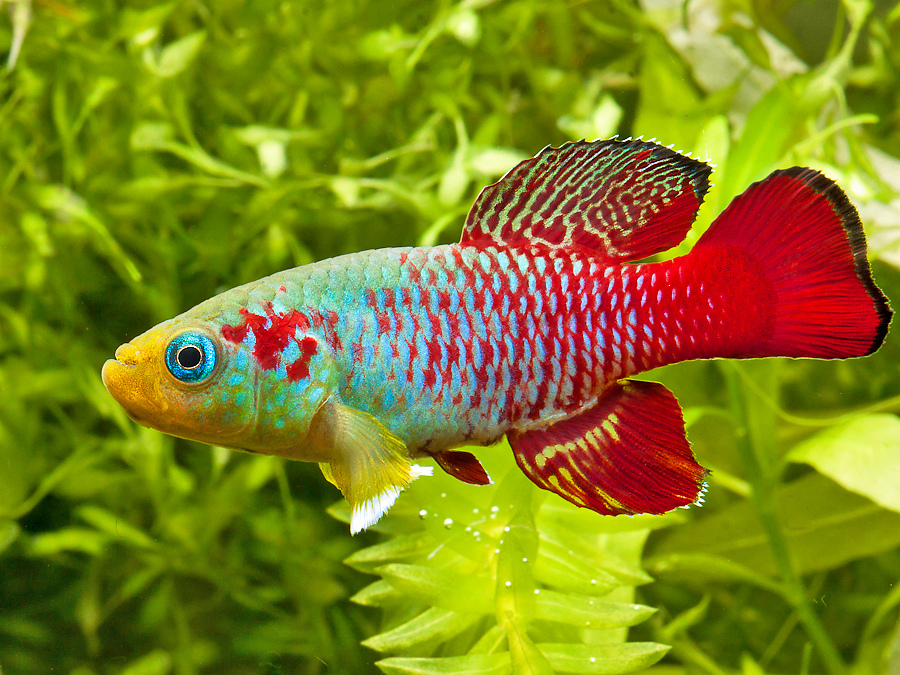
- Size: 2-3 inches (5-7.5 centimeters)
- Minimum tank size: 5 gallons
- Care level: medium
- Temperament: semi-aggressive/aggressive
- Schooling/shoaling fish: no. You can keep a single male with several females, but they don’t need to be kept in a group.
- Temperature: 72°-75°F (22°-24°C)
- Diet: omnivore
There are over 1,200 different species of killifish. They’re found in Asia, Africa and North and South America.
Each species has its own needs, so make sure to do lots of research before bringing fish home.
In the wild, killifish live in small ponds, ditches and rice patties. I have always labeled killifish, Bettas and gouramis as “Southeast Asian Puddle Fish.” Their natural territories are quite small, making them perfectly adapted to life in a 5 gallon tank.
Males are particularly colorful and will flash their colors in a territorial display. Females tend to have more subdued coloring.
In a small tank, it’s usually best to keep no more than a trio of fish, one male and two females.
6. Dwarf Pea Puffer (Carinotetraodon travancoricus)
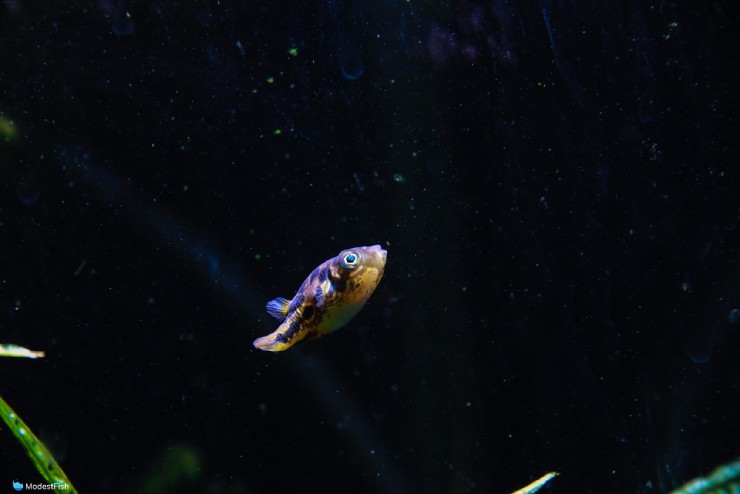
- Size: 1 inches (2.5 centimeters)
- Minimum tank size: 5 gallons
- Care level: medium
- Temperament: territorial and aggressive
- Schooling/shoaling fish: NO! In a 5 gallon tank, I would only recommend that you keep one pea puffer. They can be very territorial and nippy with each other and other fish/invertebrates.
- Temperature: 74°-82°F (23°-28°C)
- Diet: carnivore
Pea puffers are probably the cutest fish in the world. They have the goofiest faces, they almost look like a cartoon character.
Like most pufferfish, they buzz around like little blimps, exploring their surroundings and searching for food.
But don’t let the bumbling persona fool you. Pea puffers are vicious micro-predators that skillfully hunt down their prey. They have pointed beaks that can crush up snail shells and take nasty bites out of the fins of tank mates.
These puffers might look cute, but they can also be fairly mean to other fish. In a 5 gallon tank, you really only have room for one puffer. Each fish needs to stake out their own little territory, and they would be way too crowded in such a small tank.
But, a single puffer can live happily on its own in a 5 gallon.
Be aware, these fish will usually only accept live and frozen foods. Folks have tried to get them to adapt to flakes or pellets, but without much success.
7. Honey Gourami (Trichogaster chuna)
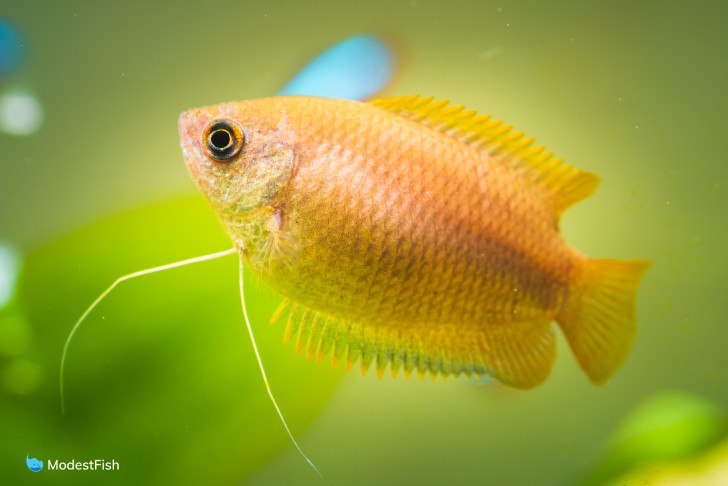
- Size: 3 inches (7.5 centimeters)
- Minimum tank size: 5 gallons
- Care level: medium
- Temperament: peaceful and shy
- Schooling/shoaling fish: No. In larger tanks, you can keep multiple honey gouramis, but you should only keep one in a 5 gallon.
- Temperature: 75°-82°F (24°-28°C)
- Diet: omnivore
Most species of gouramis are fierce little fish, like their close relatives, Betta splendens. They are often naughty and aggressive towards other fish, but not the honey gourami.
This species is much more shy and gentle than its bolder cousins.
These guys do best in a heavily planted tank with lots of stem plants that reach the water’s surface. Honey gouramis like to hide among tall vegetation throughout the day. It’s so cute to see them peeking out from between plants, exploring with their antennae-like pectoral fins.
It is possible to keep more than one honey gourami in a tank, but not in something as small as a 5 gallon. But a single fish would happily live in a tank that size.
Other Critters to Consider for a 5 Gallon Tank
Fish aren’t the only game in town for an aquarium! You can have a thriving underwater community made up of invertebrates.
8. Cherry Shrimp (Neocaridina davidi)
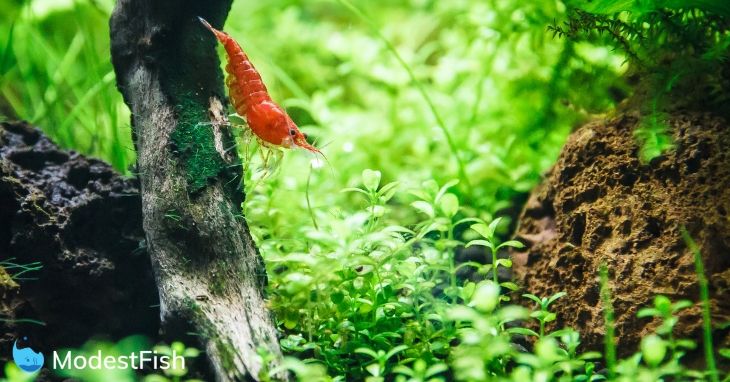
- Size: 0.75-1.5 inches (2-4 centimeters)
- Minimum tank size: 1 gallon
- Care level: easy
- Temperament: peaceful
- Schooling/shoaling fish: You can keep a single shrimp, or a giant mob of them, they’ll be happy either way.
- Temperature: 65°-78°F (18°-26°C)
- Diet: omnivore
I love cherry shrimp. I have dozens and dozens of them spread out among my eight home aquariums. They’re really easy to take care of and can adapt to a wide variety of tank conditions.
I have some in tanks with hard water and others in tanks with really soft water. I’ve got cherries that live in unheated tanks and others that are in tropical tanks with heated water that stays in the upper 70s at all times.
As long as you carefully acclimate cherry shrimp when you first add them to a tank, they can adapt and thrive, it’s amazing.
Cherry shrimp are wonderful algae eaters. They will devour soft algaes, like green dust or brown algae, but they’re not able to eat really tough algaes, like green spot or black beard algae.
Cherry shrimp readily breed in home aquariums. The colony of shrimp will grow to match the available food supply in the tank.
9. Amano Shrimp (Caridina multidentata)
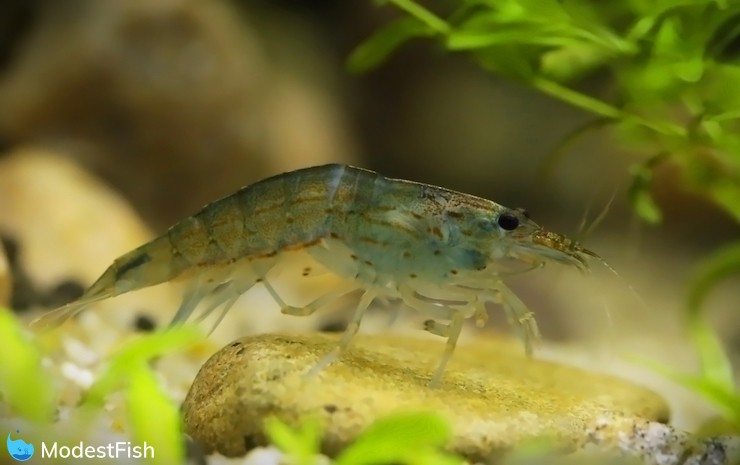
- Size: 1-2 inches (2.5-5 centimeters)
- Minimum tank size: 5 gallons
- Care level: medium
- Temperament: peaceful
- Schooling/shoaling fish: Amanos can be kept as just a single shrimp, or in a group, they’re fine either way.
- Temperature: 65°-80°F (18°-27°C)
- Diet: omnivore
Hands down, Amano shrimp are the best algae eaters in the aquarium hobby. They will devour even super tough algaes, like black beard algae, they are amazing.
Amano shrimp are much larger than cherry shrimp, making them stronger and capable of scraping off even the toughest algae from plant leaves.
This species only comes in its natural brown coloration, no flashy color variations. But, I still think they’re really cute and interesting to watch.
These guys are a little more picky about their water parameters. They do best in hard water that has lots of available calcium to help promote their shell growth.
Amano shrimp cannot breed in a freshwater aquarium. Their eggs will only hatch in a brackish environment.
10. Ghost Shrimp (Palaemonetes paludosus)
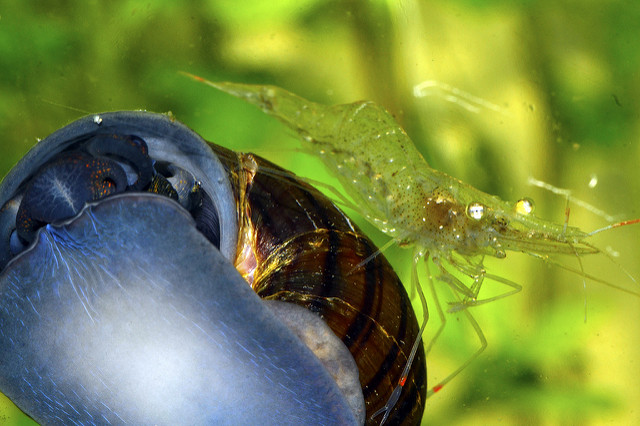
- AKA: glass shrimp, grass shrimp, eastern grass shrimp
- Size: 1 inches (2.5 centimeters)
- Minimum tank size: 1 gallon
- Care level: easy
- Temperament: peaceful
- Schooling/shoaling fish: Ghost shrimp can live alone or in a large group.
- Temperature: 65°-75°F (18°-24°C)
- Diet: omnivore
Ghost shrimp are interesting because their bodies are almost completely transparent. This is an extremely effective form of camouflage. It’s so good in fact, that you may have a really hard time finding the ghost shrimp you add to your tank.
This species prefers to graze along the substrate. They don’t really feed on algae that’s growing on plant leaves.
It’s possible for ghost shrimp to breed in a home aquarium, but it’s unlikely any of the babies will survive. The eggs of other shrimp species, like cherry or crystal shrimp, hatch and tiny shrimplets emerge that are perfect replicas of their parents.
But, when ghost shrimp eggs hatch, a larvae emerge. These tiny, free swimming young must go through several stages of metamorphosis before finally developing into a form like that of their parents.
These larvae most often get eaten before they get a chance to fully develop. Aquarium inhabitants, including their own parents, will gladly devour the poor little guys.
This species is very easy to take care of, they can practically live in a toilet. But, because breeders and wholesalers tend to keep them in poor conditions, expect to have some losses early on, but survivors of the initial acclimation period should be quite hardy.
11. Mystery Snail (Pomacea bridgesii)
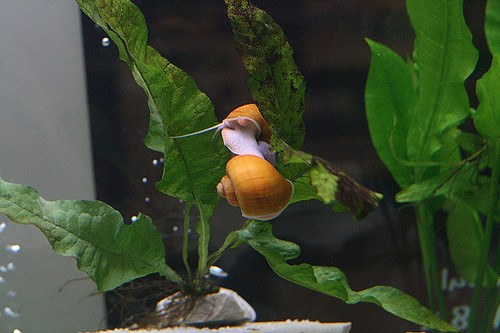
- Size: 2 inches (5 centimeters)
- Minimum tank size: 1 gallon
- Care level: easy
- Temperament: peaceful
- Schooling/shoaling fish: Yes, but keep only a single snail to avoid unwanted breeding.
- Temperature: 68°-80°F (20°-27°C)
- Diet: omnivore
Mystery snails are such interesting additions to an aquarium. I love to watch them glide along the glass with their long, flowing antennae streaming behind them.
I’d recommend that you keep only a single snail to avoid being overrun with a million babies.
I love all of the different color variations that have been created through selective breeding. I especially like the blue mystery snails. I have quite a few of them in my angelfish tanks.
Mystery snails will eat some algae, but they’re not the best algae eaters. But, they’re great at cleaning up leftover fish food that’s sunk to the bottom of the tank.
12. Nerite Snail
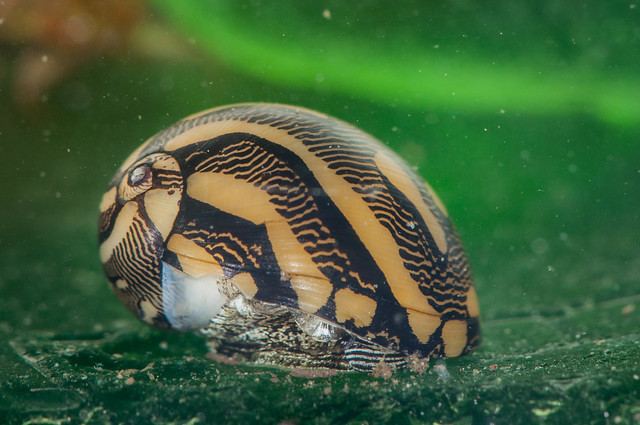
- Size: 1.5 inches (4 centimeters)
- Minimum tank size: 5 gallon
- Care level: easy
- Temperament: peaceful
- Schooling/shoaling fish: Can be kept singly or in a group.
- Temperature: 72°-78°F (22°-26°C)
- Diet: omnivore
Nerites are the best algae eating snails in the aquarium hobby. They will Hoover up most kinds of algae like it’s nobody’s business.
There are many different species of snail sold under the moniker “nerite snail” in live fish stores. You’ll see a huge variety of colors and patterns; many are quite beautiful.
There are even species that grow little horn-like projections on their shells.
Nerites cannot breed in a freshwater aquarium. Their eggs will only hatch in a brackish water environment.
Even though the eggs won’t hatch, females will still lay them on rocks and other hardscape elements. This is the only true downside to nerite snails, in my opinion. The eggs won’t harm anything, but they are an eyesore. And they’re very hard to remove.
Conclusions
Keeping an aquarium as small as a 5 gallon can be challenging. With such a small water volume, it doesn’t take much to get things out of balance.
So, it’s important to pick the right livestock for your tank. It’s best to choose critters that don’t create a heavy bioload and that will stay the right size to be happy in such a small aquarium.
If at all possible, I like to have both fish and invertebrates in my aquariums. It’s good to have your flagship species, like a Betta or a honey gourami, but a supporting cast of shrimp and snails for a cleanup crew can be great as well.
I hope you find this article helpful.
I wish you and your fish the very best!

Thank you for this! I’m trying to get back in the hobby, and my son is as well! We just got a 5 gallon tank for him tonstart with, and going through the fishless cycling process now. This was an excellent guide that answered so many questions I had!
You’re welcome, Dave! Wish you and your son all the best with the new tank
Hello, we are starting with a 5 gallon. I’m wondering if you are able to put a couple shrimp and a fish in the tank? Or is it preferred to put a snail and a fish?
Thanks!
Hi Amanda, you can definitely add shrimp to a five gallon. Cherry shrimp (Neocaridina davidi) would be a good choice. Start with 5-10. The population will grow to the size of the food source, so I always recommend just adding a smaller amount to start with and go from there.