

Using a quality plant fertilizer can really bring out the true beauty of your aquarium’s plants.
Personally, I use the Seachem flourish series on my tanks, and I’ve always found them to reliable products.
In this guide, I’ll walk you through what you should look for when deciding on the best fertilizer for you, the different types available, and recommend some great products you can buy today.
Best Overall All-In-One Liquid Fertilizer
Seachem Flourish Comprehensive is a great all-in-one liquid fertilizer that’ll give you all the micronutrients you need for lightly stocked tanks with a few plants and nano fish.
Dosing: 5 mL for each 250 L (60 gallons)
Key Ingredients per gram
- Total Nitrogen (N): 0.07%
- Available Phosphate (P2O5): 0.01%
- Soluble Potash (K2O): 0.37%
- Calcium (Ca): 0.14%
- Magnesium (Mg): 0.11%
- Sulfur (S): 0.2773%
- Boron (B): 0.009%
- Chlorine (Cl): 1.15%
- Cobalt (Co): 0.0004%
- Copper (Cu): 0.0001%
- Iron (Fe): 0.32%
- Manganese (Mn): 0.0118%
- Molybdenum (Mo): 0.0009%
- Sodium (Na): 0.13%
- Zinc (Zn): 0.0007%

Best Combination of Liquid Fertilizers For Heavily Stocked Tank
The Flourish series (Potassium, Phosphorus, Nitrogen), is geared towards advanced aquarists. Instead of the convenience of having everything in one bottle, the macronutrients are separate from the micronutrients. This lets you add just the nutrients you need, and skip the ones you don’t.
Best works for a heavily stocked tank.
Dosing:
- Seachem potassium: 1 capful (5 mL) per 30 gallons (125 liters)
- Seachem Phosphorus: 2.5 mL (half a cap) per L 20 gallons (80 liters)
- Seachem Nitrogen: Nitrogen (N) 1.5%, 2.5 mL (half a cap) per 40 gallons (160 liters)
Key Ingredients per gram
- Seachem potassium: Souluble Postash (K2O) 5% (50,000 ppm)
- Seachem Phosphorus: Phosphate (P2O5) 0.3%, Soluble Potash (K2O): 0.2%
- Seachem Nitrogen: Nitrogen (N) 1.5%, Soluble Potash (K2O) 2%


Best Pre-Packed Substrate Fertilizer For Root Feeders
ADA Aqua Soil is considered to be one of the best plant substrates on the market. It was developed by the guru of modern aquascaping, Takashi Amano.
I think pre-packed substrates are the best bet if you want to have thick carpeting plants. They really do appreciate a rich soil substrate that lets them spread their roots as much as possible.

Best for Root Tabs for Heavy Root Feeders
If your tank contains a lot of heavy root feeders, Seachem root tabs will be best for you. They’re nice because you only need to worry about fertilizing the tank every few months and there’s fewer nutrients in the water column for algae to use.
These tabs contain all of the macro and micronutrients that your plants need, delivered straight to their roots.
Dosing: 6 per 10 gallon tank (one every 10–15 cm (4–6 in.) radius)
Key Ingredients per gram
- Total Nitrogen (N): 0.8%
- Water Soluble Nitrogen: 0.8%
- Available Phosphate (P2O5): 0.11%
- Soluble Potash (K2O): 0.28%
- Calcium (Ca): 23.3%
- Magnesium (Mg): 0.29%
- Water Soluble Magnesium: 0.06%
- Sulfur (S): 16.5%
- Boron (B): 0.003%
- Cobalt (Co): 0.002%
- Copper (Cu): 0.006%
- Water Soluble Copper (Cu): 0.001%
- Iron (Fe): 3.07%
- Water Soluble Iron (Fe): 3.07%
- Manganese (Mn): 0.16%
- Water Soluble Manganese (Mn): 0.16%
- Molybdenum (Mo): 0.0005%
- Zinc (Zn): 0.003%
- Water Soluble Zinc (Zn): 0.003%

What Nutrients Do Your Plants Need?
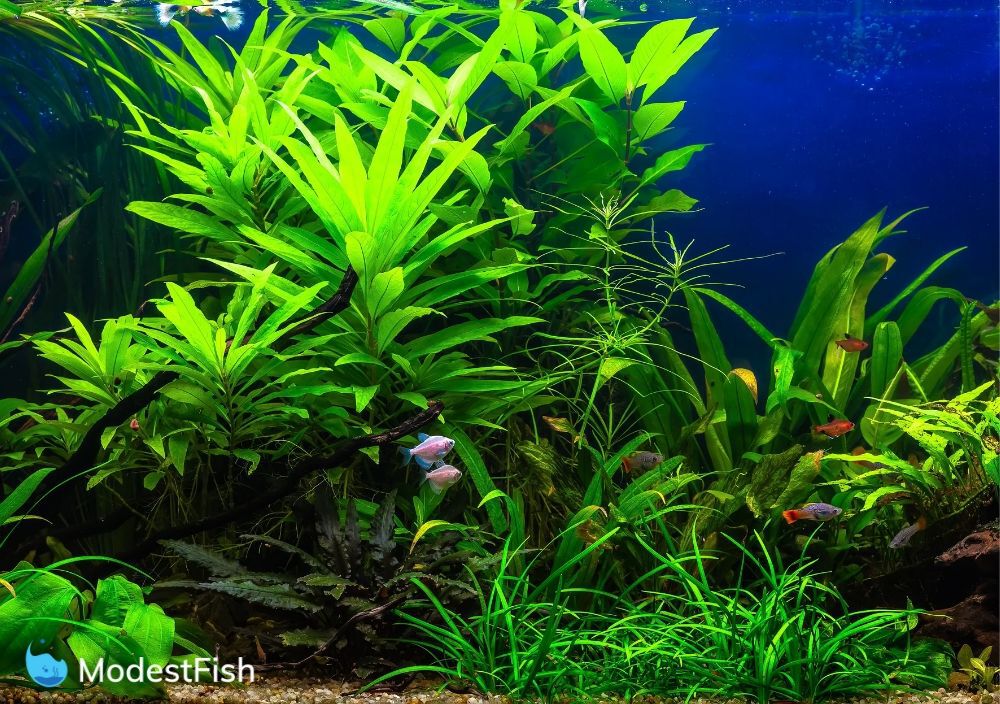
Before you buy plant fertilizer for your tank, you need to understand what you’re actually buying.
They’re not all the same, so here’s what you need to know.
Macronutrients vs Micronutrients
These might seem like confusing terms at first, but they’re actually pretty simple. Macronutrients are nutrients that plants use in large quantities. Micronutrients are just as essential, but plants use them in much smaller amounts.
There are three essential macronutrients contained in aquarium fertilizers:
- Nitrogen (N) – plants can get nitrogen in several different forms, not just pure nitrogen, including ammonium (NH4+) and nitrate (NO3-). Plants use nitrogen for leaf and stem growth and it’s an essential part of chlorophyll.
- Phosphorous (P) – this is derived from monopotassium phosphate, a mix of phosphorus pentoxide (P2O5) and potash (potassium oxide K2O). This actually gives you two macronutrients, since it also contains potassium. Plants use phosphorus for flowering and fruiting, but it’s also critical for any process where the plant uses energy.
- Potassium (K) – this is derived from potash (potassium oxide K2O), a water soluble form of potassium. Since tanks with lots of fish and/or invertebrates create their own nitrogen and phosphorus, it can be helpful to have just potassium. Plants use potassium to strengthen their roots, leaves and growing points.
Plants may use smaller amounts of micronutrients, but they are just as important.
The most common micronutrients in fertilizers are:
- Iron (Fe)
- Manganese (Mn)
- Chlorine (Cl)
- Copper (Cu)
- Boron (B)
- Molybdenum (Mo)
- Cobalt (Co)
- Nickel (Ni)
There are other kinds of micronutrients, but they are commonly found in tap water. So no need to add extra.
Root Feeders vs Column Feeders
Some plants get a lot of their nutrition through their root systems. These are known as heavy root feeders, sword plants and Cryptocorynes are good examples.
Other species do not absorb nutrients through their roots at all, only through their leaves and stems, like Java fern.
And then, there are some that do a mix of both.
Liquid Aquarium Fertilizers
Liquid fertilizers are just what they sound like, fertilizers dissolved in water that you pour into your tank water.
They are great for plants that feed directly from the water column, like Java fern, mosses, Brazilian pennywort, African water fern and anubias.
It will settle into the substrate somewhat, but it’s not the best for heavy root feeders like Amazon swords.
Pre-packed Substrates
Pre-packed substrates are special soils designed for aquarium use. They contain the nutrients root-feeding plants need, so there’s little need to add extra fertilizers.
Basically, it’s dirt that you can put in your fish tank that’s meant to hold together when you add water. That way, you can fill the tank up and not have giant clouds of muddy water all over the place.
But, there are some drawbacks to these kinds of substrates.
They’re only good for plants that are heavy root feeders. They’re great for:
- Amazon sword
- Cryptocoryne
- Sagittaria
- Vallisneria
- Dwarf baby tears
- Dwarf hair grass
However, if you’re not planning on adding heavy root feeders, there’s no need to go to the trouble or expense of using one of these substrates.
These soils also break down over time. Within a year or two of adding them, they start to turn to mud and the plants have eaten up all the nutrients.
Then you have to rip out all the plants, dig out all the substrate and redo everything.
But, here’s the biggest thing to remember about these substrates, a lot of them leach ammonia when they’re first added.
This isn’t a huge deal in a brand new tank. Ammonia in the water column can help to get your nitrogen cycle going.
But if you’re trying to add one of these to an existing tank, it can put off enough ammonia to kill all of your fish. So you might need to keep your fish in a separate tank when you redo the substrate every few years.
Aquarium Fertilizer Root Tabs
Root tabs are little pieces of compressed fertilizer. They’re meant to be used if you have an inert substrate in your tank, like gravel or sand.
You bury the root tab down in the gravel, in a circle around your root-feeding plants. The tabs slowly dissolve and the plant roots eat up the nutrients they put off.
This is a great alternative if you want to keep heavy root feeders but don’t want the hassle and expense of a pre-packed substrate.
Reviews For Aquarium Plant Fertilizers
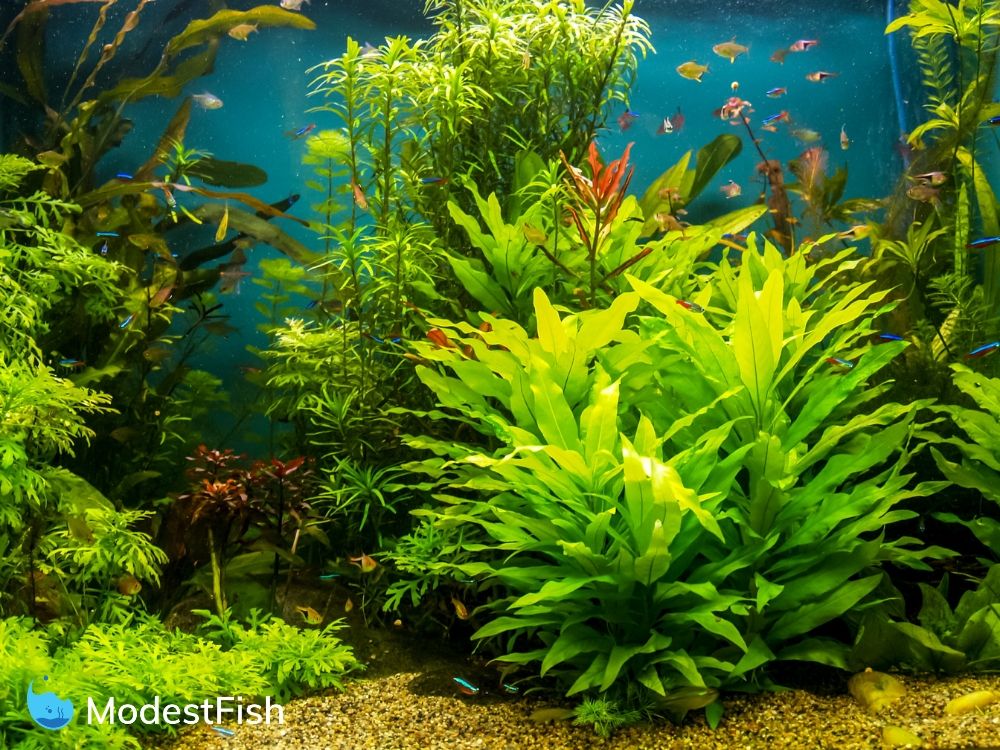
1. Glosso Factory All in One Planted Aquarium Fertilizer
Glosso Factory makes a liquid fertilizer that contains all of the macro and micronutrients that plants need in one convenient bottle.
You should go slowly with this at first, since overdoing it can lead to algae blooms.
This kind of all-in-one fertilizer is best suited to a tank that has a light bioload, in other words, one that is not heavily stocked with fish.
If you have a heavily stocked tank, fish waste and feeding will put off plenty of nitrate and phosphorus for plants to eat. So this fertilizer would be overkill.
But if you have a lightly stocked tank with lots of plants, there may not be enough nitrogen and/or phosphorus available for plants.
This all-in-one approach would be great for something like a heavily planted shrimp or nano fish tank.
Ingredients:
- Nitrogen (N)
- Phosphorus (P)
- Potassium (K)
- Iron (Fe)
- Manganese (Mn)
- Magnesium (Mg)
- Zinc (Zn)
- Copper (Cu)
- Boron (B)
- Molybdenum (Mo)
- Cobalt (Co)
So, just about everything.
Pros:
- No need to measure out individual nutrients.
- Easy to follow instructions that are beginner friendly.
- A good value since a 16 ounce (500 milliliters) bottle treats over 4,700 gallons (17,800 liters).
- Great all round fertilizer for lightly stocked tanks.
Cons:
- You may not need all of the nutrients included and there’s no way to separate out what you don’t need.
- Can seriously promote algae growth if you overdo it.
- Ingredients separate so you have to really shake the bottle before dosing.
- Can make the water cloudy when it’s first added, but this clears up after an hour or two.
- May have too many macronutrients for tanks with a big bioload.

2. The Seachem Flourish Series
Seachem does things a little bit differently.
The Flourish series is geared a bit more towards advanced aquarists. Instead of the convenience of having everything in one bottle, the macronutrients are separate from the micronutrients.
This lets you add just the nutrients you need, and skip the ones you don’t.
This is better for a heavily stocked tank that produces plenty of nitrogen and phosphorus on its own.
For example, in my big rainbow fish tank, I add just Seachem Flourish Comprehensive. That gives me some potassium, all the micronutrients I need and doesn’t add any more nitrogen or phosphorus to what is already a nutrient rich tank.
This lets me dial in on just the micronutrients I need. It’s perfect.
The downside to all of this is that you may need to buy multiple bottles to get everything you need. If you did need to add nitrogen, phosphorus, potassium and all of the micronutrients, that could get pretty pricey.
You would need to figure out what balance of nutrients works for your tank and play around with your dosing schedule. So this may not be the most beginner friendly method.
Pros:
- Let’s you dial in on the nutrients you want and skip the ones you don’t need.
- Great for heavily stocked tanks that produce their own nitrogen and phosphorus.
Cons:
- Can get expensive if you need to buy multiple bottles to cover all of your needs.
- Can take some guess work, so it may not be the most beginner friendly.
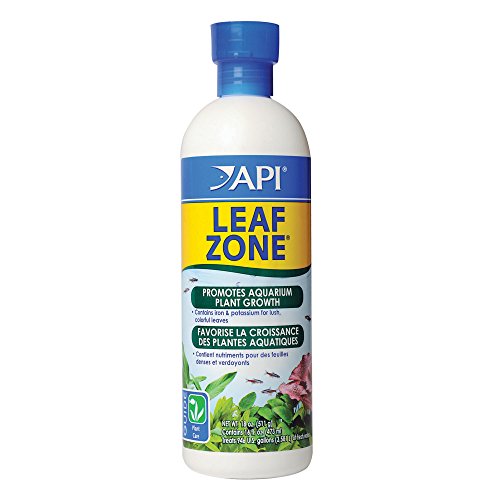
3. API Leaf Zone
OK I’ll be honest, I’m not a big fan of this fertilizer.
I used it several years ago, and it was better than nothing, but I felt that Flourish Comprehensive blew it out of the water.
Leaf Zone is geared towards tanks with a high bioload that have plenty of nitrogen and phosphorus.
Ingredients:
- Potassium
- Iron (Fe)
That’s it, just potassium and iron.
Yes, this can help give plants a bit of a boost, but nothing compared to what you get from something like the Glosso Factory or Seachem products.
It is a very affordable product, but I really think you get what you pay for here. It’s only a couple of bucks more to pick up a bottle of Flourish Comprehensive and you get a lot more benefit.
Pros:
- Very inexpensive.
- Does provide some important potassium and iron.
Cons:
- Very limited nutrients.
- Not a great value.
4. ADA Aqua Soil Amazonia
ADA Aqua Soil is considered to be one of the best plant substrates on the market. It was developed by the guru of modern aquascaping, Takashi Amano.
It is made of small spheres of soil, packed with nutrients that can really give plants a huge boost.
It does break down after a year or two and requires replacing. And it does put off a significant amount of ammonia when it is first added and can cloud your water at first.
Pros:
- Nutrient rich substrate.
- Looks beautiful in the tank.
- Great for any heavy root feeding plants, especially carpet plants.
Cons:
- Leaches ammonia, so not great if you already have fish in the tank.
- Pretty darn expensive.
- Does bring down overall hardness and pH. Could be a problem if you already have soft water.
- Will eventually need to be replaced.
- Can cloud water quite a bit.
5. UP Aqua Sand
UP Aqua Sand is made from baked soil that comes in small spheres, similar to ADA. It’s another nutrient-rich substrate that helps grow lush plants.
Many users love the fact that it kicks up very little dust when water is added to the tank, so no huge clouds of muddy water.
A key benefit of Aqua Sand is that it doesn’t seem to leach tons of ammonia the way ADA does. For me, this is a major point in its favor if you’re trying to replace the substrate in an established tank.
It does reduce pH and hardness, so it may not be the best choice if you have really soft water already.
Supposedly, it lasts longer than ADA Aqua Soil before it needs to be replaced. However, there’s no exact data on this, so you might still need to replace it every few years.
The biggest complaint online is that the bags often split open in shipping, making a mess. It’s also not cheap, but it’s less expensive than ADA, but that’s not saying much.
Pros:
- Nutrient rich baked soil.
- Doesn’t leach much ammonia.
- Reported to last longer than ADA Aqua Soil.
- Cheaper than ADA.
Cons:
- Bags frequently split open in shipping.
- May not be great if you already have soft/acidic water.
- Less expensive than ADA, but still pretty pricey.

6. Seachem Flourish Tabs
Ingredients:
- Nitrogen (N)
- Phosphorus (P)
- Potassium (K)
- Calcium (Ca)
- Sulfur (S)
- Chlorine (Cl)
- Iron (Fe)
- Manganese (Mn)
- Magnesium (Mg)
- Zinc (Zn)
- Copper (Cu)
- Boron (B)
- Molybdenum (Mo)
- Cobalt (Co)
These tabs contain all of the macro and micronutrients that your plants need, delivered straight to their roots.
7. API Root Tabs
Ingredients:
- Potassium (K)
- Iron (Fe)
Just like with API Leaf Zone, these root tabs really don’t provide that much in the way of nutrients.
In my opinion, they really are not a great value. Seachem Flourish Tabs provide a lot more nutrients and actually cost less than the API Root Tabs.
It’s also a common complaint that the tabs dissolve into mush before they can be buried in the substrate.
Pros:
- Provides a little bit of potassium and iron.
Cons:
- Way short on most macro and micronutrients.
- Can fall apart before you can get them buried.
Final Thoughts on Aquarium Fertilizers
Liquid fertilizers are a great all around choice that work for a lot of aquarists.
An all-in-one liquid is a good choice for lightly stocked but heavily planted tanks. So if you just have a few nano fish and shrimp in a tank, an all-in-one can fill in the macronutrients your plants need.
For a more heavily stocked tank, adding potassium plus micronutrients is a good way to go.
I think pre-packed substrates are the best bet if you want to have thick carpeting plants. They really do appreciate a rich soil substrate that lets them spread their roots as much as possible.
These substrates do require extra maintenance, but you can’t really argue with the thick lush carpets they produce.
If you don’t have anything but heavy root feeders, I’d go with root tabs. Then you only need to worry about fertilizing the tank every few months and there’s fewer nutrients in the water column for algae to use.
So what if you’re on a serious budget?
Frankly, pick up a bottle of Seachem Flourish Comprehensive and dose it once a week or so. The bottle will last you a long time, it will help improve things and it’s really not that hard on your wallet.
I’ve gotten through many lean times with this.
In fact, when it comes to overall quality, I’m a strong believer in Seachem products in general. I really don’t think you can go wrong with the Flourish series and they let you mix and match what you need, and leave out what you don’t.
Experiment and figure out what works best for your tank. Take notes and be patient. You’ll figure out the formula for your setup and be enjoying your own underwater garden before you know it.

It’s really a good info..
Thank you very much for the knowledge , it helps me a lot .
By far the most detailed article touching most of the bases
Absolutely wonderful article.. Loved it!