

Goldfish don’t need substrate in their tank, but having substrate can provide a ton of surface area for beneficial bacteria to grow, creating a healthier environment for your fish.
In this guide, I’ll help you understand the difference between substrates, why inert is always the best, and share my best substrates for goldfish tanks.
Best Subsrate for Goldfish Tanks Overview
When it comes to substrate, your goldfish doesn’t require one, so none of them is the standout best.
However, none on this list will change your water chemistry so it’ll come down to your preference: sand or gravel.
I personally think gravel is easier to clean since you don’t have to worry about it going into your bucket the way sand does.



Best Goldfish Substrates Reviewed
Let’s run through the top choices when it comes to substrate for goldfish.
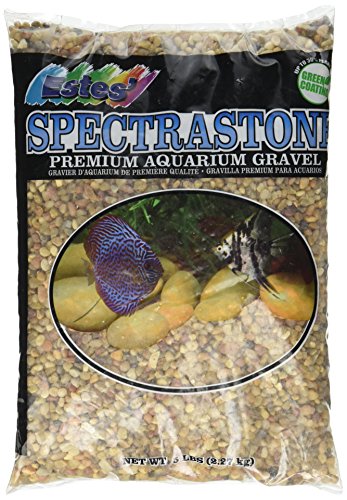
1. Spectrastone Shallow Creek Aquarium Gravel
This is your classic aquarium gravel, the old standby that you can always count on.
I especially like this if you’re going for a more natural look in your aquarium. You can really make something that looks like a little piece of creek bed, right in your home.
The stones vary in size somewhat, making it look even more natural.
You will need to do a thorough gravel vacuuming when you do your water changes.
Pros:
- Natural look
- No added dyes or plastic coatings
- Inert gravel
Cons:
- Has to be gravel vacuumed
2. CaribSea Super Natural Peace River Sand
I love this stuff. There is nothing more natural looking than sand in an aquarium, in my opinion.
And this Peace River Sand really looks like you dug it out of your local creek.
Also, the darker color will not show every speck of fish poop that floats to the bottom.
Sand is trickier to clean than gravel. I recommend that you wave the gravel vac tube just above the surface of the sand to stir up poop so it can be sucked up.
I also highly recommend that you stir up the sand bed once a week to prevent gas pockets. You can just use your hand or even a clean wooden spoon from the kitchen.
Pros:
- Looks very natural
- Color helps conceal fish poop
Cons:
- Trickier to clean than gravel
- Can form gas pockets
Pro Tip: Fish waste can become trapped below the surface in deep sand beds. When the waste rots, it can produce pockets of toxic hydrogen sulfide (H2S) gas. Once disturbed, these gas pockets burst into the water column. Hydrogen sulfide is toxic to fish and it smells awful. Stir your sand bed weekly to avoid these gas pockets.
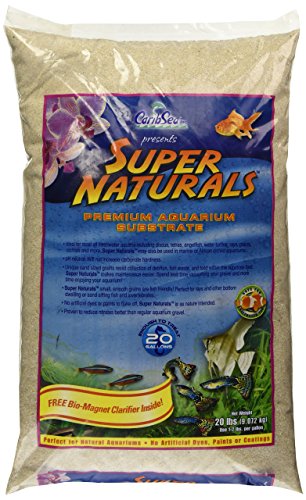
3. CaribSea Super Natural Crystal River Sand
This is another great inert sand for your aquarium. If you crave the beach sand look in your tank, this is the one for you.
Crystal River Sand is a uniform light beige that calls to mind carribean beaches and sunny river banks.
I especially like this paired with natural rocks and maybe even a little driftwood.
One downside, fish poop is very easy to see against this light beige color. But, I think the gorgeous natural look is worth a little extra cleaning to maintain it.
Pros:
- Looks like natural beach sand
Cons:
- Trickier to clean than gravel
- Fish poop is easy to see against the light color
4. Imagitarium Black Aquarium Sand
If you want your tank to be all about the fish, black sand is the way to go. I’m especially fond of goldfish tanks with black sand and a plain black background.
This kind of backdrop forces your eye to the fish again and again.
Black sand isn’t necessarily a natural look, but it’s really great if you want your fish to “pop.”
Fish poop on the surface of the sand is still visible, but frankly, you have to look pretty hard to really notice it.
Pros:
- Great backdrop to make fish stand out
Cons:
- Fish poop is somewhat visible
- Not a natural look
5. Pisces Midnight Pearl Aquarium Gravel
This unique gravel is gathered from beaches in New Zealand. It’s been smoothed by ocean waves, making it a rounded gravel, and the color is quite unique.
I think this would make a great dark colored backdrop for your fish, but still give you a more natural look than straight black sand.
I also like that the dark color would do a good job of hiding fish poop on the surface.
Like any other gravel, you’ll need to vacuum it carefully each week to remove wastes.
Pros:
- Unique color
- Color would hide fish poop
Cons:
- Needs gravel vacuuming
6. Pisces Silver Pearl Aquarium Gravel
This is another unique gravel option from Pisces. It’s a neat texture, in my opinion, too coarse to be called a sand, but almost too fine to be called a gravel.
I like substrates like this because you get the look of sand but it’s easier to clean because it’s not as easy to suck it up into the gravel vacuum.
You still need to be more careful than you would with regular gravel while you’re cleaning, but it’s much easier to deal with than fine sands.
Silver Pearl Gravel is collected from beaches on New Zealand’s South Island Plains.
My Verdict on Substrates for Goldfish
Each one of these products is an inert substrate, so no worries about them changing your water chemistry at all.
There is a big difference between sand and gravel when it comes to cleaning. I personally think gravel is easier to clean since you don’t have to worry about it going into your bucket the way sand does.
So, it is something to consider, are you willing to put up with keeping the sand clean and stirred? Or is it just better for you to have gravel that’s simple to clean?
Changing out the substrate in a tank that’s already established is a major pain, believe me, I’ve done it. I definitely recommend that you really think it over beforehand so you’re not stuck with something you’ll be unhappy with.
I hope you’ve found this article helpful.
I wish you and your fish the very best.
Do You Have To Use Substrate For Goldfish Tank?
Actually, no, you don’t.
Some people prefer to have a bare bottom tank because goldfish produce so much waste. They find it easier to just vacuum up the poop off the bare floor of the tank.
Here’s my thing about this, and this is just my opinion, but I really don’t think it’s that much more work to stick the gravel vacuum down into the substrate than it is to vacuum the bare bottom.
Also, having substrate in the tank provides even more surfaces that beneficial bacteria can grow on.
Pro Tip: For more information about beneficial bacteria and the Aquarium Nitrogen Cycle, see our article here.
Inert Substrate is Best For Goldfish
Some substrates, like aragonite sand (aka cichlid sand) and some planted substrates, can significantly change your water parameters.
Aragonite increases the general and carbonate hardness of your water and raises the pH. Many planted substrates leach ammonia into the water early on and can lower the pH.
I recommend going with an inert substrate when it comes to goldfish. That way, you don’t have to worry about monitoring what your substrate is doing to your water and trying to adjust it.
Related: Best Filter For Goldfish Tank
