

The best CO2 diffuser is the Aquerio Neo, in my opionion.
In this guide, I’ll review and compare 5 different diffusers and explain why I think the Aqueio Neo is the top of the list.
Best CO2 Diffuser Product Table



How to Choose Your CO2 Diffuser
I’ll start by walking you through how to know if a CO2 diffuser fits your setup.
Start With Your Tank Size
Size does matter when it comes to CO2 diffusers. A diffuser meant for a 10 gallon just isn’t big enough for a 55.
The surface area of the ceramic disk won’t be large enough to put out the volume of gas you need for that much water.
A smaller diffuser is also not designed to take the higher pressure needed for a larger tank.
On the flipside, using a diffuser meant for a bigger tank, lower CO2 pressures might not be able to push gas through the ceramic disk.
So, it’s important to get a diffuser that’s the appropriate for your tank size.
Think About The Overall Quality
With a lot of aquarium equipment, you get what you pay for. CO2 diffusers are no different. Yes, some diffusers seem like they cost a ton more than others when you’re shopping around.
But, if the cheap one doesn’t work as well, what’s the point? CO2 isn’t free, so having a diffuser that doesn’t distribute it well through your water is like throwing money away.
Sometimes, you have to look at the cost of use over time instead of just the price.
Frankly, I’d rather pay a bit more for something at the outset if it will do a better job and is going to last me longer.
What Does The Kit Include
Some diffusers come with additional equipment included, like U-bends, bubble counters and/or check valves.
If you’re basing a lot of your choice on price, it’s important to take into account whether or not you’re going to need to buy additional pieces of equipment.
My Reviews For The Best Co2 Diffusers
Now you know a little more about what to look out for, you can use my reviews to make an informed buying decision and get the best CO2 diffuser for you.
1. Fibst CO2 Diffuser
Key Features:
- Stainless steel construction
- Dome that holds ceramic disk screws open/close so replacing/cleaning disk is simple
- 6 month warranty on disk
- 24 month warranty on other parts
- Diffuser has a 13 inch (33 centimeter) tube with built in U-bend
- The Fibst diffuser is actually a pretty cool design. I like that the body and stem of the unit are made out of stainless steel.
I’ll freely admit it, I’m clumsy and tend to break things. I’m a big fan of items that are sturdy and I prefer to stay away from things described as “delicate.”
So something made out of a tougher material is always good in my book.
The ceramic disk is housed in a dome with an open top. You can unscrew the dome and access the disk to clean or replace it.
There are three different sizes available, meant for tanks that are 10 to 30 gallons (37-113 liters).
At the bottom of the dome, the intake tube curves up in a J-bend and extends up a full 13 inches until it curves back the other way to form its own U-bend that hooks over the side of the tank.
I also like that the disk and other parts are actually covered by substantial warranties. None of the other diffusers I looked at had this feature.
It does not, however, come with any kind of bubble counter or check valve.
And the fixed length of the intake tube means that you can’t adjust the height of the diffuser in the tank.
Pros:
- Stainless steel construction is more durable than glass
- Can easily be disassembled for cleaning
- Easy to replace ceramic disk
- Comes with a 6 month warranty on disk and 24 month warranty on other parts
Cons:
- Will not work with DIY systems
- Fixed stem with U-bend means height is not adjustable
- Does not come with bubble counter or check valve
- Not designed for tanks over 30 gallons
Summary: This stainless steel diffuser looks great, is durable and puts out a fine mist of bubbles.
2. Starside Aquarium CO2 Diffuser
Key Features:
- Kit includes diffuser, U-bend and check valve
- Made of more durable resin glass
- Ceramic disk permanently attached to glass
- Starside has put together a nice little kit here that includes a classic bell-shaped diffuser, separate U-bend and a check valve.
The bell of the diffuser holds the ceramic disk where the bubbles come out. From the bottom, a short piece of intake tube curves up in a J-bend and attaches to the wall of the aquarium with a suction cup.
A piece of CO2 tubing is run from the intake tube, up the tank wall and attaches to one end of the U-bend. The U-bend hangs over the tank wall and prevents CO2 tubing from getting crimped.
Another piece of tubing connects to the other side of the U-bend and goes to the bubble counter and then the check valve.
This kit takes a little more time to put together, but really it’s not bad to install. It’s nice that you only need to add on a bubble counter and then you’re ready to hook it to your gas system.
And, since the U-bend is a separate piece, you can adjust the height to fit your aquarium.
It’s also made of a clear resin that’s not as fragile as regular glass.
This system requires more pressure than a DIY system can provide.
Pros:
- Includes check valve and U-bend with the diffuser
- Separate U-bend lets you adjust height
- Resin construction is tougher than glass
Cons:
- Doesn’t include bubble counter
- Cannot remove ceramic disk for cleaning
- Cannot replace ceramic disk
Summary: This resin diffuser has the look of a classic glass diffuser without being as delicate.
3. Jardli Pollen Glass CO2 Diffuser with Bubble Counter
Key Features:
- Built in bubble counter, no need for separate piece
- Ceramic disk permanently attached to glass
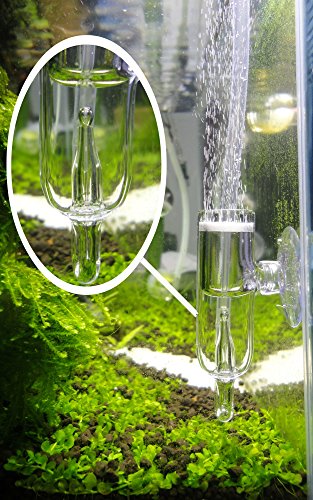
- What makes this diffuser unique is that it has a built in bubble counter.
The bell shape is longer and skinnier than most, and at the bottom, the tube feeding CO2 into the bell comes to a fine point. Water fills the bell in between the tube and the ceramic disk.
As gas comes through the tube, it goes through the fine point, it forms a bubble.
This eliminates the need for a separate bubble counter, which is pretty cool.
There is no attached U-bend, so the height is completely adjustable.
Unfortunately, the ceramic disk is permanently attached to the glass. So you can’t remove it for cleaning or replace it.
You’d have to buy a whole new diffuser when the disk eventually becomes too clogged.
The kit also does not come with a check valve or U-bend, so you’ll need to get these separately.
It is also made of regular glass, so it is a bit fragile.
Pros:
- Built in bubble counter
Cons:
- Doesn’t include U-bend or check valve
- Glass is easily broken
- Cannot remove ceramic disk for cleaning
- Cannot replace ceramic disk
Summary: A glass diffuser that doubles as a bubble counter but it can be kind of fragile.
4. Hagen Fluval Ceramic CO2 Diffuser
Key Features:
- Simple design with a tough plastic construction
- Round plastic body with ceramic disk at the center
- Meant for smaller systems, 20 gallons and under
The Fluval Ceramic Diffuser features a round plastic body around a ceramic disk. It looks kind of like a little black donut or tire. Jutting up from the top of the donut is a small nipple where you attach the CO2 line.
The whole thing can be attached to the side of the tank with a suction cup.
And that’s about it, it really is that simple.
It’s nice that this diffuser is easy to install and won’t break easily, but if I’m honest, it’s pretty darn ugly. Most diffusers look pretty cool, but this one just sort of looks like a weird hunk of plastic in the tank.
Luckily, it’s small, so it’s simple to hide it behind some plants at the back of the tank.
Pros:
- Simple to install
- Plastic body won’t break easily
Cons:
- Just kind of ugly
- Not meant for bigger tanks
- Won’t work with DIY systems
- No way to take apart diffuser for cleaning
- Can’t replace ceramic disk
- Does not come with bubble counter, U-bend or check valve
Summary: Simple and sturdy, this diffuser won’t win any beauty contests but is practical and beautiful.
5. Aquario Neo CO2 Diffuser L
Key Features:
- Acrylic body that is much tougher than glass
- Larger capacity makes it good for tanks over 30 gallons (>113 liters)
- Can be used with DIY CO2 setups
The Aquario Neo is unique to this list in that it is the only diffuser that will work with a DIY system. The membrane is so highly porous that it will still bubble even under low pressure.
The body of the diffuser is made from clear acrylic that is much more resistant to breaking than glass. The folks at Buce Plant went as far as throwing the diffuser on the floor and it still didn’t break.
Considering that I’ve seen reviews from people complaining that their glass diffuser broke after a 6 inch (15 centimeter) drop, I’d say that’s a big improvement.
I’ve even seen reviews of glass diffusers breaking while they were still in the aquarium. So one made out of tougher stuff is A-OK with me.
Just like other diffusers, the intake forms a J-bend that goes in through the bottom, but instead of a bell-shape, the diffuser is a cylinder. The intake tube is a bit longer than most and is attached to the glass with a large suction cup.
Since there’s no fixed U-bend, the height is adjustable.
This diffuser does not come with a bubble counter, check valve or U-bend.
The ceramic disk is not detachable, so there’s no way to take the diffuser apart for cleaning or to replace the disk.
The Aquario Neo also comes in a small and medium size for smaller tanks.
Pros:
Shatter resistant acrylic body that is much tougher than glass
Highly porous ceramic disk that will diffuse even under low pressure
Large suction cup
Cons:
Doesn’t come with bubble checker, U-bend or check valve
Disk can’t be removed for cleaning or replacement
Summary: A higher capacity diffuser for larger tanks that will work with a DIY system.
Which Is The Best CO2 Diffuser?
Weighing everything, I think I’d have to side with the Aquario Neo being the best of the lot. It’s not as fragile as a glass diffuser, so you don’t have to worry about it being easily broken.
The highly porous ceramic disk means that you can use it with pressurized or DIY CO2 systems, so it’s more versatile.
Plus, it’s the only one of the bunch that is capable of handling the needs of a tank over 30 gallons.
Sure it doesn’t come with a check valve, U-bend or bubble counter, but that can be said for a lot of diffusers.
It’s only real drawback is that you can’t remove the disk for cleaning or replace it once the disk eventually becomes too clogged over time.
FAQs For CO2 Diffusers
Where should you place your CO2 diffuser?
You should place your diffuser where there is the highest amount of flow in your tank. This will help to distribute the bubbles all over the aquarium and help the CO2 dissolve in the water.
If you put the diffuser in a spot with little/no flow, the bubbles will go straight to the surface and escape. You want to keep the bubbles under the water as long as possible so that the CO2 has a chance to dissolve in the water.
How to install a CO2 diffuser?
There are A LOT of different CO2 diffusers on the market and installing the various models can be a little different. But here are some general guidelines.
I’ll go down the line from the CO2 tank to the aquarium.
The first device after your CO2 tank should be your check valve. This keeps water from backflushing into your CO2 tank when pressure is decreased, like when the power is turned off for the night.
The next device should be your bubble counter (if using a separate one). This lets you know how fast gas is being fed into the system so you can increase/decrease the pressure and fine tune how much CO2 is being pushed through to the aquarium.
Next comes your U-bend. This is important since CO2 tubing can harden over time and become crimped where it bends over the rim of the tank.
The diffuser is the end of the line. You want to attach it as far down towards the bottom of the tank as you can. It’s totally fine if it’s just above the gravel. You want the bubbles to spend as much time underwater as possible.
Pro Tip: Make sure that you use CO2 tubing instead of regular airline tubing. CO2 can leak out of regular airline tubing, leading to significant loss.
Which CO2 diffuser is right for you?
Just like the people who keep them, every aquarium is different. So you’ve got to figure out which diffuser is going to be right for you and your particular setup.
The first factor to consider when you’re trying to decide on a CO2 diffuser is the size of your tank. Luckily, it’s pretty easy to figure out what size tank diffusers will work with.
For a larger tank, 40 gallons (151 liters)and up, you’ll probably need multiple diffusers in different parts of your tank.
Another big factor is whether or not you have pressurized CO2 or a DIY system. Since DIY operates at much lower pressures, not all diffusers will work.
After that, think about what kind of material the diffuser is made of. I know that I like the look of a glass diffuser, but I also know that I’m a clutz who breaks things all the time.
So, for me, I’m always going to go with the tougher materials.
But hey, maybe you’ve got a delicate touch and are willing to risk some breakage to have the prettier diffuser. More power to ya!
