

African Dwarf Frogs (Hymenochirus boettgeri), are wicked cool little critters that’ll provide many hours of entertainment.
With no real natural defense, setting up your tank, and providing the care right for African Dwarf Frogs (ADF) is important.
In this guide, I’ll share with you how to set up your aquarium and provide the optimal conditions so your ADFs live a happy and healthy life.
But don’t worry, african dwarf frog care is not hard.
African Dwarf Frog Quick Stats
- Min. Tank size: 5 gallons (19 liters)
- Temperature: 68°-82°F (20°-28°C)
- Care level: medium
- Diet: carnivore
- Temperament: peaceful
- How many can be kept together: 1 per 5 gallons
- Size: 3 inches (7.5 centimeters)
Scientific Classifications:
- Kingdom: Animalia
- Phylum: Chordata
- Class: Amphibia
- Order: Anura
- Family: Pipidae
- Genus: Hymenochirus, Boulenger, 1896
African Dwarf Frog Appearance
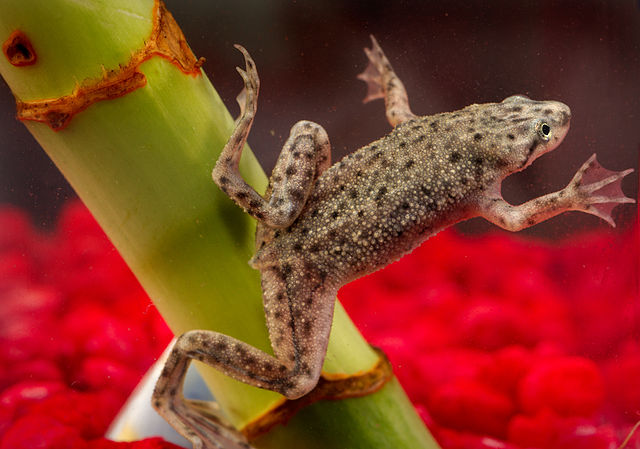
It’s important to pay attention to what an African dwarf frog looks like so that you don’t accidentally buy the wrong species.
Sometimes, African clawed frogs, which are a very different species, are sold under the name African dwarf frogs.
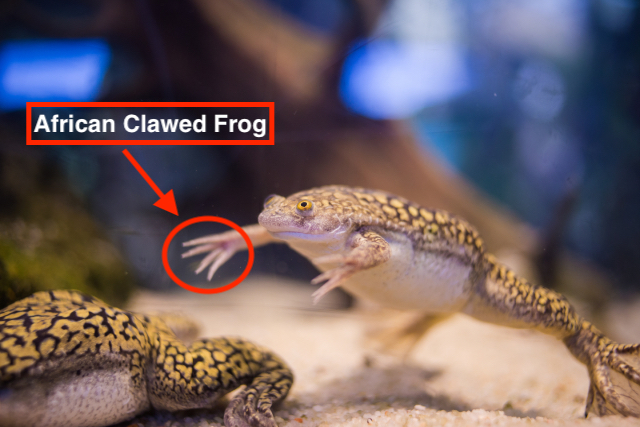
The problem is, African clawed frogs grow much, much larger than African dwarf frogs. If you put the two species in the same tank, eventually the clawed frogs will grow large enough to swallow the dwarf frogs whole.
So, double check that you’re bringing home the right species from the pet store.
Look for these features to make sure you’re getting an ADF:
- Four webbed feet (clawed frogs don’t have webbing on their front feet)
- Eyes on the sides of their heads (clawed frogs have eyes on top of their heads)
- Pointed snout (clawed frogs have curved flat snouts)
Where Do African Dwarf Frogs Come From?
African dwarf frogs are native to equatorial Africa. They live in shallow streams, creeks and ponds during the dry season.
They spread out along the flooded forest floor when the rainy season comes.
ADF spend most of their time along the bottom of the waterway where their color acts as camouflage against the muddy and leaf strewn substrate.
This species eats worms, insect larvae and small invertebrates.
Pretty much, they’ll eat any other little creature they come across that’s small enough for them to gulp down whole. Not what you would call a discerning eater.
Tank Size For African Dwarf Frogs
Luckily, African dwarf frogs (ADF) don’t get very large, so you don’t have to make a huge investment or add on another wing to the house in order to keep them.
I would recommend that you use at least a 5 gallon (19 liter) tank if you plan to keep a single frog. And then add on another 5 gallons for each additional frog.
So you’d need 10 gallons (39 liters) for 2 frogs, 15 gallons (57 liters) for 3 frogs, and so on.
ADF are very social animals that love to hang out with their buddies. I would recommend going with a larger tank, at least a 15 gallon (57 liter), so that you can keep a group of three or four frogs.
Pro Tip: African dwarf frogs need to be able to swim to the surface of the water so they can take a breath. It’s generally recommended that their tank be no more than 2 feet (61 centimeters) deep to ensure they can easily breach the surface to breathe.
Water Parameters for African Dwarf Frogs
Luckily, ADF are tank raised and can adapt to a wide variety of water parameters. They prefer soft to moderately hard water. These frogs are sensitive to ammonia and nitrite, so they will do best in an established and well cycled aquarium with a filter.
- Temperature: 68°-82°F (20°-28°C)
- Ammonia/Nitrite: 0
- Nitrate: <20 ppm
- pH: 6.5-7.5
- GH: 5-20
- KH: 4-15
How to Set Up Your African Dwarf Frog Tank
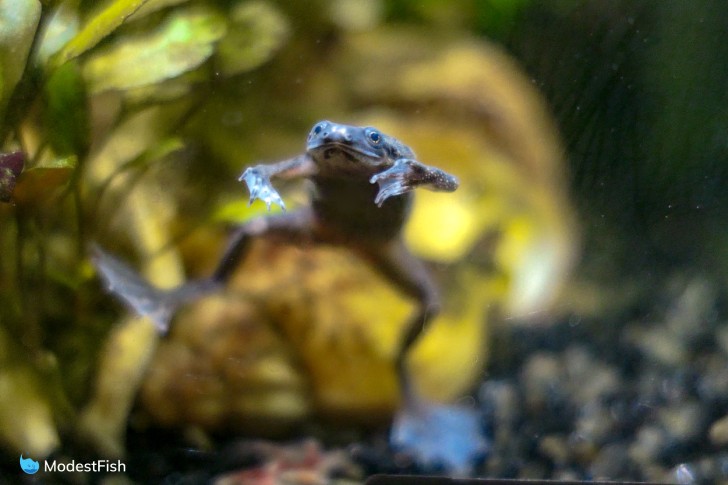
When it comes to african dwarf frog care, getting your tank set up properly will make your life much easier in the long run.
Pro Tip: ADF are completely aquatic and DO NOT need an “island” in their tank to crawl out of the water.
Lighting
ADF are most comfortable with dim lighting.
So, no need to spend the big bucks on an ultra bright LED or anything.
And ADF do not bask in sunlight like reptiles do. There’s no need to provide a UV bulb for this species.
If your tank is already brightly lit, make sure to provide a few heavily shaded areas so the frogs have somewhere to retreat to if they feel shy.
Filtration
Filtration is a crucial part of any African dwarf frog aquarium.
Filters don’t just move water around.
Fish and frogs produce urine and feces that goes into the water of the aquarium. As this waste begins to rot, it puts off deadly ammonia (NH3).
Without a filter, that waste would just build and build until the water basically became toxic soup that killed any fish and/or frogs swimming in it.
The Nitrogen Cycle
Fortunately, adding a filter can keep your tank from becoming a death box where hapless aquatic animals go to die.
Normally we think of bacteria as being a bad thing, but when it comes to aquarium filters, bacteria are your best friends.
There are several species of beneficial bacteria that live in aquarium filters.
One kind eats the ammonia produced when fish waste breaks down and turns it into something called nitrite (NO2 -1).
Nitrite is also really toxic, but luckily, there is another kind of bacteria that almost instantly eats the nitrite in the water and turns it into nitrate (NO3-).
Nitrate is much less toxic and can be allowed to build up in the water column in between water changes.
But you see, without a filter, there is not enough room for beneficial bacteria to set up shop and process fish waste for you.
They need biomedia (special filter media designed specifically for beneficial bacteria to grow on) so that there is enough surface area for the millions and millions of bacteria you need to transform wastes.
Pro Tip: The bacteria you need to process fish waste for you don’t show up instantly. Read more information about the Aquarium Nitrogen Cycle.
Water Flow
African dwarf frogs are not the strongest swimmers. So they do best with a low flow filter.
My number one recommendation would be to use a sponge filter. They provide excellent mechanical and biological filtration without the risk of frogs getting sucked into a power filter.
If you are using something like a hang-on-the-back filter, you can baffle the flow meaning you can put something in the way to break up the flow.
Heater
African dwarf frogs come from a very warm climate. You absolutely should add a heater to their tank.
Keeping your frogs at a warmer temperature will help make your frogs more active and lively.
It’s best to provide consistent temperature between 68°-80°F (20°-27°C).
Substrate
There is a ton of debate about what kind of substrate you should keep in an ADF tank.
Some people think that if you use sand, the frogs will accidentally swallow sand when they eat and then the sand will get impacted in their intestines, killing them.
They argue that they keep ADF on gravel with no problems and that’s the best substrate to use.
Then there are people who argue the exact opposite, that sand is better and that frogs will swallow pieces of gravel, get impacted and die.
Frankly, I haven’t seen any actual evidence one way or the other when I looked into it. Lots of people keep ADF on gravel with no problem and there’s tons of people who keep them on sand as well.
So go with whichever you prefer.
I do recommend that you go with an inert substrate that won’t affect your water parameters.
Related Post: Best Substrate For African Dwarf Frogs Reviewed
Plants and Decor
ADF are not the smartest or the most coordinated creatures in the world. It’s best to use plants and decor that they can’t hurt themselves on.
Don’t use anything with sharp edges or rough surfaces. That way, when frogs clumsily swim past the decor, they don’t scrape their delicate skin.
African dwarf frogs do get shy sometimes, so it’s a good idea to provide them with a few hiding places.
Live and/or silk plants will be greatly appreciated. This kind of cover makes ADF feel safe from predators.
Feeding African Dwarf Frogs
How to Feed ADF
Getting ADF to eat, especially when you first get them, can be a bit of a challenge.
Let’s just be honest, African dwarf frogs are not the smartest of creatures, but we forgive them because they are so damn adorable.
Is this shallow… maybe?
But, we enjoy the frogs, so let’s just not ask too many questions about our priorities.
Seriously though, it can be hard to get ADF to find their food at first.
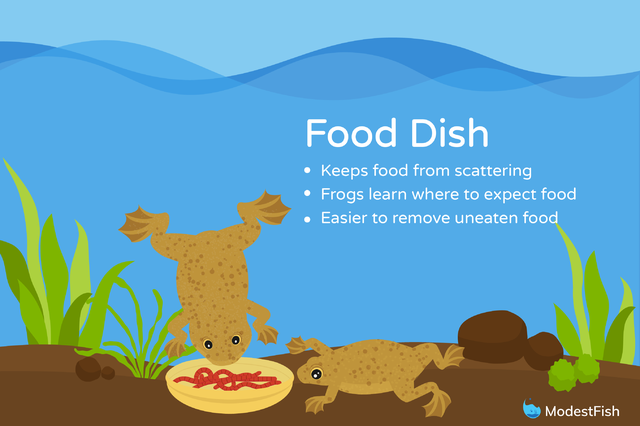
Definitely, the number one tip that’s given by experienced frog owners is to set up a feeding station. It doesn’t have to be anything fancy, just a small dish or plate.
If you place the food in the same place every day, the frogs will learn to go to that spot to find food.
It’s also helpful to add food at the same time each day so the froggies can get used to the routine.
I’ve also seen it recommended to tap on the glass a few times to provide a signal that the frogs will learn means it’s dinnertime.
What to Food To Feed Your ADF
In the wild, these frogs are tiny predators that mostly subsist on insects and their larvae.
So it’s best to provide them with meaty foods:
- Frozen bloodworms
- Frozen brine shrimp
- Frozen mysis shrimp
- Frog and tadpole pellets
It can be challenging to get ADF to accept pellets because they may not recognize them as food at first. Usually, they’ll adjust after repeated attempts, but if not, try offering them frozen foods like bloodworms and mysis shrimp.
How Often and How Much to Feed ADF
There’s some debate about how often to feed African dwarf frogs. Some feed their frogs a little bit each day. Others feed their frog until they’re full every other day or three days a week.
You’ll have to go through a period of trial and error to see what’s going to work best for you and your frogs.
It’s important to watch your frogs and make sure that they’re not getting too chubby. If so, decrease the amount of food or switch to every other day.
It’s generally recommended that you feed your frogs as much as they can eat in 10-20 minutes. They can be little piggies, so don’t let them stuff their faces too much.
Pro Tip: Don’t let uneaten food sit in the tank. Remove it with a gravel vacuum so that it doesn’t start to rot in the tank, fouling your water with extra ammonia.
Related Post: Best Food For African Dwarf Frogs Reviewed
African Dwarf Frog Tank Mates
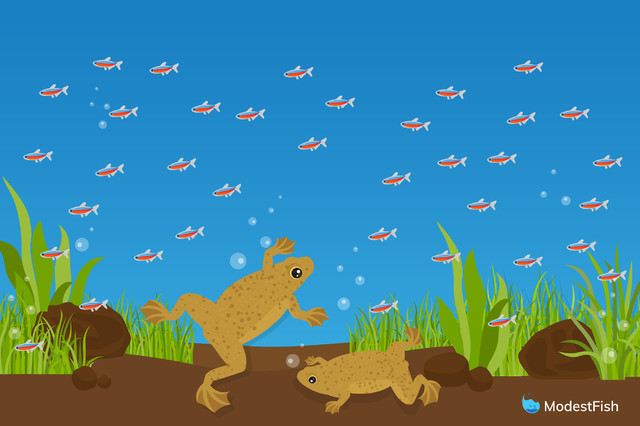
African dwarf frogs are pretty small and don’t have any kind of natural defenses other than hiding.
So they really cannot handle any kind of aggression from tank mates. They will just get injured and stressed until they die.
Your best bet for adding tank mates are snails and small, peaceful community fish:
- Nerite snails
- Mystery snails
- Neon tetras
- Cardinal tetras
- Corydoras catfish
- Chili rasboras
- Harlequin rasboras
- Rummy nose tetra
- Black skirt tetra
I don’t recommend mixing cherry shrimp with ADF. Adult female cherry shrimp might be OK but younger shrimp might end up being a tasty treat for the frogs.
Bigger species of shrimp, like glass shrimp or Amanos, should be big enough to not look like food.
Related Post: Best African Dwarf Frog Tank Mates
Breeding African Dwarf Frogs
Spawning
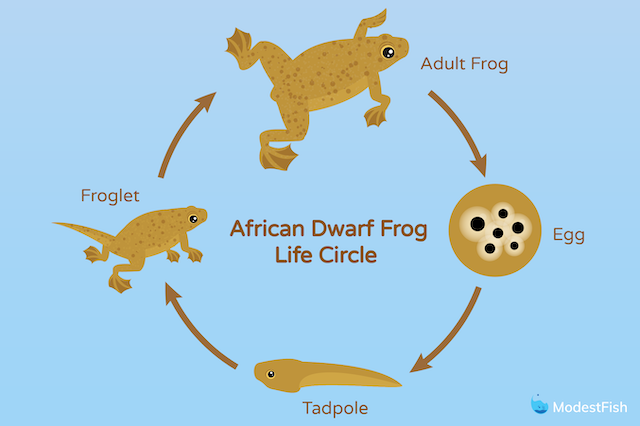
Breeding African dwarf frogs is easy. It’s raising the tadpoles that’s the real challenge.
You will need a seperate tank to raise the tadpoles. It doesn’t have to be anything fancy. A 10 gallon (39 liter) with a heater and an air-driven sponge filter will be just fine.
To stimulate the frogs to begin spawning, it’s best to simulate a drought and flood cycle. Lower the water level by about half in their tank for around two weeks.
Then, add in dechlorinated water that’s around 5 degrees colder than the tank water. The tank heater should then be allowed to gradually turn the temperature up to 80°F (27°C).
This should spark a romantic mood in the tank.
Before the whirlwind froggy romance occurs, males will often go to the water’s surface and “sing” or “hum.”
Hey, ya know, sometimes you gotta go out of your way to impress the ladies.
When the magic moment arrives, the male will grasp onto the female around the “waist,” just in front of her hind legs. He’ll stay latched on like this for the entire mating process.
The female will swim to the top of the tank, towing the male along the way, so she can release eggs at the water’s surface. The male will release sperm into the water to fertilize the eggs.
Raising Eggs
Collect the eggs from the surface of the water. The ones that sink to the bottom usually don’t hatch.
The eggs are really sticky so you may want to collect them with something you can place under the water in the other tank, like a glass jar.
Keep the water in your tadpole tank around 80°F (27°C). It’s best to just keep a bare bottom tank and there’s really not a need for decor.
The single most important thing is to keep the water as clean as possible. The tiny tadpoles are very sensitive to poor water conditions.
Frequent water changes will get rid of wastes and maintain a healthy environment.
The eggs will hatch after 2-7 days and be free swimming 5 days after that.
It’s best to feed them commercially prepared fry food designed for baby fish. When they grow large enough, they can start to eat things like frozen daphnia and baby brine shrimp.
Related: How To Care For African Dwarf Frog Eggs
Are African Dwarf Frogs Right for You?
There’s no denying that ADF are super cool little critters that will provide many hours of entertainment.
I would recommend that you keep them in at least a 15 gallon (57 liter) tank so that you can keep a group. They’ll be so much happier if they have buddies.
On the flipside, it’s also really important that you don’t put them in a tank that’s too big. The frogs might struggle to make it to the surface to breathe in something like a 55 gallon (208 liter).
These little guys are very vulnerable physically. They don’t really have any natural defenses other than hiding.
So don’t put them together with large or aggressive tank mates.
It’s important to do regular water changes to maintain clean water and a healthy environment for your frogs. Frogs are very sensitive to water parameters and need good filtration and tank maintenance.
I hope that you’ve found all this information helpful.
I wish you and your froggies the very best!
